
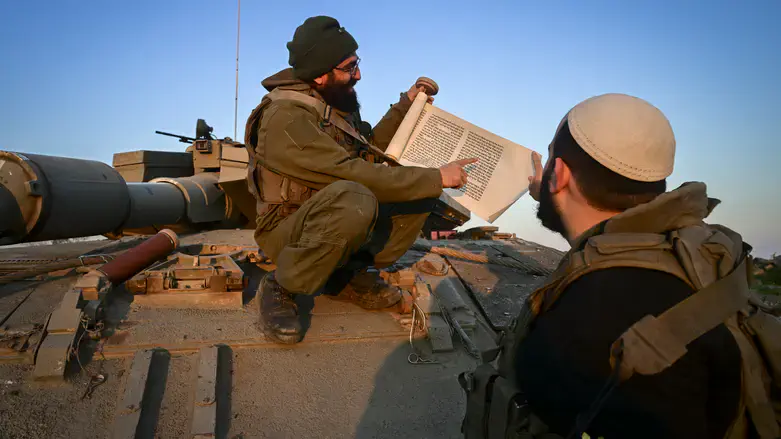
Just about every Jew in the world feels instinctively that Purim this year is different. As we read the Megillah this year, we are reading not just events from more than 2,300 years ago; we are reading the prequel to the great events that are happening today.
The very name מְגִלַּת אֶסְתֵּר, Megillat Esther, literally “the Scroll of Esther", connotes מְגַלֶּת הַסֵתֶר, megalleh ha-seter, “revealing the hidden". The Book of Esther is replete with hidden and half-hidden hints, indications of a deeper text and deeper meanings.
G-d’s presence is hidden throughout the Book: His Name is never mentioned - yet He is the Author of a sequence of events that stretched over twelve years. His Name is hidden in the text in several places, and we mention just a few here.
When Esther invited King Achashverosh and Haman to her banquet, she used the words
יָבוֹא הַמֶּלֶךְ וְהָמָן הַיּוֹם, “Let the king and Haman come today…" (Esther 5:4). These four Hebrew words are the acronym of the Name of G-d.
When Haman boasted of his intimate relationship with the King and Queen, he then bitterly added, “But all this is worthless to me as long as I see that Jew Mordechai sitting at the King’s gate" (5:13).
Haman’s words are וְכָל־זֶה אֵינֶנּוּ שֹׁוֶה לִי, hinting at the Name of G-d exactly the reverse of Esther: as Esther hints at G-d’s Name is the first letters of her words spelt in the correct direction, so Haman hints at G-d’s Name is the last letters of his words spelt backwards.
King Achashverosh was manipulated both by Esther and by Haman. But in his moment of clarity, when Esther revealed the plot of genocide against all the Jews of his Empire, he roared in his rage: “Who is this and where is he who dares consider this?!" (7:5)
The Megillah records his words as: מִי הוּא זֶה וְאֵי־זֶה הוּא אֲשֶׁר־מְלָאוֹ לִבּוֹ לַעֲשׂוֹת כֵּן. The final letters of the words הוּא זֶה וְאֵי־זֶה spell אֶהְיֶה, “I will be"; then comes the word אֲשֶׁר, “who" or “that". And then the final letters of the words זֶה וְאֵי־זֶה הוּא backwards again spell אֶהְיֶה, “I will be".
Together they reveal אֶהְיֶה אֲשֶׁר אֶהְיֶה, “I will be that which I will be", the appellation by which G-d makes Himself known to Moshe for the first time (Exodus 3:14). G-d is the G-d of history, the G-d Who, hidden from us His creations, secretly directs events for the benefit of His nation Israel.
This year we enter Purim in a whirlwind of conflicting emotions. Even as we rejoice over our modern Purim miracle, our impending defeat over the modern Haman in the modern Persia, we mourn nine of our people killed, and dozens more injured, in a missile-strike on Beit Shemesh.
Even as we rejoice over our successes so far, this war is far from over.
Every Israeli above a certain age will forever remember Erev Purim of 30 years ago, when an Arab terrorist, Abd el-Rahim Ishaq y"sh, detonated his suicide-belt in Dizengoff Centre in Tel Aviv, murdering 13 and injuring well over a hundred other Jews.
Then, too, we entered Purim under a heavy cloud of mourning.
But there is a monumental difference: Back in 5756 (1996), our Prime Minister was carrying out the Oslo Accords which meant actively collaborating with the terrorists, supplying them with weapons and ammunition, guaranteeing them safe passage, even hiding their identities in order to protect the genocidal organisations that were despatching them on their murderous missions.
Little wonder that the Israeli public then were thoroughly demoralised.
Today we have a Government that has gone to all-out war in order to protect its citizens. The story of Megillat Esther is the narrative of a nation that, when it believes in its G-d and its destiny, and when it is free to defend itself, is invincible.
Had Mordechai dealt with Haman in his plot against the Jews in the way that the Israeli Prime Minister of 30 years ago collaborated with the PLO, then the Jews of the Persian Empire couldn’t have survived.
By the grace of G-d and the determination of today’s Children of Israel, we live in happier times.
The Book of Esther is set against the backdrop of monumental historical events: just a few years earlier the Persian Emperor Koresh (Cyrus) had given his permission - indeed his active encouragement - to all the Jews of his Empire (which meant almost all the Jews in the world at the time) to return home to Israel.
Haman promulgated his decree of genocide as the Jews were in the process of rebuilding Israel.
Today we are again in the process of returning home to Israel and rebuilding our Land. History is speeding up at a dizzying pace: we are more independent as a nation today than we were at the time of Mordechai and Esther, and a far greater proportion of Jews live in Israel today than did at the time of Mordechai and Esther.
This Purim we are living the Purim miracle. Not as a metaphor, but as tangible reality.
Thousands of years ago, the events in Shushan and throughout Persia, great though they were, were but the prelude to a new and wonderful epoch in Jewish history. The generation of Purim was the generation that returned to Israel, founded the Second Jewish Commonwealth, rebuilt the Holy Temple in Jerusalem, and some two centuries later took up arms against the Seleucids, defeated them, and restored Jewish national sovereign independence - a War of Independence which we celebrate until today as Hanukkah.
I write these words knowing that only G-d knows what the coming days will bring; the coming weeks, months, years, decades are as far beyond our knowing as today’s Israel was from our great-grandparents’ generations.
And I write these words in the absolute confidence that just as G-d directed history in the days of Achashverosh and Haman, Mordechai and Esther, so too He will continue directing history now and into the future.
This is clearer this Purim than ever before.
Happy Purim 5786!