

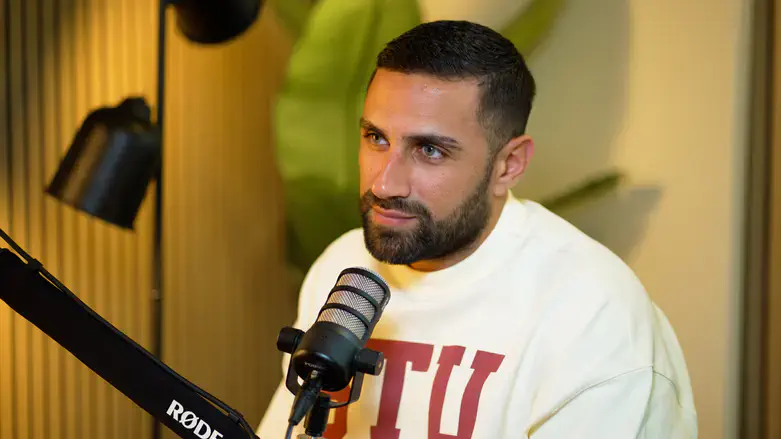
In a special interview on an Arutz Sheva-Israel National News podcast, former hostage Segev Kalfon spoke about the faith that sustained him throughout his captivity in Gaza - moments in which he says he looked death in the eye more than once.
“I was certain I was going to die. One hundred percent sure there was no way back to life," he recalls. The conviction that his life was over ran so deep that every action by his captors felt like preparation for his execution. Yet, surprisingly, he says he didn’t feel fear in those moments - only a profound, painful sorrow. “I accepted it. I felt sorrow - for my family, for going to that party in the first place."
Life in captivity, if it can be called that, was an unending cycle of psychological and physical terror. Kalfon describes unimaginable abuse. “They would come in masked, beating us brutally, and we didn’t understand why. They said, ‘It’s because of Ben Gvir.’"
One of the most dramatic moments came when Kalfon says divine providence saved him from certain death. After weeks of despair, convinced his fate was sealed, he devised a desperate plan: to seize a weapon from his captors during prayer and try to kill them, fully aware he would likely not survive. “I thought I might as well take a chance. On the day I planned to do it, I turned on the radio - perhaps guided by God - and heard my mother’s voice."
That moment changed everything. “I told myself, just for her and for the people fighting for me outside, it was worth surviving whatever I was going through."
The radio, originally intended to broadcast the Quran as part of forced Islamization, became a lifeline. Even brief moments of reception allowed the hostages to hear Galei Tzahal (IDF Radio), grasp the scale of the national crisis, and understand the intensity of the rescue efforts.
Kalfon also recalls a chilling episode during “Operation Arnon," when Israeli forces approached the location where he was held. Six hostages sat for seven hours while a terrorist, weapon ready, waited for soldiers to breach the site, with orders to kill three and wound three. At the last moment, a mysterious call from a senior Hamas official changed the order. “Where did that call come from, if not from God?" he asks.
Even after the immediate danger passed, terror lingered as they ran through a tunnel corridor, debating who would enter a bathroom first out of sheer fear.
Amid the chaos, bonds formed. Kalfon speaks emotionally about fellow hostage Ohad Ben Ami, whom he calls “a lion." Though Ben Ami described himself as a secular kibbutznik, he was drawn to the spiritual atmosphere of the younger captives. “Suddenly, you see five people, depressed all week, singing on Shabbat, joyful. He wanted to feel that light too."
After his release, Kalfon was moved to see Ben Ami on television at a hostage rally, wearing a kippah and reciting Kiddush over wine. “I thought, ‘Wow - it wasn’t just there. He carried it with him.’"
Kalfon also planned a symbolic “revenge" against Hamas: to stand on the stage intended for hostage-release ceremonies and shout “Shema Yisrael" before the world. Though Hamas canceled the ceremony, he now plans to do so in Times Square, New York. “They didn’t let me shout Shema Yisrael in Gaza. I’ll shout Shema Yisrael in New York," said Kalfon, who has started telling his story in English in appearances around the world.
He shares a post-captivity anecdote: during his captivity, his father sought guidance from Rabbi David Abuhatzeira of Nahariya, who replied cryptically: “Your son is guarded like the lulav and the etrog together. ‘A heralding voice announces and says.’" The meaning became clear on Kalfon’s release day - Hoshana Rabbah - when those words are recited in prayer.
Visiting the rabbi afterward, Kalfon was given a mission: “Sanctify God’s name." Since then, he has devoted himself to spreading light and strength to others. “Every day in captivity, I prayed for a chance to return and make things right. God answered every one of my prayers."
He concludes with a message of resilience and determination. Despite attempts to convince him Israel had abandoned him, he knew the people stood with him. Now he looks forward with purpose: “I said to myself, over their heads, over their ‘Palestine,’ I will build my home here. That will be my revenge against Hamas."