

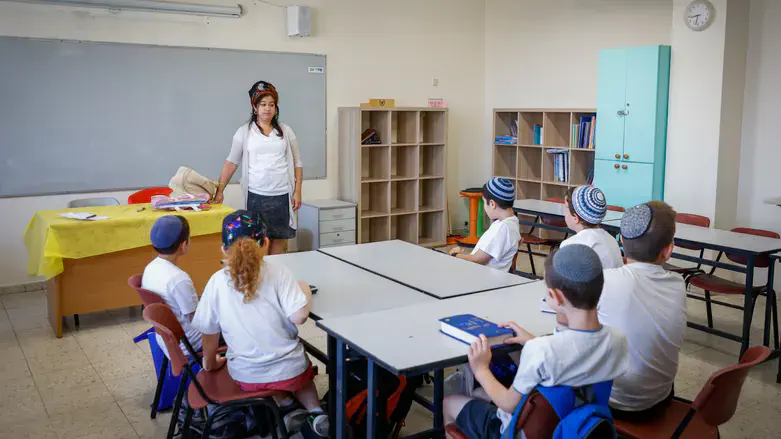
Israel's Finance Ministry has unveiled a dramatic plan called "From Quantity to Quality," which could reshape the elementary education system in Israel.
According to Yedioth Ahronoth, the plan aims to align Israel with OECD countries by transitioning to a five-day school week, eliminating classes on Fridays, and shortening the gap between the school year and the Tishrei holidays.
In addition to moving to a five-day school week for preschools and elementary schools, the long summer break will be shortened, with the school year starting on August 15 instead of September 1. This change is expected to save two billion shekels, which will be allocated for increasing teachers' salaries, recruiting quality staff, and upgrading technology.
In the coming weeks, a pilot program is set to begin in about 30 preschools and elementary school classes in the central region. Parents in Ra'anana have already begun receiving initial notifications about their institutions being included in the trial program, which is expected to expand to more communities next year.
Finance Ministry data reveals that Israeli elementary schools currently teach 941 hours per year, compared to just 804 hours on average in OECD countries. The Ministry argues that Friday classes (about 4.5 hours on average) are ineffective, with low attendance.
Teachers Union Secretary-General Yaffa Ben-David, announced that she would oppose the move. "The summer break will not be shortened. This will not happen."
The full implementation of the plan is scheduled for the 2027/28 school year, upon the completion of the current agreement with the Teachers' Union.