
A special debate was held in the Knesset plenum marking 77 years since the establishment of the Knesset. The President of the State was absent from the session after the President of the Supreme Court was not invited. The opposition also boycotted the debate, though MK Yair Lapid did deliver a speech.
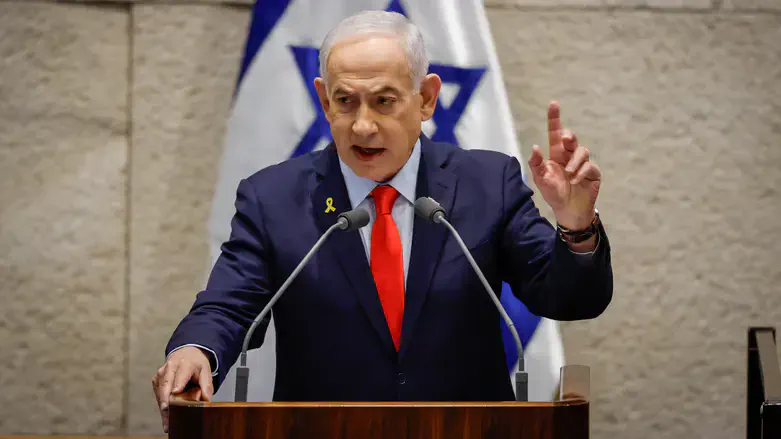
Prime Minister Benjamin Netanyahu addressed the fact that Justice Yitzhak Amit was not invited to the session and said: “I hope that next year we will overcome all the obstacles and reach full understandings. We want to arrive at the same understandings that guided the State of Israel for decades."
He added, “We need to restore the balance between the three branches of government. In the past, it was customary that the judiciary was selected through the Knesset. Let us moderate the tone of the debate. I will act to reach understandings."
Netanyahu noted: “Israel is not a perfect democracy. There is no such thing. We are a challenged democracy. I do not know of any other democracy that faces tests like those faced by the State of Israel. Let us tone down the language of the dispute-this is at least how I try to conduct myself. But such a Knesset is always preferable to one in which elected officials are not allowed to open their mouths. Silencing elected representatives would be the end of democracy. We have disagreements on fundamental issues-these disagreements are not a flaw in democracy. They are the essence of democracy, and the public decides at the ballot box."
Addressing the Iranian regime's repeated threats to attack Israel if it is struck by the US, Netanyahu warned: "Anyone who attacks us will suffer unbearable consequences for them."
Knesset Speaker Amir Ohana opened the debate and said: “The current controversy, because of which many members of Knesset are absent, concerns the custom whereby presidents of the Supreme Court were invited in previous years to mark the Knesset’s anniversaries. Unfortunately, there are other customs that have also been violated.
“For example, the custom, enshrined in law, whereby presidents of the Supreme Court were chosen by the Judicial Selection Committee convened by order of its chairperson, and not by court orders issued by colleagues of the designated president. That custom and that law were violated as well. There was also a custom whereby it was unthinkable to annul a Basic Law-a custom that was likewise trampled, in the midst of the war, by a decision that is patently unreasonable," he added.
He continued: “I regret that once again there are those who view non-invitation to a ceremonial event as a substantive blow to Israel’s democratic system. I regret even more that those same people accept with equanimity the transformation of the judiciary into a super-authority that can judge, legislate, and annul laws and Basic Laws, like an all-powerful king. One exception regarding invitations will be on national memorial days. As was the case last year, we will not drag the dispute into those sacred days."
“I repeat: the Knesset under my leadership is open to dialogue with the judicial system. Whenever the heads of the system ask to meet, talk, clarify, and try to bridge gaps, I commit that their outstretched hand will not be returned empty. Those who show respect will be respected. But respect between branches is not one-sided. One cannot demand that the legislative branch respect the judiciary while the judiciary continues to empty the legislature’s powers of their content. This is a fundamental matter for the existence of the State of Israel as Jewish and democratic. The Knesset cannot ignore the trampling of the public and must stand up for its rights," the Speaker concluded.