

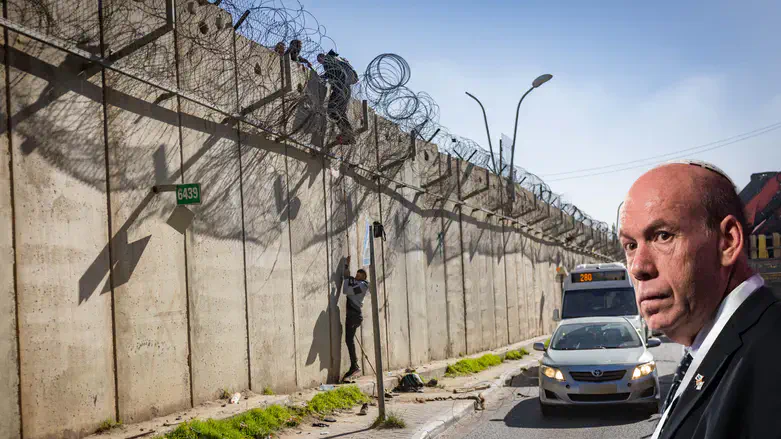
State Comptroller Matanyahu Engelman on Tuesday published an extensive audit report examining the effectiveness of the Seam Line barrier and the crossings in the Jerusalem perimeter sector.
The report points to serious deficiencies in security, operations, and the implementation of government decisions over many years. The audit assessed the operational readiness of the responsible authorities, particularly in light of the October 7 massacre and the Swords of Iron War.
According to the report, of the several hundred kilometers of the seam line route, only 61% is equipped with a physical barrier. In other areas, significant openings remain, allowing Palestinians to pass freely without inspection. In some locations, including stretches of 11 kilometers on one route and six kilometers on another, no obstacle exists at all-posing what the Comptroller described as a substantial risk of terrorist infiltration.
Additional shortcomings cited include the absence of a regulated operating concept for the crossings, failure to implement key government decisions regarding their civilian management, and an inadequate response by the Shin Bet to professional recommendations. Despite a Prime Ministerial decision in 2005, not a single crossing in the Jerusalem perimeter sector has been civilianized to date.
The report further notes that the Israel Police have been operating the crossings for two decades without a formal operating doctrine and without permanent command. Of the 16 crossings in the sector, only two are overseen by commanders formally authorized for the role. Engelman warned that this situation creates serious security gaps and undermines coordination among the IDF, police, Border Guard, and civilian security personnel.
On the operational level, the audit found that Border Guard forces were diverted from routine security missions in the area to other tasks, weakening the overall response along the seam line. In addition, gaps in reporting between the IDF and police regarding infiltration incidents point to a partial and uncoordinated response.
The Comptroller also identified infrastructure deficiencies, manpower shortages, inadequate inspection equipment, and failures in inter-ministerial coordination. One example cited was the delay in opening the subsidence road at the Qalandiya crossing, caused by disputes between the Ministry of Transportation and the police.
Among Engelman’s recommendations are completing the process of civilianizing the crossings, establishing a clear police operating doctrine, improving intelligence-sharing among all relevant agencies, and immediately installing barriers in areas where openings exist. The report also calls for a reassessment of the barrier’s route in accordance with updated threat assessments.
Responding to the report, the Regavim movement said: “The State Comptroller’s report addressing the October 7 scenario in the Jerusalem area is welcome, but it focuses on marginal issues. The seam line will always be breached. Every day, dozens and hundreds of Arabs from Judea and Samaria cross the fence. Even the most expensive and fortified fence in the south was breached within minutes by terrorists wearing flip-flops.”
Regavim argued that terrorism does not begin with a fence, but with education, Israeli withdrawal from territory, failed agreements, and a lack of governance and enforcement. “In Jerusalem, as elsewhere,” the organization said, “only firm control of the territory-through military and civilian presence, settlement, and governance-can address the dangerous security reality facing the State of Israel.”