

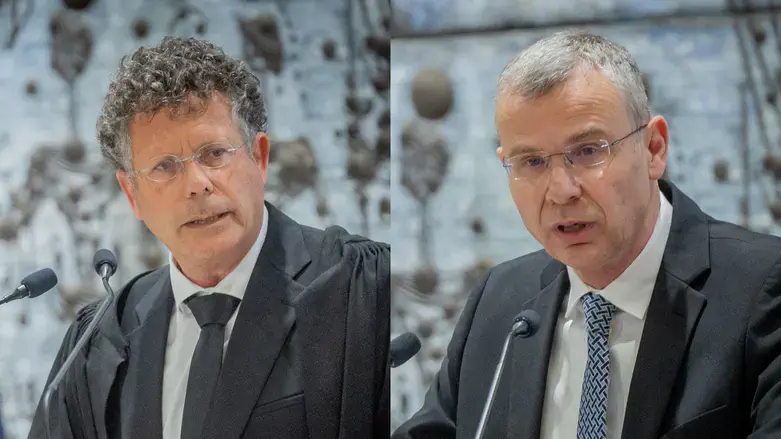
The Supreme Court ordered an additional hearing on whether Justice Minister Yariv Levin is authorized to appoint a state employee to accompany problematic investigations.
The hearing is scheduled for early 2026 before an expanded panel of all 11 justices of the Supreme Court.
The President of the Supreme Court, Justice Yitzhak Amit, decided that the additional hearing will not apply specifically to the Military Advocate-General investigation, but to the principal question: whether the justice minister is authorized to assign a state employee to accompany a criminal investigation when an issue of conflict of interest arises.
Yesterday the Supreme Court annulled the appointment of retired Judge Yosef Ben Hamo as head of the " investigation. The reason for the annulment is that Ben Hamo did not meet the basic and substantive condition that the candidate for the position be a "senior civil servant."
Judge Amit wrote in the ruling, "The appointment decision in its two parts - the consultation with the acting Civil Service Commissioner, as well as the appointment decision itself - is not supported by a minimal factual basis as to the review process that led to the conclusion that apparently there is no person in the civil service who meets the standards set in the ruling."
"If, according to the minister, an emergency has arisen that must be completed in a way that does not allow additional time to find a senior civil servant in accordance with the appointment ruling - the path is open to him to reach an agreed solution, using the general authority of this court," he added.
Justice Wilner, who wrote the main opinion, noted, "Given the state and apolitical character of a civil servant in the public service, the requirement in the ruling that the transfer of authority in cases like ours be made to a senior civil servant is an essential requirement intended to blunt the significant difficulties involved, as said, in ministerial-level interference in the management of a specific criminal investigation."
Wilner rejected Levin's argument regarding meeting the condition of a "senior civil servant," adding, "When a person is brought into the civil service solely for the purpose of filling a specific role assigned by the minister, the concern intensifies that that person will serve as the minister's 'agent' for the purpose of fulfilling the assigned role; this contrasts with a civil servant who already holds a certain position in the public service, and alongside his regular role the minister assigns him additional responsibility regarding oversight of the present investigation."
"When the minister chooses a person from outside the public service, and that person is brought into the civil service temporarily solely for the purpose of filling the role the minister wishes to assign him, the minister's choice in these circumstances - regardless of the identity of the selected person - inherently increases the concern that political considerations unrelated to the matter are at the basis of the appointment," she said, "Such an appointment therefore exacerbates the difficulties arising from political-level interference in a concrete criminal investigation, contrary to the purpose of the conditions set in the ruling, which intended to blunt such harm."
Minister Yariv Levin criticized the ruling. "This plot looks as if it was taken from a criminal case. It all began when Judge Amit's colleague, Justice Wilner, was appointed to the Supreme Court with his blessing. Then Justice Wilner, in a scandalous and unlawful ruling, granted the title 'President' to Judge Amit. Then serious complaints were filed against Judge Amit. This is where the Attorney General came into the picture, who made it possible to close them in the blink of an eye."
"Now the debt is to be repaid. Amit and Wilner are intercepting, one after the other, the judges who were appointed to accompany the investigation. They are preventing the discovery of the truth regarding the involvement of the Attorney General and those subordinate to her in the Mil tary Advocate-General case. Here before you is the core of control that repeatedly thwarts the pursuit of the truth. Those who call themselves gatekeepers and guardians of the law are actually protecting one another. They are hiding. They are afraid of the discovery of the truth. And it will not help them. We will not give up until the truth comes to light," said Levin.