

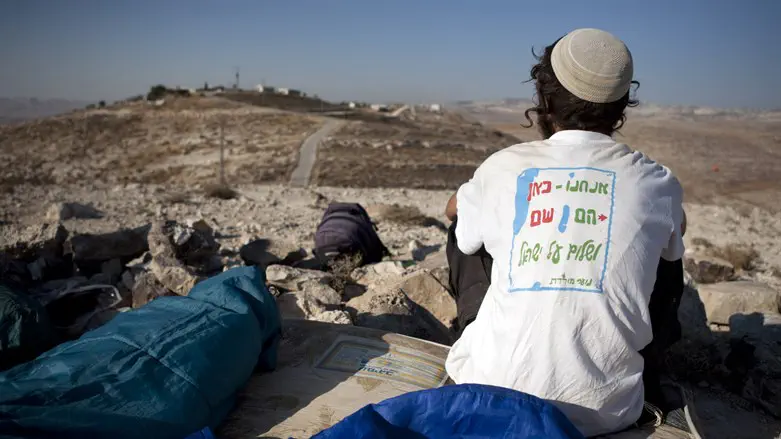
Two special government meetings held last Thursday focused on the growing phenomenon of hilltop youth in Judea and Samaria.
Arutz Sheva - Israel National News has learned that the first meeting, attended by the Prime Minister, several other ministers, and senior security officials, concentrated on educational and support frameworks for the youth. The second meeting examined enforcement strategies targeting the extremist factions within this group.
Security officials from the IDF and ISA presented data showing that of the roughly 560,000 Israelis living in Judea and Samaria, about 1,000 teenagers reside on isolated hilltops, often without parental supervision or formal education. Most of these teens did not grow up in the area.
According to the data, around 800 of them are considered active in settlement and Zionist work, while roughly 300 are involved in violent incidents. Officials estimate that the hard core of violent activists numbers only about 70 individuals, including some adults who view violence as a goal in itself.
Participants stressed that the recent rise in numbers is linked to the war: nationwide adolescent crises have deepened, school dropout rates have increased, and many youth-support professionals were unavailable due to prolonged reserve duty. The discussions highlighted the need to significantly boost staffing and equipment for youth services, including vehicles capable of reaching remote areas.
Minister Orit Strock said, “Every effort must be made to help as many of the 300 as possible join the 800 considered ‘quality and good youth.’”
IDF Central Command chief Avi Bluth urged decision-makers to differentiate between distinct groups, noting that some outposts and hilltop sites contribute positively by preventing Palestinian Authority encroachment into Area C. Prime Minister Netanyahu also acknowledged this positive aspect, provided the activity is nonviolent.
Bluth emphasized that the key distinction is not between “outposts” and “hilltops,” but between youths focused on settling the land and those seeking violent confrontation with Arabs, police, soldiers, or even other Hilltop Youth.
Following Strock’s recommendation, the Prime Minister directed officials to prioritize efforts to move as many teenagers as possible into the nonviolent, settlement-focused group.
ISA chief David Zini warned that even though the violent faction is small, its members believe they enjoy broad public backing. This perception, he said, makes enforcement difficult. The issue, he explained, is a sense of unequal enforcement-such as classifying arson in Judea and Samaria as “terror,” while similar offenses in the Negev or Galilee are not treated the same. “Without equal enforcement,” Zini said, “we cannot secure supportive public opinion.”
The meetings concluded with an agreement that Avichai Tanaami, previously appointed as coordinator for issues related to Hilltop Youth, will now lead inter-ministerial coordination to advance government responses and support programs for these youths.