

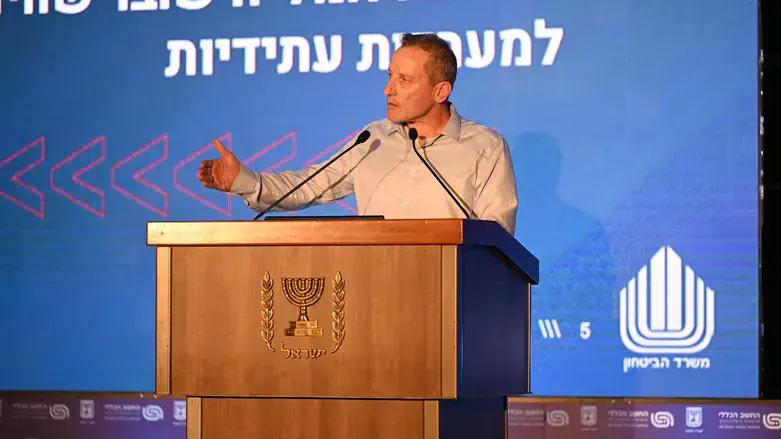
Major General (res.) Amir Baram, Director General of the Defense Ministry, participated today (Monday) in an economic conference and addressed, in his remarks, the close connection between security and the economy.
“We are standing at the threshold of a significant security decade, both globally and locally. Security and the economy are intertwined tools—especially in the State of Israel. Fundamental security is a major component of national security, alongside the economy, society, and advanced technology,” Baram said.
Regarding the global security situation, the Director General stated: “We are witnessing a dramatic increase in global defense budgets. Global defense spending in 2024 reached approximately $2.7 trillion, a 20% increase compared to 2023—the largest rise since 1988.”
On the impact of the war on Israel’s economy, he said: “Despite the ongoing war, which has cost the economy over 205 billion NIS, economic indicators signal strength—especially following military successes such as the Beeper operations or Operation ‘Rising Lion’ The CDS index (Credit Default Swap) and the exchange rate (shekel-dollar) are stronger today than they were before October 7, 2023. Despite the continuation of the war and its immense challenges (erosion, costs, social strain), there is a correlation between these two indicators that reinforces economic strength and reduces the risk premium.”
“Wars are expensive. Reservists cost money, armaments cost money, and rehabilitating the wounded is both vital and costly. Estimates are presented transparently, both in advance and during the process, to the Treasury and the political echelon. There are no surprises here.”
He added: “We are trying to optimize everything related to reserve days, but as long as the war continues, it is very difficult to be precise regarding every reservist. After two years of combat, reservists will not show up without additional incentives. They don’t come just because of these incentives, but the incentives help. When the war ends, it will be possible to reduce them again.”
Addressing the Defense Ministry’s preparations for continued combat and emerging security challenges, Baram said: “To maintain military superiority, the Defense Ministry operates on three timelines: in the immediate term—equipping forces; medium term—improving readiness for the next decade; and long term—developing game-changing weaponry for future systems.”
“We are in the process of forming and establishing a ‘Supreme Armaments Council,’ which will dramatically accelerate our readiness for the third and fourth operational cycles—a management body in which all relevant entities will sit at the same table: the defense establishment, the Treasury, the National Security Council, defense industries, the Exemption Committee, and more.”
He added that Israel must invest in “the next surprises” and future Beeper operations. “This is a security economy. Each such surprise has broad implications: an operation of ours in Yemen costs an average of 50 million NIS, but it has a wide impact on deterrence and our global positioning. Interception using Arrow 3 costs 15-30 million NIS, but the damage from a failure can reach nearly 300 million NIS (as happened with the ballistic missile strike in Bat Yam).”
“Therefore, we must fundamentally change the production and procurement processes of critical defense and combat systems—a process that the Iranian regime completes in a month, but takes Israel months or even years. Our procurement processes are multi-year and require responsible budgeting.”
“The lessons of the war, as well as de-globalization and de-legitimization, require us to expand Israel’s production base, achieve independence in critical components, and engage in long-term and sophisticated agreements.”
Baram reiterated that there will be additional rounds of combat against Iran: “Operation Rising Lion' ended in a clear Israeli victory, but there will be further rounds against Iran. The Iranians have not disappeared—they feel a deep sense of humiliation, which is why they are investing massive resources in security and accelerating their force-building processes.”
On the strategic effort led by the Defense Ministry to increase defense exports, he said: “The Defense Ministry is an entity that brings in money, not just spends it. A significant part of our strategic activity is promoting defense exports, including through government-to-government (G2G) deals.”
“Just last week, we signed deals worth $2.5 billion. I cannot name the countries, but they understand the importance of long-term defense investment in an unstable world.”
“Our strategy also focuses on promoting the ‘Defenstek’ industry while strengthening the unique Israeli ecosystem. Last week we announced the establishment of a joint fund with the Accountant General, which will help transform ‘Defenstek’ into an economic engine for the economy, increase defense exports, and support the IDF’s needs.”
Regarding the rehabilitation of Israel’s wounded and support for bereaved families, he said: “The defense establishment alone cannot bear this effort—it requires national-level organization. Just yesterday we reported that the number of wounded in the war surpassed 20,000, more than half of whom suffer from psychological injuries. Proper rehabilitation means returning thousands of young wounded to life, vitality, and work. That is why the Ministers of Defense and Treasury decided to establish a joint committee led by Professor Shlomo Mor Yosef, which will recommend a national program for treating IDF wounded, with an emphasis on mental health.”