

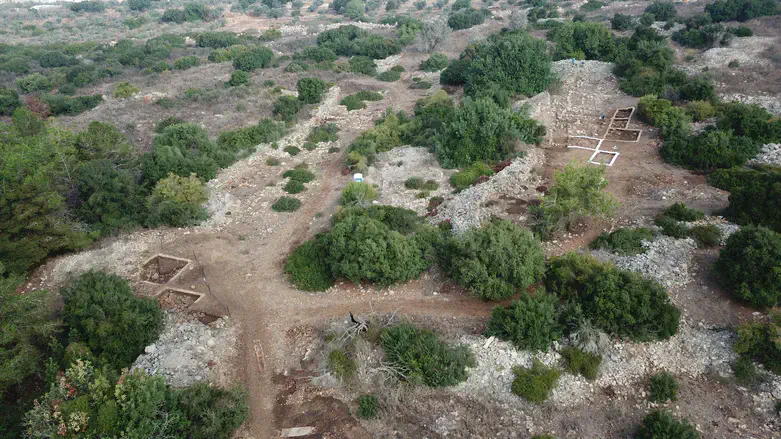
A new University of Haifa study reports "extraordinary" archaeological findings from El-Ahwat, an ancient, short-lived settlement from the Early Iron Age in northern Samaria, on the edge of Israel’s Central Hill Country. For the first time, researchers have direct evidence of local bronze production in the region some 3,000 years ago.
Microscopic and chemical analyses of production remains and smelting residues found at the site show that this was not recycled metal, but a primary manufacturing process in which copper and tin were alloyed on-site.
“This is the first conclusive proof that bronze was actually produced in the country during the Early Iron Age—not by recycling existing items, but through smelting—and in a peripheral mountain settlement rather than a major urban center,” said Dr. Tzilla Eshel of University of Haifa, who led the study.
At the transition between the Late Bronze Age and the Iron Age, the great empires of the eastern Mediterranean collapsed, and their trade networks disintegrated. This upheaval created opportunities for local powers, including groups controlling copper production in the Arabah. The metal industry that emerged in those years is now seen as one of the growth engines behind the rise of new political entities, including the kingdoms of Israel, Judah, and Edom. Dr. Eshel’s study set out to determine whether bronze was produced locally at El-Ahwat and whether the site was integrated into a broader regional trade network during the Early Iron Age.
The research drew on finds unearthed about 30 years ago during excavations led by the late Prof. Adam Zertal. Dr. Shay Bar of the Zinman Institute of Archaeology at University of Haifa submitted the metal items for scientific analysis, conducted in collaboration with Yoav Bornstein and Gal Bermatov-Paz from the School of Archaeology and Maritime Cultures. Detailed examinations—including microscopic photography, internal structure analysis, and chemical composition testing—identified the items as smelting products and residues made of copper and bronze, as well as slag, a by-product of production. Lead isotope analysis was also conducted to determine the source of the raw materials.
According to the results, published in PLOS ONE, at least some of the metal droplets—solidified remnants of the smelting process—were created through alloying copper and tin rather than re-melting existing bronze. The metal structure and composition of inclusions within the items suggest that production took place under varying conditions: some smelting was uncontrolled and cooled unevenly, while other batches were produced more precisely.
The tests also revealed mineral traces typical of ores from the Arabah, originating from different geological sources—some matching copper ores from the Faynan mines in Jordan, others from the Timna mines in Israel. While these sources share a similar isotopic signature, making them hard to distinguish, metallographic analysis identified manganese and other elements found only in Faynan, indicating both regions supplied copper to the site.
“The findings point to a developing, non-professional industry,” said Dr. Eshel. “The alloys are inconsistent in quality, but it is clear there was a deliberate attempt to produce bronze on-site. This unusual discovery forces us to reconsider the economy and social organization of the Iron Age.”
These results reveal organized metal production in mountainous regions once considered marginal, adding a new dimension to our understanding of Early Iron Age economic and social networks. Instead of small-scale recycling, the picture is one of raw material distribution and emerging technological capabilities extending beyond major cities. Central questions—such as the source of the tin, the identity of the groups at El-Ahwat, and the scope of their trade networks—remain open for future research.