
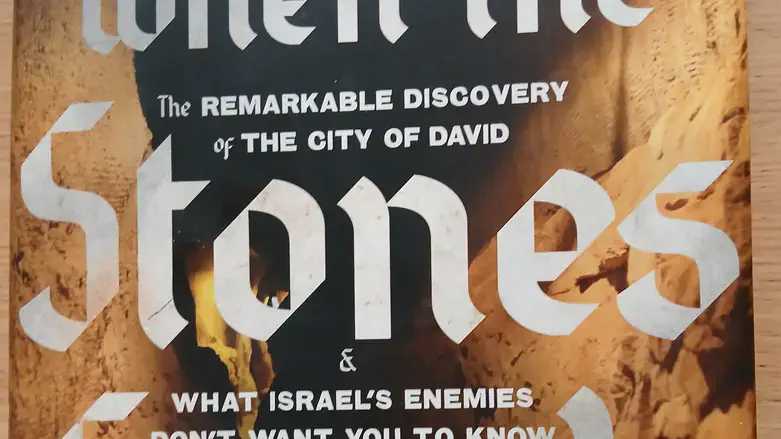
Reviewing "When the Stones Speak: The Remarkable Discovery of the City of David" by Doron Spielman, Center Street Publishing, 2025.
Just a few days ago the U.S. Secretary of State, Marco Rubio and U.S. Ambassador to Israel, Mike Huckabee attended a ceremony at The City of David and walked from the Siloam Pool to the Temple Mount on the ‘Pilgrim’s Road.’ That road has existed since early First Temple times..
The recent ceremony highlighted the historical accuracy of the ancient descriptions of the Jews of Israel coming to the Temple in Jerusalem in Biblical times and yet again refuted the avalanche of lies which originate in and circulate in the Arab and Moslem worlds claiming that there never was a Jewish Temple in Jerusalem and that the Jewish people do not have an ancient claim to Jerusalem and the Land of Israel.
That ceremony was also the product of decades of carefully conducted archeology to excavate the original City of David, the Jerusalem of the Hebrew Bible. The City of David is adjacent to the ‘Old City’ and outside the Ottoman walls which were built in the sixteenth century.
In When the Stones Speak: The Remarkable Discovery of the City of David, Doron Spielman, a long-time officer of the institute that has been primarily responsible for excavating the City of David, tells the stories of the archeology of the City of David, the determined and dishonest efforts of some Arab groups and other Israel-haters to stop the excavation and to suppress the truth and also his own story.
He tells the stories clearly and directly, skillfully weaving together the social-political context, the archeology and his own involvement in the project.
Since the seventh century of the common era, when colonialist and expansionist Islam captured and occupied Israel and the rest of the Middle East and North Africa, Moslem scholars recognized and acknowledged that the Temple Mount in Jerusalem had been the site of the Jewish Temples and that the Jewish people had lived in Israel long before the birth of Mohammed. (That can be found in Moslem documents, ed.)
So long as the Jews were politically powerless and had sub-citizen status in the Moslem majority countries and ruled no country of their own there was no reason to pretend that the Jews had never been dominant in Israel in ancient times.
The lie that there had never been a Jewish Temple on the Temple Mount in Jerusalem is clearly a recent political invention.
After the establishment of the Jewish State in 1948, various Arab groups did everything they could to erase Jews and Judaism from Israel’s history. For instance, in 1948 when the Jordanian Army illegally occupied the Old City, East Jerusalem and Judea and Samaria, the Jordanian Army tore down almost all the synagogues in the Old City many of which were hundreds of years old, dynamited the ancient Horvah Synagogue, tore down Jewish headstones and grave markers on the Mount of Olives and desecrated Jewish religious sites in other ways.
Luckily, they barely noticed the City of David which lay outside the walls of the Old City, because if they had noticed, they probably would have done what they could to destroy the archeological testimony of Jewish connection to the land.
The story of the archeology discoveries begins in the mid-nineteenth century with Queen Victoria endorsing and subscribing to the Palestine Exploration Fund and the appointment of Charles Warren, an officer in the royal engineers to lead an expedition. Warren was given unprecedented access by the Ottoman bureaucracy on one condition: the Temple Mount was off limits.
Warren originally discovered what he thought was a part of King David’s capital. Due to multiple conquests and different conquerors building different walls around the city, the city had moved but had not moved far. "[T]he inhabitants of Jerusalem had moved only a few hundred yards away from the City of David, the original location of Jerusalem from the Bible, to safer ground at the top of the Mountain….Over the centuries the City of David at the bottom of the hill was buried and the actual site of ancient Jerusalem -this tiny stretch of land only 2 per cent the size of New York’s Central Park - was forgotten and covered by the sands of time and the rubble of conquests."
The story continues in the 1880s when Baron Edmund De Rothschild began buying large amounts of land in what is now Israel to be used as a refuge for persecuted Eastern European Jews. He bought as much land in Ottoman Palestine as he could and by 1918 Rothschild owned one-twentieth of the fertile lands of Israel as well as he and other Jews buying infertile lands which they then made fertile. All of those purchases are recorded in Ottoman land records, much to the anger of the frauds who claim that the Jews somehow stole Israel from Arabs.
In 1913 Rothschild bought the land that now includes the City of David for archeological excavation from the Arab family that had owned it for a long time. Rothschild hired a local Arab to be the caretaker of the properties that he had purchased there.
Moving forward to the modern era, a collaboration between the City of David, professional archeologists and the Israel Parks Authority resulted in the sifting of tons of material from the Temple Mount that had been dumped by the Moslem authorities in the Kidron Valley as refuse, likely in a deliberate attempt to treat this important archeological material as refuse. Sifting through it with volunteers caused numerous artifacts, such as seals, coins and other items, to be found. Of the artifacts discovered thirty-three per cent were from the First and Second Temple periods, twenty percent were from the early Roman and Byzantine periods and fifteen percent dated to the Moslem period. The overwhelming plurality of artifacts that the Moslems had removed from the Temple Mount area were from the pre-Moslem Jewish periods.
Spielman also discusses the philosophical approaches of Israeli archeologists in the last few decades, particularly the disagreement between biblical ‘minimalists’ who think the Bible a misleading or completely unreliable source for interpreting archeological finds and the biblical ‘maximalists’ who believe that the Bible can and does shed significant light on the archeology of ancient Jewish sites. This became important because in the course of excavating the City of David the archeologists gradually unearthed the rest of the Siloam Pool and the ‘Pilgrims’ Road’ which led directly to the Temple Mount but also many artifacts showing Jewish presence and use of the area..
The approach taken by the archeologists on the City of David excavations was not to belong to any academic clique or faction but ‘to let the stones speak,’ that is to follow the evidence without having to make the evidence fit into preconceived academic categories. Using this approach and relying on the best scientific methods available, the archeologists concluded from the excavations, carbon dating, and various other scientific methods that ‘ancient Jerusalem during the tenth to twelfth centuries BCE which includes the time of King David and King Solomon was much larger than previously thought’ and also more developed. Although none of the evidence points directly to David or Solomon, it does point to a thriving Jewish monarchy during the time attributed to those biblical personae. The ‘stones were speaking’ and telling the archeologists something important about the Bible and Jewish history.
Importantly, the hero of When the Stones Speak is not Spielman himself but the project director, David ("Davideleh" to his friends) Beeri. It was he who recognized the first steps in the Pilgrims’ Road and insisted on following them to see where they lead, who worked tirelessly at gathering the funding for the excavation, who brought in the engineers and other specialists who were needed to make the excavation of an ancient site possible in the middle of a modern city.
Along the way Beeri and his group fought off hostile forces such as the usual antagonistic Israel-hating NGO’s, Arabs who falsely claimed to the press that the excavations were damaging their homes, an often hostile press that tended to see even the archeologists as oppressors and the Arabs who complained as victims, and lawsuits brought by Arab groups making outlandish claims in an attempt to stop the archeological project thereby enabling lies about Jewish history.
Even the detestable UNRWA joined in attempting to prevent the excavation by having an UNRWA school falsely claim that its walls were cracking because of the excavation. There were also fatwas (death threats) by sheiks against anyone selling land to Jews in the neighborhood of the excavation. UNESCO, always antagonistic to Jewish history and culture along with the Obama administration were eventually enlisted to campaign against finishing the excavation of the Pilgrims’ Road.
Through all of this Beeri and his team persevered, intent on letting the stones speak.
Because Spielman was also an IDF reserve officer in a group detailed to encounter the foreign press, he understood the dishonesty of the coverage of the excavation from personal experience. He had seen the foreign press’ dishonesty in their coverage of terrorist and other military attacks on Israel and how the press tends to report Israel as always in the wrong. That aspect of press coverage of the excavation of the City of David was as ugly as usual.
This is an engaging and informative book about an important subject. Anyone interested in Biblical archeology, Jewish history, how the politics of Israel-hatred has infected what ought to be a subject governed by scientific research and, of course, in the story of the City of David for itself, will be the wiser for reading Doron Spielman’s When the Stones Speak.
Spielman shows that even for the most routine aspects of scientific inquiry, such as archeology, Israel always has to contend with hostile forces, a fact that could not have escaped Secretary Rubio and Ambassador Huckabee in their recent participation in a ceremony at the City of David.