

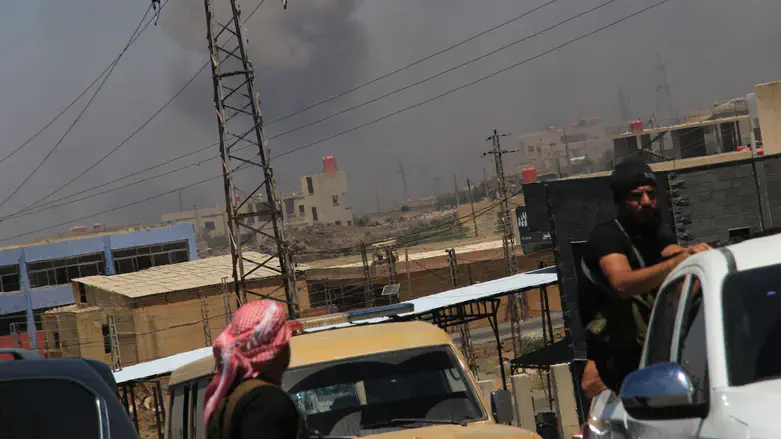
Recent Israeli aerial bombardments targeting Damascus are obstructing Syria's ongoing efforts to locate and dismantle chemical weapons caches from the era of former ruler Bashar Al-Assad, according to a government adviser.
The disruption has already led to the postponement of a scheduled inspection by the Organization for the Prohibition of Chemical Weapons (OPCW), reported the Reuters news agency.
Ibrahim Olabi, legal adviser to Syria's Foreign Ministry on chemical weapons matters, stated Thursday that the OPCW had been slated for a visit that has now been delayed. In response to the escalating situation and the impact of the Israeli operations, the OPCW is set to convene an urgent meeting next Tuesday.
Requests for comment from the OPCW were not immediately answered.
Wednesday's Israeli airstrikes on Damascus were described as powerful, resulting in damage to a section of the defense ministry and impacting an area near the presidential palace. Israel stated the actions were undertaken to safeguard the Druze minority residing in southern Syria.
Olabi emphasized the critical role of the Syrian defense ministry, explaining that it provides the necessary institutional framework to organize and ensure the security of OPCW inspector visits.
Since March, when Syria’s Foreign Minister Asaad Hassan al-Shibani declared that the country is committed to eliminating any remaining chemical weapons, several inspection teams have visited previously undisclosed chemical weapons production and storage sites.
The OPCW, an intergovernmental organization based in The Hague with 193 member states, is responsible for overseeing the implementation of the 1997 Chemical Weapons Convention.
Syria agreed to destroy its chemical weapons in 2013 under a deal brokered by Moscow and Washington, which came two months after a chemical attack on an opposition-held Damascus suburb killed hundreds of victims. The UN concluded in 2014 that the attack involved the use of the nerve agent sarin.
In 2014, the OPCW launched a "fact-finding mission" to investigate the use of chemical weapons in Syria. To date, the team has published 21 reports on 74 alleged incidents of chemical weapons use, even after Syria agreed to destroy its arsenal of chemical weapons. Of these, investigators have determined that chemical weapons were used or likely used in 20 instances.
In 2023, the OPCW produced a detailed report following a fact-finding mission that investigated a 2018 attack on the town of Douma, in which 43 people were killed. The report found that the Syrian air force dropped two cylinders of chlorine gas in 2018 on the town.
The Assad regime regularly denied having any connection to chemical weapons attacks in Syria and rejected past OPCW investigations into its chemical attacks as “fabricated”.