

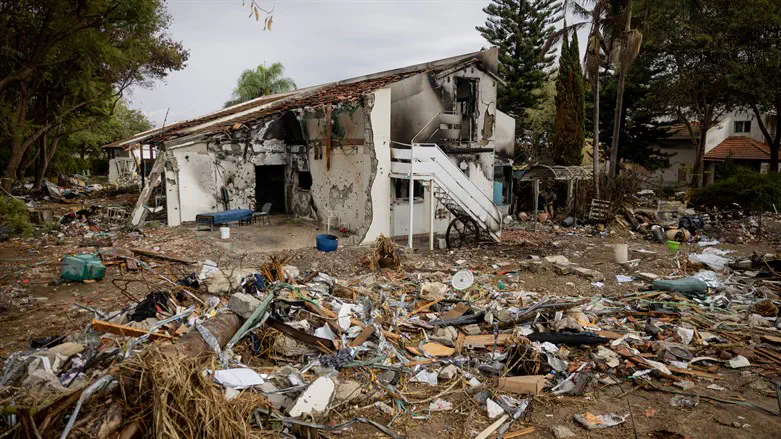
On October 7, Yasmin Porat left the music festival at Re'im, and survived the massacre at Kibbutz Be'eri, to be held hostage in the kibbutz cafeteria with another 15 people.
Together with journalists from Kan 11, Porat returned to the kibbutz, reliving the course of that horrific day and recounting how a terrorist who decided to turn himself in ended up saving her life.
Porat had arrived at the music festival just after midnight on October 7. At 6:15 in the morning, she went to her car to take a break and refresh herself. While she was in the car, rockets started flying over her head, and she called out to her partner, Tal, to get in the car: "We're getting out of here."
"We were in the first 10-20 cars to leave the party," she said. Shortly after they left the party, they passed a bomb shelter on the side of the road. While Tal wanted to go into it, Porat saw terrorists breach the fence and start firing indiscriminately. She called Tal and they sped towards Kibbutz Be'eri, where they knocked on three doors before Hadas and Adi Dagan let them in and offered them coffee and breakfast.
At some point, after receiving WhatsApp messages about a terrorist infiltration into the kibbutz, Hadas Dagan, Porat's friend, said, "I think it's time we went into the safe room."
Several hours later, in the early afternoon, the group started hearing the terrorists nearby: shouts in Arabic, shooting, and explosions.
"I was sure I wasn't going to make it out alive," she said, recalling how she sent messages to her children, telling her that she loved them and to stick together.
Porat also explained how the myth that 50 hostages were being held in Be'eri's cafeteria was born: In a phone call with the police, she was forced by the terrorists to say that there were 50 hostages in the cafeteria, instead of 15.
Suheib abu Amar, an Israeli Arab, was kidnapped from the music festival and brought to Be'eri. "He was with them, cooperating with them," she said. "He was my communication. I spoke with him and he translated everything for Hassan," the terrorist leader.
At some point, the terrorists asked for Porat's phone, and asked if she has connections with the police.
"He called 100 (the police hotline - ed.), Hassan," she said, explaining that the terrorists wanted an escape route together with the hostages, to allow the terrorists to escape to Gaza. "They were sure that the military was already surrounding everything."
In her phone call, Porat said that the terrorists "want a ceasefire, they want to release us, the hostages, and they want to come out of here in peace." Ordered to "exaggerate" the number of hostages, she was told, "50, 50," and told that number to the police.
There were three consecutive phone calls to the police, Porat added. "At that stage I was still optimistic,: she said. "They asked me where I was and I said 'under the cafeteria,' and they heard 'the cafeteria.' And that's how the scene that never happened, of 40-50 hostages in the cafeteria, was created."
Hassan wanted to surrender, "and the police told him how to do it." At one point, Hassan called Porat, "he was in underwear and an undershirt," and she ran over to him. "He pulled me close to him and embraced me, and then showed me with actions that we are getting out of there. He took me out."
As she ran, Porat saw Tal lying on the ground and said, "Tal, are you okay?" and he raised his head and said he was, "and then he put his head back on the ground." Porat continued running with Hassan, and shouted to the line of police officers, "Don't shoot, don't shoot." They assured her that they would not.
A few minutes later, she understood what was happening and ran from Hassan to the police.
"People tell me that G-d took me out of there with tweezers. And that's exactly what happened," she said.
Of the 15 hostages, only Porat and Dagan survived. Porat's partner, Tal, and Hadas' husband Adi Dagan, were murdered together with the other hostages.