

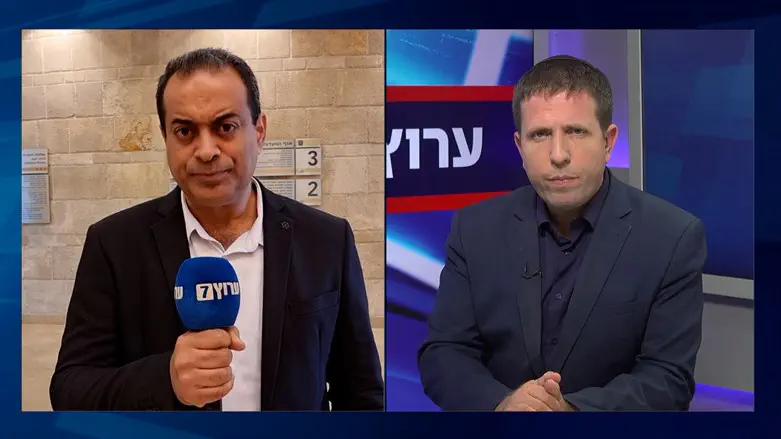
The Chairman of the Independent Workers Movement, Oren Buta, participated on Monday in a special discussion of the Knesset Finance Committee and shared his concerns about the crisis surrounding the consequences of the war on the economic arena.
Speaking with Arutz Sheva - Israel National News, he said, "The situation today is much worse than during the coronavirus crisis. Businesses are closed all over the country, activity is very, very low because many people are in the reserves and many people do not know what to do with their money and are waiting for the results of the war. That is why consumption has decreased significantly. We all feel a serious decrease in business."
He added, "If we don't improve the current economic plan, which is worse than that of the coronavirus crisis, before the vote in the Knesset, we will reach a situation where people will be jumping out of windows. People will not feel safe due to the financial compensation and the national mood. I will not allow such a failure."
Buta mentions that a business that does not receive compensation will not be able to pay salaries. The compensation should arrive within forty days, that is, on November 18, and until then "the self-employed have to rely on savings, and they don't have any extra fat after a month of holidays and after three years of the coronavirus crisis. That's why I call on all those involved in the matter at the Ministry of Finance, including the director of the Ministry - we need immediate assistance, advances as early as the 10th of the month so that people don't collapse, and then you can make the reparation payments."
"We will not give up," says Buta. "We will be wherever necessary to take care of the self-employed and their employees." He added that, if in the first month, independents go into a deficit, few will be able to get out of it, and then "we will all be in a lot of trouble when this war ends".
The money should now be given from foreign currency balances that exist at the level of two hundred billion dollars, he says. The national debt is one trillion shekels and the gap is two hundred billion shekels, meaning that the economic situation of the State of Israel is good and "it is time to transfer the money to the public". Buta stated that an amount of close to 15 billion shekels could be sent in the first month, after which the amount will decrease every month, to 13 billion, 12, 10 and so on if the war lasts six months.
"I believe that after we win this war, all businesses will survive if we take care of good compensation, and we can relax. Otherwise, we will be there every minute to remind the government that we will not be a victim of operations and epidemics," says Buta.
Regarding the fear that there will be businesses that will take advantage of the grants even if they do not deserve them, Buta is blunt and divides his answer into two main parts. "The small businesses are tax-exempt and are supposed to receive NIS 1,750 per month. What will they do with this amount if their business drops by one hundred percent or by eighty or sixty percent? Businesses that earn between 50 and 120 thousand shekels, which are also exempt, receive NIS 3,300 per month, less than the minimum wage. It's a disgrace and we won't let it go on. The Knesset members from the Likud told me that they won't vote in the Finance Committee until things are resolved."
"Big businesses pay 22 percent in fixed expenses will increase their tax to 35 percent, and this is a painful issue because they employ workers and the cost of each worker is 15,000 shekels per month and some have 40,000 shekels. We need to take care of everyone. The employees need to understand that if the independents collapse now they will not have anywhere to go back to. They should be with us," says Buta.
Buta also recalls his call on the Minister of Finance, at the start of the war, to contact the banks with a request not to revoke preauthorized deposits and checks. This did not happen due to the unstable relationship between the Treasury and the banks, "but we are not interested. The banks made a profit in the last year, it's good that they made eight billion shekels this year alone. They can survive for another two years and give loans at three percent. They don't do it because they want to earn more," he says and appeals to the banks to understand the need to give to the public, which is the biggest customer of the banks themselves.