
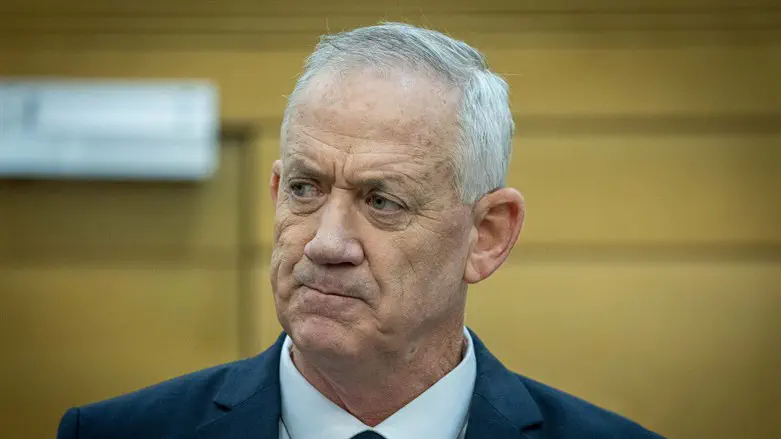
National Unity Party chairman Benny Gantz on Wednesday evening made a statement to the media in which he called on the Prime Minister to immediately return to the negotiations on the judicial reform at the President's Residence, and to stop the legislation of the bill that would limit the use of the judicial doctrine of reasonableness.
Gantz set conditions for the talks and said that any future legislation would only be promoted with broad agreement. He stated that his remarks were made with the knowledge of opposition leader Yair Lapid, but refrained from saying whether Lapid agrees with his proposal.
In his statement, Gantz claimed, "The Days of Awe have arrived early, we are on the eve of Tisha B'Av, on a path to the danger of destruction. The security situation is the most challenging we have known since the Yom Kippur War. There is a real danger of war in arenas near and far, terrorism strikes our streets, and our enemies are receiving the wrong message, which erodes deterrence. As a former Chief of Staff and Minister of Defense I look you in the eyes and say - I am very worried. This is a 'clear and immediate danger.'"
Commenting on the threats of refusal to serve as a means of protesting the judicial reforms, Gantz said, "We need to stop now, and maintain Israel's security, take care of the IDF, take care of the operational competence and I am calling from here to everyone - continue to fulfill your vital task of volunteering and serving. Not only security is harmed, but also our political strength. I congratulate the President on his important speech [before Congress], but at the same time we all heard very well what the administration said. I tell you - Israel cannot lose its strategic assets."
"Alongside these, the high cost of living is skyrocketing, the crime and murders in our streets claim victims, and above all - the internal resilience, the great strength of the Israeli people has been damaged. The State of Israel will win any war against any enemy, except for a civil war in which we will all lose and it is our duty to do everything to prevent it. The disintegration of Israeli society is the greatest danger we have faced in our 75 years of existence. At this time, responsible leadership must act," he added.
"I would like to appeal to the majority of the Israeli public who want a broad agreement. Those who think it is right to carry out a real reform, but fear a regime coup. Those who worry that even an agreement on the reasonableness doctrine will not stop the continuation of the rift, and the upheaval, which will be followed by the appointment of political judges, the rise of power, the dismissal of Attorney General and dozens of laws that will threaten our character. I would also like to appeal to those who voted for the government and want to see the progress in the implementation of the legislation, but want this to be done with broad consensus among the people. The State of Israel must have an agreed upon solution that will bring stability to the IDF, the economy, and society. We must not be torn apart again and again in every chapter of the revolution. Therefore, tonight I am laying down a basic infrastructure for rescuing the State of Israel, which will return us to dealing with the enormous challenges we face - together," Gantz declared.
He presented his outline: "Already this evening we will gather at the President's Residence, and discuss an agreed upon outline for the doctrine of reasonableness, in a way that does not open a window to corruption and preserves the principles of democracy. All this under the overriding principle that agreement is conditioned on agreement. This is also the basic condition for negotiations - that the Prime Minister commit, in the presence of the President and with his backing that, if we reach agreements, from now on legal and administrative steps will be done only by broad agreement, including all the elements of the legislation that were discussed in the President's Residence. No further legislation will be promoted and there will be no further legislation without broad agreement."
Gantz also issued a threat to Prime Minister Benjamin Netanyahu, "I call on Netanyahu and all the responsible members of the Knesset - you have a national duty to accept the proposal. To the majority of the people who oppose the coup and are afraid of the discourse, I say - I do not trust Netanyahu either, but the State of Israel is at stake. If we reach an agreement and he cheats - he will pay the price and lead to a protest of the kind that we have never been seen before. We must remember, our goal is to preserve democracy, the security of Israel and the unity of the entire people, and all of Israeli society on all its components. Therefore, at this time, responsible leadership is required that will put Israel first, and I hope that it will be found."
The Likud responded to Gantz's remarks and said, "After Gantz rejected every compromise proposal at the President's Residence and blew up the talks for no reason, we were hoping to hear a serious proposal from him. Unfortunately, all we received was another dictate. If Gantz really wants negotiations and a compromise, he is invited to the Prime Minister's Office this evening."
"Instead of idle maneuvers, Gantz must demand that his friends in the opposition resolutely stand up this evening against the refusal that endangers the security of all Israeli citizens," the Likud added.
Sources close to National Security Minister Itamar Ben Gvir responded, "Any compromise on the doctrine of reasonableness is a surrender to refusal to serve, to anarchy, to Ehud Barak and Yair Golan, and it will encourage the continuation of the disobedience. The right-wing government has no mandate to submit to blackmail."
The chairwoman of the Labor party, MK Merav Michaeli, attacked Gantz. "It is forbidden to conduct any negotiations with Netanyahu on the coup laws; Gantz must inform Netanyahu that if the law to repeal the reasonableness doctrine is passed, the door to negotiations is definitively closed. Netanyahu has already lied to the opposition, he lied to the President of the United States that the legislation will pass by consensus."