
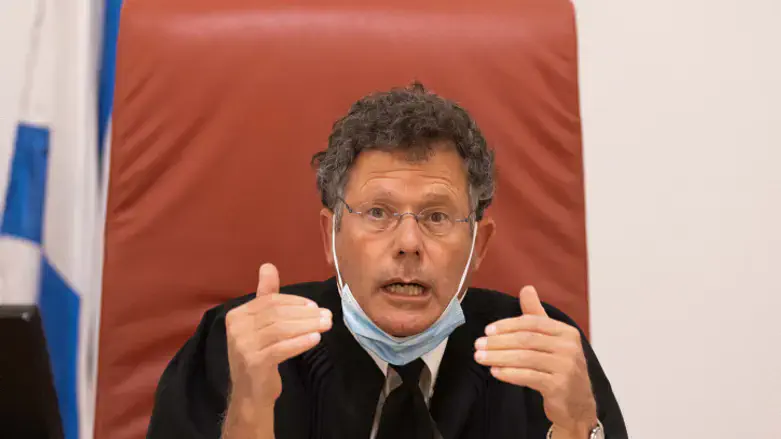
The clash between these branches of government has been brewing for years, even decades, since past Supreme Court president Aharon Barak undertook to refashion the entire legal system in his own image.
Soon:
-What had been called “Basic Laws” suddenly had the force of an undeclared Constitution;
-The attorney general was deemed the executive branch’s final arbiter of the public interest in any legal matter;
-“Unreasonableness” became a sufficient justification to disqualify governmental appointments, annul legislation and single-handedly determine matters of public policy;
And the list goes on.
Still, Barak had the intellect, political acumen and manipulative adroitness that none of his successors have possessed thereafter. Hence, a slow but growing realization began fermenting amongst the other two competing branches that something had gone terribly awry. Finally, it seems, the cracks are beginning to show, and we have no one to thank for that more than Yitzchak Amit himself.
The scourge of hubris has been described as “pride that blinds,” and Amit, as has been said by others, exemplifies that self-induced affliction perfectly. According to his dogmatic understanding of bio-anthropology, judges are distinguished from lesser human beings by virtue of their superior “judicial DNA,” and I quote verbatim.
When speaking to a group of 12th-graders, Amit was recorded as saying: “Do me a favor, leave me alone about what we call ‘electoral democracy.’ It reminds me of the stale joke about the four wolves and a sheep who took a collective vote to decide who's going to be served for dinner tonight.”
Remember that the next time you go to vote.
Amit had no compunctions about participating in the Israel Bar Association’s annual conference in Eilat (all expenses paid), despite sitting as the senior justice on a pending petition against the Knesset’s decision to cut the organization’s budget by 20%.
During sessions of the Judicial Appointments Committee, Amit refused to recuse himself even though the deliberations centered around whether or not he should be appointed the next president of the Supreme Court. “I’m sitting here merely as a potted plant,” he smugly quipped. And Levin refused to convene the committee in protest of this insufferable impropriety, Amit’s cronies on the Supreme Court simply usurped such ministerial privilege and bestowed the title of “president” upon their colleague.
We can offer only the highest regard for Levin, who from then onwards has resolutely repudiated this judicial coup, ceasing to cooperate with Amit at all levels and desisting from participating in any ceremony honoring Amit’s fabricated appointment. It’s hard to think of a single politician, past or present, who would so doggedly adhere to his principles; certainly not previous ministers of justice who more often than not immediately capitulate to the whims of the judicial elite.
Which is exactly what has caused these oligarchs to go apoplectic over such umbrage to the extent that yet another “public petitioner” has filed suit to coerce Levin into cooperating with Amit or else be removed from office. The fact that this same Supreme Court has refrained from immediately dismissing such dross stupidity serves as yet another example of the absurd depths to which we have descended.
What’s surprising, however, is that the executive and legislative branches of government are, for once, fighting back. A longstanding practice of Supreme Court presidents allows them to determine the panel of judges sitting on particular cases. Initially, this was to ensure that justices with expertise in specific areas of the law would be assigned to handle matters in which they excelled.
Already from the reign of the aforementioned Barak, this powerful authority has been exploited for manifestly political purposes, primarily to ensure a pre-determined outcome in highly sensitive cases. In this regard as well, Amit has proven how sorely he lacks the intellectual stature of this renowned predecessor.
Whereas in the past, fiercely contested issues regarding public policy were brought before an expanded panel of five, seven or more justices, Amit has time and again chosen the “seniority panel” of three—consisting of himself, Deputy President Noam Solberg and Associate Justice Daphne Erez-Barak to adjudicate even the most controversial matters. Given that Amit and Erez-Barak are stalwart activist judges, the majority (2 to 1) is preserved, making life remarkably easy for them.
Nor do they fail to demonstrate their disdain for Netanyahu’s cabinet and their own unshakable belief that these justices alone stand as the last line of defense before Israel slips into dictatorship.
Yet recently, Amit has unwittingly committed two glaring tactical errors. For reasons unknown, he reassigned the panel hearing the petition against Netanyahu’s decision to appoint Zini to head Israel’s Shin Beit security service. Instead of the usual three senior justices, Amit replaced Solberg and Erez-Barak with Alex Stein and Gila Canfy-Steinitz, two justices sometimes mistakenly considered of a more conservative bent.
What transpired was a rare insight into Amit’s greatest fear that he and his enlightened comrades might lose their singular command over every act and decision undertaken by the executive and legislature. When these two associate justices began dissecting the attorney general’s extremist position that Netanyahu should be stripped of his authority, the terror gripping Amit’s face was apparent for all to see.
Which brings us to his second fatal mistake—allowing the seven-hour session to be live-streamed. Besides witnessing the heart-wrenching execution of his order to have bereaved parents and family members of Hamas atrocities on Oct. 7, 2023, dragged from the courtroom, Amit’s pathetic squabbling with his colleagues on the bench offered a rare insight into his judicial immaturity. Canfy-Steinitz dared refer to a previous Supreme Court ruling that the attorney general’s decisions do not necessarily bind the government. Amit frantically attempted to degrade the importance of such a verdict by pointing out that it was accepted only by a 4-3 majority. To which Canfy-Steinitz shot back, referring to the 3 judges sitting on the court: “Now we’re counting by what majority?!”
It seems the government, as well, is at long last coming to realize that Amit cannot be taken at his word. Throughout the marathon hearing on the dismissal of previous Shin Bet chief Ronen Bar, Amit repeatedly entreated the parties to reach some kind of consensual arrangement and eagerly offered his services to assist in such a congenial effort.
In the end, the dispute resolved itself: Bar notified that he would be resigning in the following weeks, the government withdrew its decision to fire him, and with that, the case should have been expunged from the record. But then the attorney general’s office demanded that the court nevertheless issue a ruling since the episode addressed “a matter of principle.” But if there’s one thing the courts love, it’s when the parties resolve the dispute between themselves on their own. After all, the role of the judiciary is to adjudicate actual controversies and not theoretical ones whose only application is “a matter of principle.”
Furthermore, wasn’t achieving a settlement exactly what Amit had recommended from the very beginning? But he and his accomplice Erez-Barak simply couldn’t help themselves, and despite the litigants themselves having declared their divorce, these justices felt compelled nevertheless to reprimand Netanyahu and declare that he was wrong all along. How can Amit ever be trusted again when proposing that the parties resolve their disputes without the court’s intervention?
It is precisely these and similar judicial machinations that have served as unignorable wake-up calls for the Knesset to set matters right, beginning with a bill currently making its way up the legislature to expropriate the power of Supreme Court presidents to determine which judges hear petitions before the High Court of Justice, and thus guarantee that the process be arranged with pure randomicity.
It’s a small first step, and well overdue, but an important one at that.