

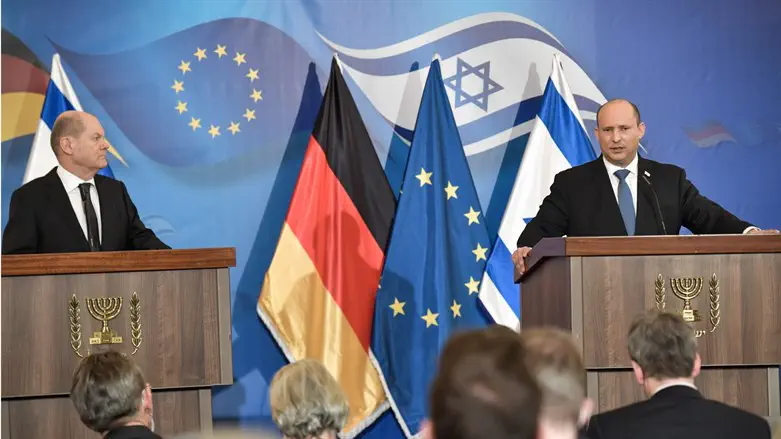
Israeli Prime Minister Naftali Bennett on Wednesday held a joint press conference with German Chancellor Olaf Scholz, announcing new and strategic cooperation between the countries.
At the beginning of his speech, Bennett noted that Israel was one of Scholz's first destinations after taking office.
"Welcome to Jerusalem," he began. "I am very pleased that you have chosen to come to us, to Israel, on one of your first stops as Chancellor of Germany. This is not a given."
"We started the day at Yad Vashem, the place that reminds us of the wound that is the basis of relations between Israel and Germany. These relations have come a long way since David Ben-Gurion and Adenauer and they are more steadfast than ever. Together we will deepen and expand them."
Looking to the future, Bennett added, "Today I am also pleased to announce that the Chancellor and I have agreed on the creation of a new strategic cooperation between the State of Israel and Germany. This will be in the format of a bi-annual dialogue on security and diplomatic matters. I think that this is a significant upgrade in our relations."
Noting that Scholz had arrived in Israel at "a very fateful and sensitive time," Bennett said, "We just spoke at length on the situation in Ukraine. Our obligation as leaders is to do our utmost to stop the bloodshed, to bring what is going on from the battlefield to the negotiating table as quickly as possible; it is still not too late."
"To my regret, we in Israel have experience with wars. Their price is great as we have already seen. Unfortunately, it could get much worse."
Bennett emphasized that, "The State of Israel stands alongside the people of Ukraine. We have sent considerable humanitarian assistance – three planes with 100 tons of equipment, mostly medical – and we are determined to continue and even do more."
Turning to Scholz, he emphasized, "We are also charged with the responsibility of making sure that Iran will have neither nuclear weapons nor the possibility of attaining them, not on our watch, not ever. We are closely monitoring the talks in Vienna including the possibility that an agreement will be signed that allows Iran to install centrifuges on a broad scale within a few years. This possibility is unacceptable to us."
"Israel will know how to defend itself and ensure both its security and its future. We also expect our friends in the world not to countenance a massive installation of centrifuges in another two-and-a-half years, and to already prepare for the day after."
"The world that we have known is changing. The challenges are great. We must join hands and work together to meet them," Bennett concluded.