
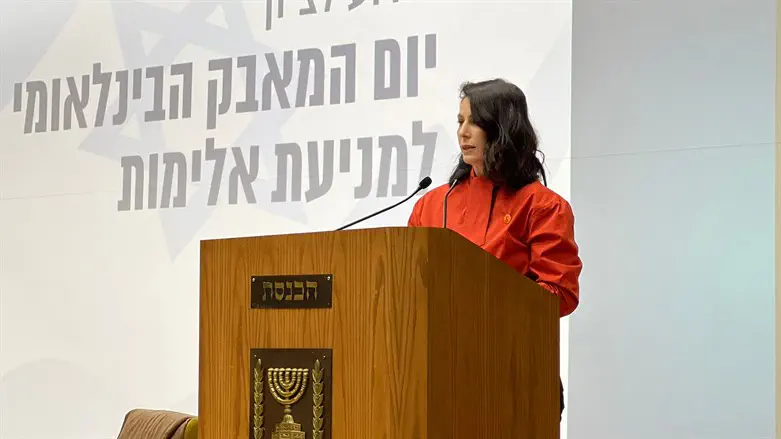
On Tuesday, the Knesset held an event to mark the International Day for the Prevention of Violence against Women, at which a number of people spoke, including Gilat Bennett, wife of the Prime Minister.
The event was the initiative of MKs Idit Silman (Yamina) and Merav Ben-Ari (Yesh Atid) and was also attended by Lihi Lapid, wife of Foreign Minister Yair Lapid (Yesh Atid), and the Knesset Speaker, MK Mickey Levy (Yesh Atid).
“My name is Gilat Bennett, and I’m here because I’m the Prime Minister’s wife,” began Mrs. Bennett. “It’s a great honor for me to be speaking here, and also very exciting and just a little bit scary too.”
Bennett then noted that, “For those who do not know, I am a professional parent counselor, and what I do every day, when I’m not at home with my four children, is meet with parents. With your permission, I want to speak here not as the wife of a prime minister but as the mother of four children and as a professional woman who has been meeting parents daily for over a decade.”
Bennett then addressed the topic of the event, describing “wonderful organizations and people who dedicate their lives to this cause.” What she focused on, however, was “prevention, something that I think is not discussed enough.”
She noted that, “The violent spouse of the future is still a child today … in a family where he learns how to perceive himself, whether or not he sees himself as worthy, and how he thinks he deserves to be treated … Then, later on in his life, he applies the lessons he has learned to the family he builds with his spouse.”
“We all want to be good parents,” Bennett stressed, “but we often feel helpless and confused, because times have changed and the old ways of doing things are no longer appropriate … Take punishments, for example … if we think about that for a moment, the idea of punishment is that in a close and family relationship, I am allowed to hurt you in order to teach you something. This is a problematic message,” she insisted. “We, as parents, need to be given tools to learn how to bring about respectful cooperation, without threats and punishments.”
Furthermore, “we need to help our children deal with anger and frustration, so that even if he is one day frustrated with his partner, he will know how to deal with it.”
“We have so much influence as parents,” Bennett concluded, “and we can make a great impact, teaching our children that they deserve to be listened to, that they can deal with frustration … We can raise our children to be responsible and caring adults and in that way, we can influence society for the better.”