

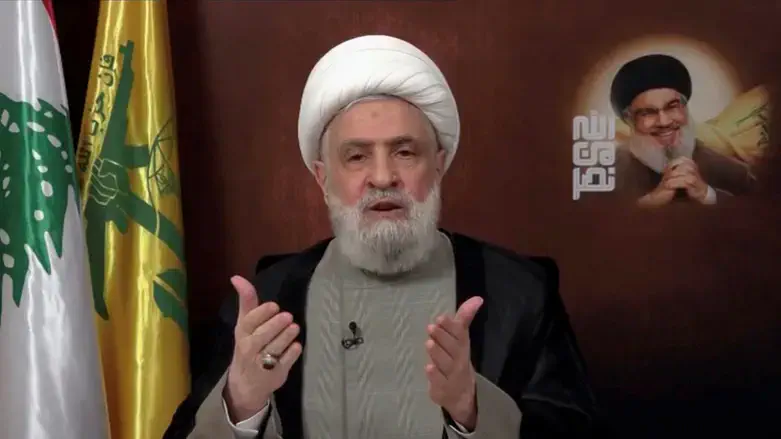
Hezbollah Secretary General Naim Qassem on Wednesday accused Lebanese President Joseph Aoun of deepening divisions in Lebanon with an Independence Day address that, in Qassem’s view, equated Israel’s military actions with Hezbollah’s armed campaign.
In his Independence Day address on Saturday, Aoun called for Israeli forces to withdraw from Lebanese territory and for Iran to stop interfering in Lebanon’s affairs. He described the two issues as linked obstacles to Lebanese sovereignty. Aoun also called on Israel to halt its attacks and release Lebanese prisoners, reaffirmed his government’s commitment to disarming Hezbollah, and said the state alone should decide when Lebanon goes to war.
Speaking at the launch of an encyclopedia by Hashem Safieddine, Qassem said an Independence Day address should bring Lebanese citizens together. He claimed that all those concerned about Lebanon’s sovereignty had condemned the speech. Invoking the president’s constitutional duty to safeguard Lebanese territory, Qassem accused Aoun of placing Israel on the same footing as Lebanese people whom Qassem described as facing genocide and resisting attack.
“Shouldn’t the president stand by his people, even if they make mistakes?" Qassem asked.
Qassem described what Hezbollah calls the “resistance" as “legitimate, national, and moral," arguing that it deserved respect for the price its members and supporters had paid. Defending Lebanese territory was primarily the state’s responsibility, he said, but Hezbollah had taken up arms because the state had been unable to repel Israeli attacks.
Qassem claimed that more than 10,000 people from Hezbollah and the communities that support it had been killed in two years and that 30,000 had been wounded. He also cited those taken prisoner and the widespread destruction of homes. He maintained that Hezbollah and its supporters had borne those losses to protect the country while sparing other Lebanese communities harm. The government, he argued, had to account for its own failure to defend Lebanese sovereignty before putting pressure on Hezbollah.
Turning to Beirut’s dealings with Washington, Qassem accused leading Lebanese political factions of helping Israel achieve goals it had failed to secure through military action. He said national unity and the defense of Lebanon required practical action and challenged officials to identify what they had done beyond offering concessions. He questioned whether surrender and concessions had become hallmarks of Aoun’s presidency, singling out the framework agreement, which he claimed had given Israel everything it wanted and secured nothing for Lebanon.
Qassem called Iran “a model of honor" and said Hezbollah was proud of its relationship with Tehran. He called for continued cooperation with Iran against Israel and credited Tehran with limiting the scope of Israeli military action. “We do not work for Iran. It works for us and bears the burdens for our sake," he said, adding that Hezbollah’s own sacrifices were for Lebanon’s independence.
Qassem described Israel’s military actions as the only threat facing Lebanon and said independence was incompatible with dependence on a foreign power. “American tutelage will ruin Lebanon if it continues," he warned. He urged Lebanese authorities to take their demands to the UN Security Council and raise them directly with foreign envoys.
Qassem said Hezbollah accepted the Taif Agreement and the constitution as a political compact uniting all Lebanese under one state. In his reading, the agreement calls for an Israeli withdrawal, the deployment of the Lebanese army, and further steps to establish state authority throughout the country. He urged the government to equip the army to defend Lebanese territory and to reject aid that came with conditions.
Full sovereignty, Qassem said, required an end to Israeli attacks, a complete Israeli withdrawal, the deployment of Lebanese troops, and the release of prisoners. He also called for reconstruction and the return of displaced residents to their villages.
Qassem also paid tribute to Safieddine’s Commentary on Nahj al-Balagha, the work whose launch he was addressing. He praised the encyclopedia as a contribution to Islamic scholarship, saying Safieddine had drawn on his experience as a leader to offer a contemporary reading of the text.