
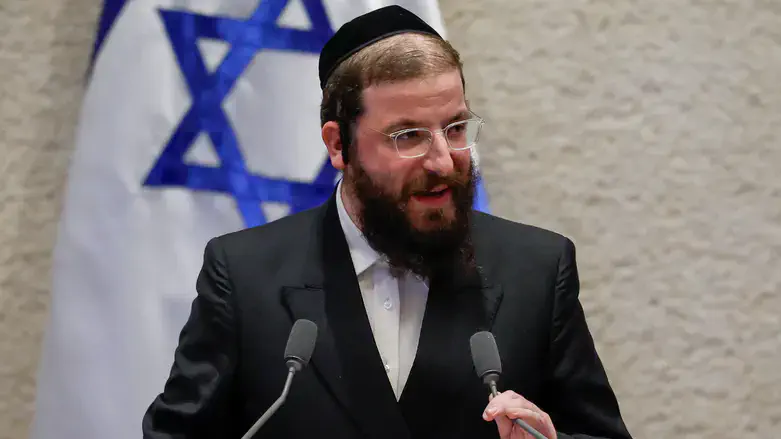
MK Eliakim Stark (United Torah Judaism) delivered his inaugural speech in the Knesset plenum on Tuesday, sharing his family's story and their prolonged struggle with the medical condition of his son Chezki, who was born with a rare structural abnormality of the brain.
Stark, who grew up in a Hasidic family in Belgium and immigrated to Israel to study at a yeshiva, shared key milestones in his life with fellow lawmakers. He thanked his wife for her devoted care of their son and outlined the issues he intends to focus on as an MK: education and opportunities for young haredim to earn a dignified living.
Opening his remarks, he congratulated the Knesset speaker on taking office and thanked the lawmakers, guests and family members who had come to honor him. He then thanked God and explained that his emotion stemmed not from the occasion itself, but from the weight of his responsibility as an elected representative.
He said, "It is not this House that I fear. Not the leather seats, nor the speaker's podium. Nor even my colleagues in this House whose views differ from mine. Rather, it is the magnitude of the mission entrusted to me".
He added that he felt accountable to hundreds of thousands of citizens, including many young people whom he had promised before the election that he would work to improve their living conditions.
Stark said he was born 35 years ago in Antwerp, Belgium, into a Hasidic Jewish family. All four of his grandparents were Holocaust survivors, he said, and their accounts of that period accompanied his childhood, alongside the antisemitism he encountered around him.
He described life in Antwerp's Jewish community, where Yiddish was the main language, alongside English and Flemish. Although he studied sacred Hebrew as part of his Torah studies, spoken modern Hebrew was unfamiliar to him.
He first visited Israel in the Hebrew year 5758 (1997-1998), when he was a young child. During the flight, he recalled, he repeatedly asked his parents whether it was indeed customary to kiss the soil of the Land of Israel upon arrival.
He said the moment he stepped off the plane and kissed the ground remains etched in his memory. He said, "The Israel Airports Authority workers saw a child's hand filthy with machine oil. To this day, I insist it was a Jewish hand touching, for the first time, a land of olive oil and honey".
Stark urged his listeners not to lose their sense of excitement at simply living in Israel. He emphasized, "Never give up the Jewish privilege of rejoicing in the fact that you live in the Land of Israel!".
Later in his speech, Stark said he married at 19 and established his home in Jerusalem. All four of his grandparents, who survived the Holocaust, lived to attend his wedding. He said they were especially moved to see another grandchild establish a Jewish home in Jerusalem, decades after surviving the horrors of the Holocaust.
Stark said he is the father of six children and stressed that his family takes priority over all his public roles.
He then turned to the most personal and emotional part of his speech, sharing the story of his son Chezki.
About seven and a half years ago, Chezki was born with a rare structural abnormality of the brain. Doctors estimated that his life expectancy would be extremely short and that he might live only a few months, or at most a year and a half. Stark said, "The nicest thing would be to tell you that we accepted everything with love. But nothing is more beautiful than the truth".
Describing the difficult period the family endured after receiving the news, he said, "Those were difficult nights. We cried, we prayed, we shouted, we were angry, we did not understand why we deserved this. What had we asked for, after all? To raise a generation of Jewish children in Jerusalem? And now this struggle".
Despite the difficulties, he said, the family continued to fight for Chezki's health and quality of life while coping with his severe limitations in movement and speech.
Stark devoted special words to his wife, who he said had shouldered most of the responsibility for caring for their son over the years. Speaking from the Knesset podium, he said, "Thank you so much for everything you do for all our children, and a special thank you for the way you accept and care for our Chezki".
He then said Chezki had surprised the doctors by living far longer than they had predicted. Visibly moved, he said, "Chezki has defied the doctors' predictions. On the eve of this coming Purim, he will turn eight. And today he is with us, watching the broadcast from home".
Stark addressed his son directly in Yiddish, "Chezki! Tati hot dir lib!" - Chezki, Daddy loves you.
He went on to thank the medical teams who had treated his son, particularly the doctors at Hadassah Ein Kerem Hospital, who he said had done everything in their power for the boy.
He also addressed families raising children with disabilities, expressing his appreciation for their devotion. He said, "You are the crown of our humanity. You teach everyone what compassion and love for others truly mean".
Stark explained that he had chosen to share his personal story to convey a message to young people facing difficulties and challenges in their lives. He urged, "No matter what challenges you face, never let yourself fall and collapse, and never give up on any dream".
He then turned to the Belzer Rebbe, who he said had taught him to persevere, not to surrender to circumstances and not to despair. Stark noted that the Rebbe had sent him to serve in the Knesset and described the Rebbe's life story as an example of Jewish renewal after the Holocaust.
Toward the end of his speech, Stark addressed his approach to public service. He said he did not believe that the path to change necessarily lay through heated battles and sweeping reforms.
He concluded by explaining the Hasidic custom of wearing a gartel, a special belt worn before prayer and the performance of mitzvot, as a symbol of spiritual preparation and heartfelt intent. Stark said he was embarking on his public service with a prayer that he would succeed in his mission and that his actions would be for the sake of Heaven and for others.
He said, "I put on the gartel and pray to God that He grant me success on my path, that all my actions be for the sake of Heaven, and that I find favor and kindness in the eyes of others". He closed his maiden speech with the verse, "May the favor of the Lord our God be upon us; establish the work of our hands for us; yes, establish the work of our hands".