
Human existence unfolds along an invisible boundary: between the world as it is and the world as it ought to be, between the sacred we seek and the ordinary life we cannot escape. The haunting song בין קודש לחול (Bein Kodesh Lechol, Between Sacred and Profane), performed by Shuli Rand and Amir Dadon, gives voice to this tension beginning where most of us actually live; in the space between.
That tension is older than any song. Thousands of years ago, Jacob lay down in the dark with a stone for a pillow. He dreams of heaven, of angels, of a stairway of light. Then he wakes, and he is exactly where he was: alone, on the ground, in the same unfinished night. That is the whole story, and the whole secret. The dream was never meant to carry him away. It was meant to send him back.
Jewish thought knows two movements of the soul. One is yeridah letzorekh aliyah, a descent for the sake of ascent, in which hardship, uncertainty, and even spiritual darkness become the doorway to a higher awakening. The other is rarer and bolder: aliyah letzorekh yeridah, an ascent for the sake of descent, in which the journey toward heaven finds its purpose not in remaining above the world, but in returning to it with greater wisdom, compassion, and responsibility.
The Talmud, in its discussions of building and demolishing on Shabbat, teaches that an act may not be what it appears: what looks like destruction may serve a larger building. So too in the spiritual life. A retreat may be preparation, and an apparent elevation may be incomplete until it is translated into deeds. The direction of movement matters less than its purpose.
Jacob was fleeing his home into an uncertain future, alone beneath an unfamiliar sky. Look at what he sees. The ladder does not hang from heaven. It stands upon the earth, its feet in the dust of his hard bed. And the angels ascend first and descend second, as though the climb were only the opening half of a sentence. Rashi explains the order through the changing angelic guardians who accompany Jacob beyond the borders of the Land of Israel, yet the image invites a larger reflection: perhaps ascent is not the destination but the preparation, and the purpose of reaching toward heaven is to bring something of its light into the world below.
Jacob does not dream of wings with which to abandon the world. He dreams of a ladder that binds heaven to the very place where he lies. The sacred is not found by escaping physical reality, but by recognizing the divine possibilities concealed within it.
Perhaps nowhere is the principle of aliyah letzorekh yeridah-ascending for the purpose of descending-more beautifully expressed than in Maaser Sheni. The farmer ascends to Jerusalem with the fruits of his labor, where, as Tosafot explains in Bava Batra 21a, witnessing the holiness of the Temple service awakens him to Torah study and reverence for God. Yet the pilgrimage is only the beginning, for he must descend from Jerusalem and carry its holiness back to his home, his fields, and the ordinary rhythms of daily life, fulfilling the Torah’s words, “למען תלמד ליראה את ה' אלהיך כל הימים"-“So that you may learn to revere the Lord your God all the days" (Deuteronomy 14:23). The words “all the days" point beyond the visit itself.
The true culmination of the pilgrimage was therefore not the moment of arrival in Jerusalem, but the journey home, when the fleeting encounter with the שכינה was transformed into an enduring presence within the fabric of Jewish life.
The Hasidic masters kept returning to this vision. The Alter Rebbe saw prayer as a ladder of longing, on which the soul rises through the worlds to touch Divine Will and then descends with blessing. In the Hasidic understanding of the four worlds, morning prayer begins in Asiyah, the world of action, and climbs from there. The lips begin on earth, the heart passes through the gates of heaven, and the feet wait below for the soul’s return.
The Lubavitcher Rebbe, Rabbi Menachem Mendel Schneerson, emphasized the principle of dirah betachtonim: to make the lowest world a dwelling place for the Divine. Prayer, Torah study, and contemplation are indispensable, but their meaning is completed when we come back down and turn elevation into action. Holiness is not finished in the synagogue or the study hall. It must walk into the laboratory where knowledge is discovered, the hospital where suffering is eased, the classroom where wisdom is handed on, and every encounter in which human dignity is protected. The descent into responsibility is not a retreat from holiness. It is holiness fulfilled.
Rabbi Joseph B. Soloveitchik warned that this is no gentle harmony. In Sacred and Profane he describes holiness as a paradox, not a state of effortless peace, and he challenges the romantic hope that spiritual achievement dissolves the contradictions of human life. The sacred and the profane remain distinct, yet the physical world is the very arena in which holiness must be realized.
In Halakhic Man the religious personality does not flee the world for mystical escape but brings the ideals of Torah into concrete existence.
In The Lonely Man of Faith, the one who masters nature through creativity and the one who stands before God in humility and longing cannot be fused, yet neither can be dismissed. Human greatness lies in the hard task of living within both.
So, it is with the ladder. It does not erase the distance between heaven and earth. It joins them while keeping them apart, as a bridge needs two banks. The angels move without dissolving the two realms into one, just as the believer must keep moving between contemplation and action, submission and creativity, the eternal and the temporal.
Even within the human body, Jacob’s ladder finds a remarkable echo. Along the spinal cord, sensory signals ascend toward the brain, while motor commands descend to guide our movements. Life depends upon this ceaseless exchange between ascent and descent, receiving and responding. So too, the angels on Jacob’s ladder move between earth and heaven, reminding us that the purpose of reaching upward is fulfilled in what flows back down. We ascend in longing and descend in action, transforming connection into life.
This movement also illuminates the mystery of time. There is chronos, the time of clocks and calendars, in which seconds become years, and the future keeps replacing the past. And there is what Henri Bergson called durée, the inward flow of consciousness, in which memory, present, and hope pass through one another and earlier moments remain alive inside the now. Chronological time runs only forward, but the soul keeps descending back through memory to people and places long gone and reaching forward through imagination toward what has not yet been.
Science offers an unexpected metaphor for this restless stability. In steady-state enzyme kinetics, the concentration of an enzyme-substrate intermediate can stay roughly constant even as molecules ceaselessly bind, react, and separate. Beneath the stillness lies uninterrupted motion. Here is Jacob’s ladder: it stands, while the angels go up and down. Continuity is not the absence of change. It is meaning preserved through movement.
But the most beautiful image of all is light itself.
In a light-emitting diode (LED), electrical energy drives electrons into higher-energy states within a semiconductor. For an instant it stands on that height. Then it falls, and the fall is a flash: the energy of the climb leaves as a photon. The ascent makes illumination possible; the descent brings it into being. Light is born not in the rising, but in the return.
The human soul may rise through prayer, contemplation, study, and the search for truth, but its achievement is incomplete if it never comes back to the world of human experience. The scientist who turns discovery into healing, the teacher who turns knowledge into education, the physician who turns expertise into compassion, the one who turns faith into a deed: each show that we are lifted not to keep what we find, but to release its power into other lives. A soul that never comes down is a lamp that can never light.
And so, when Jacob woke, he did not find himself in heaven. He found himself on the same earth where he fell asleep, now changed by what he knows: “Surely the Lord is present in this place, and I did not know it" (Genesis 28:16).
The landscape is the same. His eyes are not. The ladder has become a summons: carry this back into your life.
Perhaps that is the deepest meaning of living between sacred and the profane. Not to choose one world at the expense of the other, but to see that our highest aspirations place on us the deepest obligations to the physical world: to understand its mysteries, ease its suffering, enrich its possibilities, and leave it better for those who follow.
The ladder stands.
The angels climb, and the angels descend.
The soul goes up in longing and comes down in love.
And somewhere between the last rung and the ground, in the moment of return,
light is born.
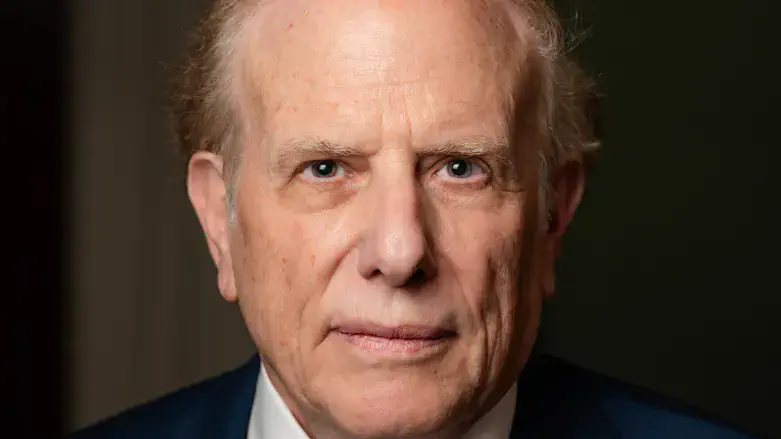
Itzhak David Goldberg ,MD, FACR, is a Professor Emeritus at Albert Einstein College of Medicine