

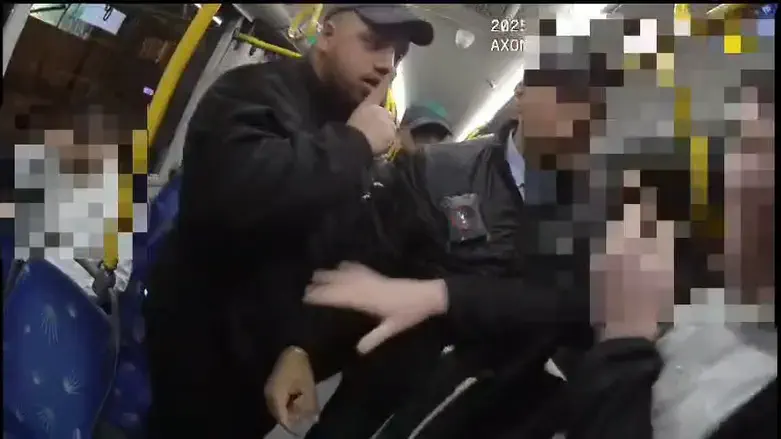
Four Arab bus fare inspectors were investigated on suspicion of violently assaulting a 17-year-old haredi boy in Jerusalem, but the case against them was closed without an indictment.
Following the decision, attorney Chaim Bleicher of the Honenu organization filed an appeal with the State Attorney's Office, demanding that the inspectors be prosecuted for serious violent offenses, abuse, abduction and tampering with evidence.
The incident occurred one evening in March 2025 on Egged bus route 39A in Jerusalem. The teenager boarded the bus on Herzl Boulevard and discovered that he did not have his Rav-Kav transit card with him.
According to the appeal, four inspectors boarded the bus several stops later and began checking passengers' tickets. When they reached the teenager and he explained that he did not have his card, they began confronting him. Feeling threatened, the teenager called the police and began recording the incident on his cellphone.
According to footage attached to the appeal, one inspector struck the teenager's phone, knocking it to the floor. When the teenager bent down to pick it up, the inspector punched him in the face.
The footage then shows the inspectors forcibly seating the teenager, instructing the driver to continue driving and beginning to punch and slap him in the face and body.
The assault was partially recorded by the inspectors' body cameras. The appeal alleges that footage collected during the investigation shows severe violence by one inspector, with the others assisting him.
At one point, the inspectors turned off their body cameras. According to the teenager, the assault continued for more than ten minutes afterward, while he remained alone on the bus with the inspectors and the driver.
The appeal also describes alleged attempts to prevent passengers from recording the violence. According to the document, when one passenger took out a camera, the inspectors forcibly took it from her, deleted the pictures she had taken and ordered her off the bus.
The inspectors also allegedly threatened other passengers, warning that anyone who tried to film would be assaulted, and instructed the driver not to open the bus doors. The appeal further alleges that one inspector took the teenager's phone and deleted content from it while the others continued beating him.
Another detail disclosed in the appeal concerns the inspectors' conduct after the assault. According to the document, one inspector took the teenager's wallet, tore it, removed his identity card and issued him a fine.
When the bus reached a stop on Golda Boulevard in Jerusalem, the inspectors made the teenager get off and followed him.
The inspectors then allegedly approached him and asked him to return the fine notice. One of them took the notice and tore off the section containing the inspector's identifying details.
According to the teenager, after he got off the bus, the inspectors tried to persuade him not to file a police complaint against them. According to the appeal, they told him, "Let's make a deal: You won't file a complaint against us, and we won't file a complaint against you."
Only about two hours after the incident, close to midnight, did the teenager call Bleicher and tell him what had happened. The next day, he went to a police station and filed a complaint. Following the assault, the teenager suffered jaw pain and was referred for medical examinations and imaging.
Following the complaint and Bleicher's appeals, police opened an investigation, during which the inspectors were arrested and footage from their body cameras was collected. The case was initially transferred to the State Attorney's Office but was later returned to the police prosecution department, which decided to close it without an indictment.
In the appeal, Bleicher argues that the investigative material and footage justify prosecuting the inspectors. Bleicher also acknowledges that the teenager behaved rudely toward the inspectors, as he says the evidence shows, but stresses that this does not justify the violence used against him.
He wrote in the appeal, "This is an extremely serious incident of abduction, a mob assault, abuse and severe violence, accompanied by evidence tampering, by four officials against a minor." He also requested that the case be returned to the Jerusalem District Attorney's Office and that the decision to transfer it to police prosecutors and close it be reviewed.
Bleicher said, "It is incomprehensible how such a serious case, with footage from every possible angle showing severe violence against the teenager, brutality and grave threats against passengers, is closed and allowed to fizzle out by the State Attorney's Office, which sends the case back to police prosecutors instead of filing an indictment on serious charges, while police prosecutors go a step further and close the case. We hope the authorities will come to their senses and that the assailants will be prosecuted for serious offenses."