
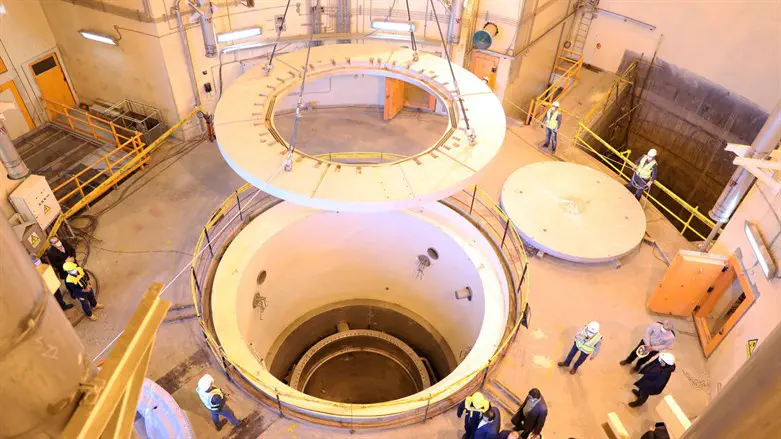
The Israeli and American strikes damaged Iran's nuclear program and significantly delayed its progress, but did not eliminate Tehran's ability to rebuild it, according to Dr. Ephraim Asculai, a senior research fellow at the Institute for National Security Studies (INSS), who identified the Isfahan nuclear complex as a particular concern in an interview with Arutz Sheva. The facility was not completely destroyed, retains substantial infrastructure, and remains inaccessible to international inspectors.
Asculai, who worked for more than four decades at the Israel Atomic Energy Commission and also served at the International Atomic Energy Agency (IAEA), emphasized that the lack of inspections makes it difficult to assess the facility's current condition or the pace of reconstruction.
"It was not completely destroyed, and it has a great deal of potential. In a certain respect, it is the most significant and most dangerous facility in Iran," he said.
The concern stems from the concentration of several key stages of Iran's nuclear program within a single complex. According to Asculai, the site contains infrastructure for preparing materials for enrichment, processing enriched material, and storing nuclear materials in a network of tunnels deep inside a mountain. In 2025, Iran also informed the IAEA of its intention to operate an enrichment facility at the site.
"This means it is a facility that has everything, provided it is operating properly at full capacity and the facilities have not been destroyed," he explained.
According to Asculai, apart from the nuclear power reactor at Bushehr, there is currently no international oversight of Iran's nuclear activities. He warned that Tehran retains the resources necessary to rebuild its program.
"They have all the personnel required and all the knowledge, and most, if not all, of the equipment needed," he said.
Asculai stressed that this assessment does not diminish the achievements of the Israeli and American strikes. Those attacks, together with other operations carried out over the years, have substantially delayed Iran's nuclear program. However, he cautioned that even significant military successes may only provide temporary relief.
"It is not certain that the military damage will achieve anything more than a delay of another two or three years," he said.
In his view, a lasting solution would require effective international inspections and Iran's abandonment of its military nuclear ambitions. He also warned that regime change alone would not necessarily resolve the threat.
"It is not certain that a new regime that emerges there would give up the nuclear vision," he said.
Asculai said the most desirable outcome would be for Iran's leadership to recognize that pursuing the nuclear program is harming the country and agree to abandon its military ambitions.
Asked what he expects to happen in practice, however, he predicted further stalling.