

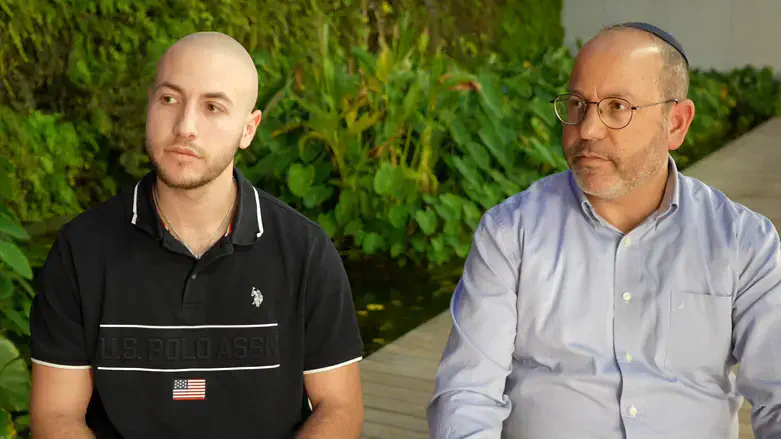
Only after returning from Hamas captivity did Eitan Mor begin to understand what his father had truly endured during the two years he was held in the Gaza Strip.
He knew the positions held by MK Dr. Tzvika Mor and knew that his father was not someone who backed down from his principles. Even when Hamas terrorists tried to convince him that his father did not love him, he did not let their words shake his trust in him.
But there was one thing Eitan did not know: how difficult it had been for his father and mother to hold the family together, bear the longing and continue functioning amid uncertainty that lasted almost two years.
In a special joint interview with Arutz Sheva marking the release of their new book, "Akedah", father and son revisit a period when they lived in entirely different realities. Eitan was trying to survive in captivity, while his father faced longing, uncertainty and public criticism of his positions on the release of the hostages.
Now, as they sit together, it becomes clear that even a father and son who were certain they knew each other well needed to share their stories to understand what the other had endured.
"I didn't know their struggle would be that difficult", Eitan acknowledges as he discusses what he read in the book. He describes learning about disagreements within the family, his father's difficulty in maintaining his public positions while also supporting his wife and children, and the ongoing effort to remain strong when there was no way of knowing what his captive son was experiencing. He says, "My father was truly strong", adding that it was precisely his parents' prolonged struggle with helplessness that brought home to him the extent of their strength.
One detail that gives the family's story a tangible dimension is the chair that remained empty at home. Tzvika says he felt Eitan's absence throughout his captivity, and that the chair bearing his son's photograph reminded him daily of the void left in the family.
Outwardly, however, he tried to project stability and confidence. He did not want the terrorists holding Eitan to see his father breaking down, and he also felt a responsibility toward other families whose sons were fighting on the front lines.
He says, "I was constantly working on myself to project resilience", explaining that this effort was not intended to conceal his pain but to enable him to keep taking action. During the war, he attended meetings with families and reservists' wives and was surprised to hear repeatedly that he was giving strength to people who had sought to support him. Behind his public appearances, he makes clear, the longing and concern for his son remained.
While his father tried to remain resilient at home and in public, Eitan had to find his own ways to cope with captivity. One was learning Arabic, which he says became a vital survival tool: it enabled him to understand conversations around him, pick up information from the news and try to follow IDF movements. In circumstances where he had almost no control over anything, simply being able to understand what was happening around him somewhat eased his sense of helplessness.
Over time, his command of the language improved until he began using his captors' slang and imitating their accent. He told them jokes from television series he knew, managed to make them laugh and even ended up cutting some of the terrorists' hair. He describes all of this as part of a conscious effort to preserve his sanity and deal with the people who held his life in their hands.
Yet Eitan stresses that the conversations and laughter never left him confused about who his captors were. He says he knew that, in the event of a rescue attempt, the terrorists might receive orders to kill him. He says explosives were planted in places where hostages were held, and that he asked his captors himself what they would do if Israeli forces arrived.
Even during moments that seemed humane, he says, the terrorists reminded him of their hatred of Jews. In one instance, he recounts, a terrorist who had just finished a conversation with him suddenly said he wanted to kill a Jew.
Coping with this also required sustained psychological effort. Eitan says he tried to work on his mindset, strengthen himself and sometimes even convince himself that the situation was bearable, even when he was hungry and waking up to harsh conditions. For him, learning a language, understanding new information and finding ways to deal with his captors were ways to keep taking action rather than sink into helplessness.
Alongside practical survival tools, faith also played a significant role in captivity. Eitan says that even before the war, he would recite the Shema and speak to God before going to sleep, although he had chosen to observe only some of the commandments with which he was raised. In captivity, when he did not always have someone with whom he could share what he was going through, he found an outlet for his thoughts in prayer and conversation with God.
But captivity also confronted his faith with questions he could not answer. He says he saw good people murdered and cannot explain why he survived while others, including people who were meticulous in their religious observance, were killed or suffered more than he did. He says, "I have no idea, for example, how I stayed alive", making clear that faith did not erase the difficult questions about suffering and the fate of the people he met.
His relationship with his father was also tested during captivity. Eitan says Hamas terrorists were aware of Tzvika Mor's public positions and tried to use them to hurt him emotionally. They told him his father did not love him, but he rejected their claims.
Tzvika, for his part, says he was certain throughout that his son understood his positions. He says he prayed that his son would have the strength to bear the suffering and hold on until his release, but never doubted that they saw the situation in a similar way.
Asked how he sees his father, Eitan replies simply, "A caring father, a father who looks at the bigger picture, who wants to look after his children's future and my children's future too. And I simply trust him".
Nevertheless, Eitan seeks to distinguish between his criticism of the public campaigns and the people who demonstrated for the hostages' release. He says he is grateful to protesters who acted out of longing and a desire to see the hostages return home, emphasizing, "And I truly thank them". At the same time, he argues that some campaign organizers sought to weaken the government during the war.
In this context, he describes an incident that he says occurred during his interrogation in captivity. He alleges that one of his Hamas interrogators asked him how more people could be brought to demonstrations in Israel. Eitan presents this as evidence that the terrorists followed the protests in Israel and were interested in expanding them, and further claims that the interrogator has since been killed.
Alongside the public issues, the joint book allows father and son to revisit their personal experiences. According to Tzvika, the title "Akedah" was chosen precisely because it is difficult and unsettling. Through it, he seeks to address Israeli parents' willingness to bear the risks involved in defending the country.
The book was compiled from accounts family members shared with the editor, including the experiences of Eitan and his parents, Tzvika and Efrat. Eitan says he has not yet had time to read the entire book, but has already found things he did not know about the struggles at home.
Tzvika, too, discovers abilities in his son's account whose extent he had not fully appreciated. He admires Eitan's ability to use humor, learn Arabic and find a sense of capability amid fear and uncertainty.
At the end of the interview, Eitan is asked about the possibility of his father contributing to the country through politics as well. He expresses support for his entering public life, explaining that, in his view, Tzvika's handling of the period of captivity demonstrated his ability to act under difficult conditions.