
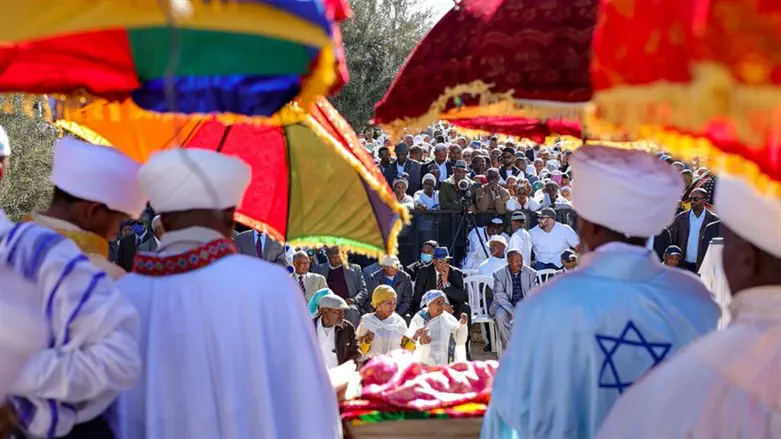
Sigd, which Ethiopian Jews will observe today (Monday), could one day become a holiday celebrated by the wider Jewish public, much like Mimouna and Saharane. Dr. Or Margalit, head of the Department of Jewish and Biblical Studies at the Levinsky-Wingate Academic Center, believes the holiday's distinctive tradition of renewing the covenant offers Israeli society an opportunity to explore what unites its diverse communities, particularly at a time when many are searching for common ground.
Speaking to Arutz Sheva-Israel National News, Margalit emphasizes that he is not a sociologist and does not claim to predict whether Sigd will eventually become a holiday for all Jews. However, he points to precedents showing how the festive traditions of individual communities can gradually become part of broader Israeli culture. This, he says, is what happened with Mimouna and Saharane, which are now celebrated and recognized well beyond the communities in which they originated.
"There is a very significant invitation here in terms of Jewish thought, perspectives and the diversity within Judaism. There is a very powerful contribution here that could be highly relevant to the Jewish people today," Margalit says.
He explains that Sigd's distinctive character lies not only in its customs or in the heritage of Ethiopian Jewry, but also in its central theme: a day dedicated to renewing the covenant.
Margalit believes that the idea of a shared covenant is particularly relevant to Israeli society. Even when deep disagreements exist over what that covenant entails and the obligations it imposes, he sees broader agreement on the need for a common bond among the different parts of the Jewish people. In his view, Sigd offers an opportunity to begin that conversation without first resolving every issue that divides the public.
He says the emphasis on covenant renewal gives Sigd a unique place in the Jewish calendar. "The concept of renewing the covenant does not exist in all the other communities and traditions," he explains.
Although holidays such as Shavuot and Simchat Torah are connected to Torah study and the revelation at Mount Sinai, they are not specifically defined as holidays of covenant renewal. By contrast, the Book of Nehemiah describes a ceremony in which the people renew their covenant with God and undertake practical commitments concerning the maintenance of the Temple and Jerusalem.
In Margalit's view, Ethiopian Jewry's preservation of a special day devoted to this idea makes an important contribution to contemporary Jewish discourse. "Here is one community that made this a special day; it meets a need that exists today," he says.
What about those who fear that embracing the idea of covenant renewal would also mean agreeing on a uniform set of Jewish laws and commandments? Margalit suggests drawing a distinction between the desire to renew the covenant and defining precisely what it entails.
He notes that Ethiopian Jewry developed over generations largely outside the rabbinic tradition, resulting in customs and religious laws that differ in many respects from those of other Jewish communities.
This background, he argues, makes it possible to view covenant renewal as a shared invitation without requiring an immediate resolution of questions of Jewish law.
"The framework of covenant renewal does not necessarily include a definition of what needs to be done, but there is an opportunity here to unite around the very need to renew the covenant," he explains.
Margalit also sees the education system as an important avenue for introducing Sigd to a wider audience. As someone involved in teacher training, he emphasizes the importance of familiarizing students with different traditions and ensuring that every child feels represented in the classroom. Incorporating Sigd into lessons on the Bible, history and Jewish holidays, he says, could enrich the curriculum while strengthening the sense of belonging among students from Ethiopian families.
"When I introduce the study of Sigd to a class learning about the covenant in the Bible, in the context of the holidays or in history lessons, I allow children from Ethiopian immigrant families to feel accepted, while also bringing to the table a subject that is highly relevant to us," he says.
Margalit stresses that teaching about the holiday does not mean expecting the wider public to adopt all its customs. "It does not mean that I require them to fast for half a day because that is part of the day's customary observance," he explains.
Rather, he says, Israelis can learn about Sigd's significance and incorporate the idea of covenant renewal into the country's education system and broader culture without having to decide exactly how everyone should observe the day. He draws a parallel with Mimouna, whose growing popularity has not required the wider public to adopt all the customs associated with it.