
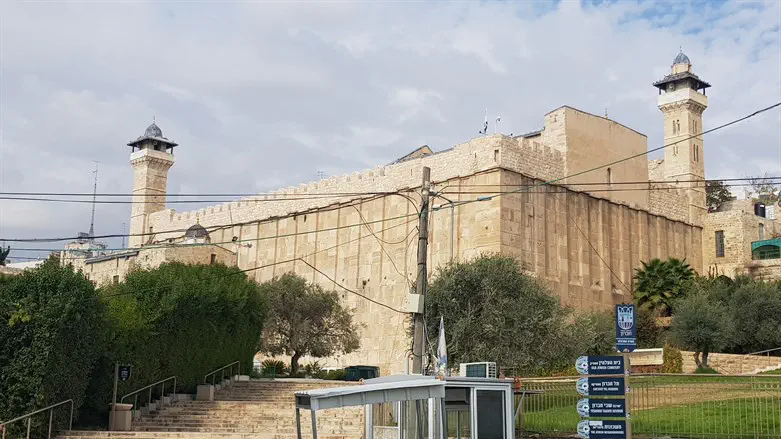
On June 8, 1967, during the Six-Day War, IDF Chief Rabbi Shlomo Goren entered the Cave of Machpelah in Hebron, sounded the shofar and opened a Torah scroll. After 19 years in which Jews had been barred from the site by the Jordanian occupation, he read the passage from this week's Parsha describing Avraham's purchase of the very place where he stood.
Why did he choose the account of a burial plot to mark the Jewish return to one of our holiest sites?
The answer begins much earlier in Avraham's life.
In Parshat Lech Lecha, the Torah tells us that Avraham settled near the oaks of Mamre in Hebron and built an altar to G-d (Genesis 13:18). It was there, near Mamre, that G-d subsequently appeared to him (18:1). And it was in Hebron that Sarah died (23:2).
Avraham did not come to Hebron for the first time to bury his wife. He had already lived and worshipped there. His purchase of the Cave of Machpelah gave permanence to a connection that was already part of his life.
That helps explain the care with which he conducted the transaction. Addressing the sons of Chet, the local Hittite inhabitants, Avraham describes himself as “a stranger and a resident among you" (23:4). Although offered a burial place, he insists on purchasing the field and cave from Ephron for 400 shekels of silver, before witnesses.
Afterward, the Torah declares that Ephron's field “was established" as Avraham's possession (23:17).
Rashi (Rabbi Shlomo Yitzchaki, 1040-1105), citing the Midrash, notes that the Hebrew verb translated as “was established" can also mean “rose up." The field was elevated, he explains, because it passed from Ephron, an ordinary person, into the possession of Avraham, whom the Midrash describes as a king.
The Ibn Ezra (Rabbi Abraham Ibn Ezra, 1089-1167), commenting on Genesis 23:19, explains why the Torah gives such attention to the purchase. The account teaches the special importance of the Land of Israel for both the living and the dead, while demonstrating the fulfillment of G-d's promise to Avraham.
Avraham had made Hebron his home in life. Now Sarah would rest there in death, and the site would remain a permanent family possession. His faith in G-d's promise found expression not only in how he lived, but also in where he chose to bury his beloved wife.
The significance of Hebron for subsequent generations of Jews is illustrated by an episode recorded in the Talmud (Sotah 34b).
When Moses sent the spies to scout the land, Calev separated from his companions and went to Hebron to pray at the graves of the Patriarchs, asking them to intercede so that he would be spared the other spies' evil counsel.
Faced with doubts about entering the Promised Land, Calev sought strength at the resting place of Avraham, Yitzchak and Yaakov, who had trusted in G-d's word.
The city where Avraham had lived and worshipped had become a place where his descendants could draw inspiration to remain faithful to that same promise.
That spiritual bond endured even when Jewish life in Hebron was devastated. Arab rioters murdered 67 Jews in 1929. The small community that returned was evacuated by the British in 1936. Under Jordanian rule from 1948 to 1967, Jews were denied access to the Machpelah.
After Hebron's liberation in 1967, Jewish life began to return. Rabbi Moshe Levinger and other families held a Passover Seder in the city in 1968. Kiryat Arba was established nearby, Jewish families returned to Beit Hadassah in Hebron in 1979, and the Avraham Avinu synagogue was rededicated in 1981.
Today, approximately 1,000 Jews, including yeshiva students, live in Hebron itself, with another 8,000 in Kiryat Arba. Yeshivat Shavei Hevron, established in 1982, has approximately 350 students learning in Beit Romano and another 450 in affiliated institutions nearby.
The transformation of Beit Romano is especially poignant. In 1929, Jewish survivors of the Arab massacre were gathered there before being removed from Hebron. Today, Torah study fills the same building. Where Jews once waited to be forced out, young men now devote their days to learning Torah.
Rabbi Goren's reading of Chayei Sarah was therefore more than a commemoration of a military victory. It recalled that the Jewish bond with Hebron began with Avraham's own life there, was strengthened by his purchase of the Cave of Machpelah, and became a source of faith for generations after him.
And that is the enduring message of this week's Parsha. The inheritance Avraham established in Hebron was never simply a matter of owning a burial plot. It was part of his commitment to the land G-d had promised him, a commitment that his descendants would carry forward.
Hebron is not merely where our forefathers are buried. It is where Avraham lived and worshipped, where Calev sought strength, and where our people have returned to walk in the footsteps of our forefathers.