
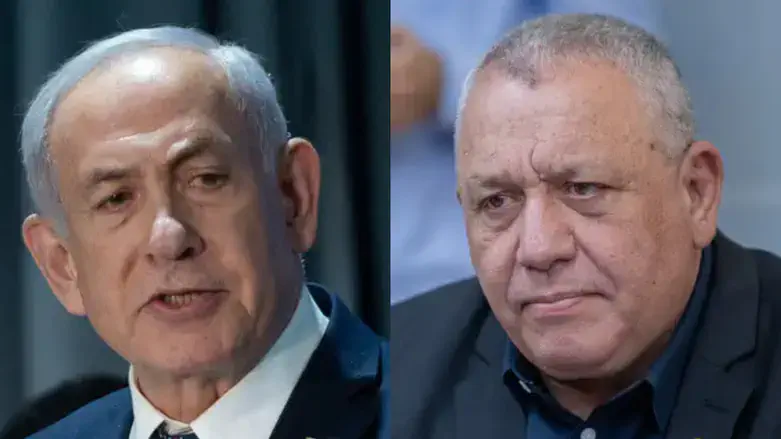
Political strategist Roni Rimon spoke with Arutz Sheva about the political options currently facing Israel's leadership. While he personally hopes for a national unity government, Rimon outlined the other possibilities as well.
Rimon began by observing that when people find themselves in a situation of uncertainty and a certain degree of shock, it is often only after some time has passed that they adjust to the new reality and understand that they must play with the cards they have been dealt, rather than the cards they wish they had. Only once they reach that understanding does a willingness to compromise emerge.
Addressing the available options, Rimon presented two main alternatives for Eisenkot's bloc if its leaders choose to bring about a change in the political landscape rather than show flexibility and pursue compromises.
"One is with the Arab parties, and the other is with the haredi parties. Those are the theoretical cards available to them. They could receive support from the Arab parties on replacing the Knesset Speaker and on the recommendation to the President, but it does not appear that the Arab parties would be part of a government, either through active participation or tacit support."
Rimon believes that on these two issues - the election of the Knesset Speaker and the recommendation to the President - the leaders of the Arab parties would be willing to join forces with Eisenkot even without receiving anything in return, because they regard the very act of bringing down Netanyahu's government as a goal and an integral part of their agenda.
Regarding the possibility of joining forces with the haredi parties, we asked Rimon whether there was any chance that those parties would join a government in which someone like Gilad Kariv would be a significant figure.
In his assessment, this is indeed a problematic issue for the haredi parties, but it is far from the only one. There are numerous other obstacles, including reaching an agreement on military conscription that would be acceptable to the haredim, as well as the fact that they have traditionally been part of Netanyahu's bloc.
"However," Rimon added, "I have spoken extensively with haredim in recent years. There is a theory among them that the very same proposals, when put forward by the right-wing bloc, encounter opposition from the Supreme Court and other bodies, but are received favorably when they come from the camp opposed to Netanyahu. Suddenly, the law enforcement system and the Supreme Court become more flexible, and so do left-wing Knesset members."
In Rimon's view, the chances of the haredi parties joining Eisenkot are virtually nonexistent. Nevertheless, at this stage, the day after the elections, he believes that even this possibility should be placed on the table and discussed.
Turning to the possibility of a national unity government, we asked whether Eisenkot, Bennett, and Liberman - all three of them, or perhaps two of them - could overcome their personal animosity toward Netanyahu and the explicit promises they made to their voters not to serve in a Netanyahu-led government.
"Politicians, and not only politicians, are people who know how to play the cards they have been dealt. They received weaker cards than they had hoped for. You don't need the entire bloc to join a unity government. It could be just two of them," Rimon said.
He added that, given their previous promises, it is indeed difficult to imagine any of them going back on their word and moving toward a unity government.
Nevertheless, he believes that once the President assigns one of the two leaders the task of forming the next government, the leaders will undergo a process, including a psychological one, as the days of negotiations pass, and circumstances will change.
"Things that might happen won't happen on the first day, but perhaps on the last day."
Rimon also raised the possibility that the American President, who very much wants a unity government, could invite Eisenkot and Netanyahu to meet with him, reveal sensitive information to Eisenkot that is best kept confidential, and thereby encourage him to join the government in light of the challenges Israel is expected to face in the near future.
Rimon also suggested that Eisenkot might agree to enter a government with Netanyahu if Smotrich and Ben Gvir were excluded, which would also make such a move easier for him.
Another round of elections would seemingly be the easiest option, Rimon said, but nobody wants that.
The possibility of another election is generally regarded in political circles as less desirable for Eisenkot's bloc, which would have difficulty reproducing the wave of voters who turned out to support it, as well as the mobilization of Arab voters.
Rimon, however, questions that assumption.
He acknowledged that it is indeed difficult to encourage someone to repeat, after only a short period, a major effort that they made almost as a one-time undertaking, particularly when nobody can guarantee them a better outcome.
However, Rimon argued that Likud would also struggle to recreate its efforts to mobilize voters and bring them to the polls.
Likud voters turned out both in response to Eisenkot's campaign and as a result of the intensive efforts of Likud activists, who went door to door to encourage people to vote. Repeating that operation would be difficult.
"Another election could also hurt Likud, because Likud voters tend to turn out at lower rates," Rimon said.
"The party that will be more interested in avoiding another round will actually be Likud, because, relative to the cards it had in its hand, it achieved a good result. It could be that Eisenkot's bloc actually has a greater interest in going to a second round."