
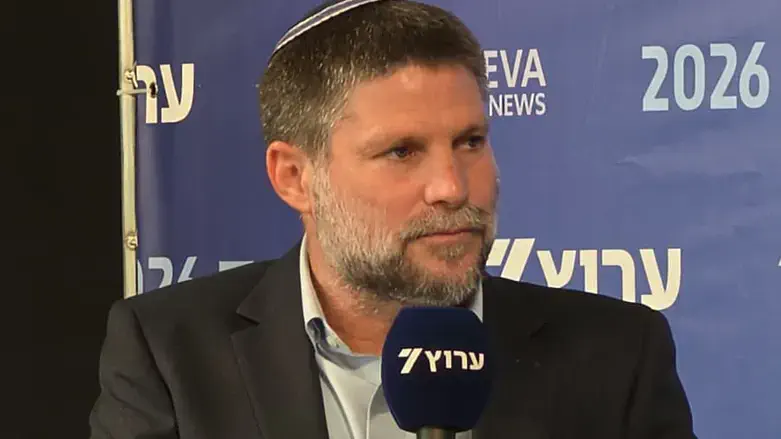
Finance Minister Bezalel Smotrich, who heads the Religious Zionist Party, revealed that the haredi parties' representatives had agreed to a Draft Law that included sanctions - but he wanted them to vote for it instead of abstain.
In an interview with Arutz Sheva - Israel National News, Smotrich also expressed his concern about wasted votes in the right-wing bloc, criticizing Ofer Winter's decision to run independently and arguing that polling did not give his Amcha Yisrael party a reliable chance of crossing the electoral threshold.
Noting that Winter's party failed to cross the threshold in seven of nine polls conducted over the weekend, he asked: "I have nine bottles here on the table. Two contain juice, seven contain poison. Would you take that risk? Who would take that risk?"
In his opinion, such an electoral gamble could cost the national camp its majority and result in a government pursuing policies contrary to his positions on security, settlement, the judicial system, and Israel's Jewish identity.
Responding to a recent statement by Rabbi Eli Sadan, head of the Bnei David institutions in Eli, in which Rabbi Sadan left open the possibility of voting for Winter, Smotrich said, "I have tremendous respect for Rabbi Eli, and this is very painful for me."
Though Smotrich acknowledged criticism within the Religious Zionist community toward the government, particularly frustration over the issue of drafting haredi men, he insisted that this did not justify risking the loss of votes.
"I can understand the criticism, and I can understand the pain. The draft issue is painful, and the haredi issue is painful. We are not perfect," he admitted.
However, he emphasized that even if Winter entered the Knesset with four seats, the resulting government would still be headed by Netanyahu and include the haredi parties, and therefore there is no justification for risking votes in the process.
"We offered Ofer the chance to run with me. We offered Ofer the chance to run with Likud. We offered Ofer the chance to run half-and-half, half with us and half with Likud, and split off the day after the elections," he said. "This is someone sitting in his cabin, drilling a hole in his cabin in the ship and sinking the entire ship," he said.
He added that even if Winter ultimately crossed the electoral threshold, that would not make the decision to run independently responsible, because the risk existed when the decision was made.
Smotrich also compared the situation to the 1992 elections, when, according to his account, votes lost to right-wing parties that failed to cross the electoral threshold helped bring Yitzhak Rabin to power, leading to the signing of the Oslo Accords in 1993. This, he warned, is an example of the long-term consequences of political fragmentation on the right and warned members of smaller parties that they could bear responsibility for a similar outcome.
"I'm really pleading with them: Take responsibility," Smotrich said, criticizing as well the Noam party, which he said had no realistic prospect of crossing the electoral threshold.
When asked about voters who believe their party might enter the Knesset through a miracle, Smotrich joked that if they were relying on a miracle anyway, they would be better off voting for another party and praying that their ballot changed inside the ballot box. However, he immediately clarified that he viewed the matter as a serious issue concerning the country's future.
One of the issues on which Smotrich faced criticism from his own voters was the issue of drafting of haredi men into the IDF.
Arutz Sheva noted the frustration of Religious Zionist families, some of whose members served hundreds of days in the reserves during the war, while young haredi men continued to receive exemptions from military service.
Smotrich replied that he understood the pain personally, recalling that both his sons enlisted in combat units during the war, one of whom was seriously wounded and remains in rehabilitation. He also noted that he lost a cousin in the fighting.
"The pain is enormous," he said, adding that pain alone cannot replace a practical plan of action.
According to Smotrich, changing enlistment patterns in haredi society requires long-term efforts involving social change, the creation of suitable military service tracks, and the development of frameworks enabling young haredi men to join the military and subsequently enter the workforce.
Smotrich then said haredi representatives had agreed to a framework that would establish a target of enlisting half of each annual cohort within five years, alongside financial sanctions if the targets were not met.
"They agreed, of course they agreed," he replied when asked whether the framework included financial sanctions. Under the proposed agreement, if enlistment rates failed to reach 95% of the established target, benefits related to municipal property taxes, daycare, housing, and public transportation would be withdrawn.
Smotrich emphasized that, in his view, quiet acceptance of the framework by the haredi parties was insufficient. He wanted them to openly support the legislation, and insisted that their representatives enter the Knesset plenum and vote for the law themselves, rather than allowing other parties to pass it on their behalf.
"I said, there's no such thing. They vote in favor, and they give it legitimacy," he explained, noting that such a vote would also have significance within haredi society by legitimizing military service for young haredi men who are not studying Torah.
Smotrich also noted that integrating haredi men into the military requires a broader support system beyond enlistment tracks themselves. Such a system would require preparatory programs, military service frameworks, and community solutions for soldiers' families, including housing, educational institutions, and youth movements.
According to Smotrich, the goal is to create a pathway allowing haredi recruits to maintain their way of life while undertaking meaningful military service.
"We are determined to bring about change, and that change will come through a process, because we need to change sociology and ideology here, and that doesn't happen overnight," he said, promising to pursue the issue using the same working methods that, according to him, had produced changes in Judea and Samaria's Jewish communities.
Later in the interview, Smotrich addressed tensions within the nationalist camp, particularly the election campaign being conducted by National Security Minister Itamar Ben Gvir, who heads Otzma Yehudit.
Rejecting suggestions that Netanyahu intended to exclude Ben Gvir from the next coalition in favor of a partnership with Gadi Eisenkot, he noted that the Prime Minister had declared his commitment to the current coalition parties.
Nevertheless, Smotrich criticized Ben Gvir's campaign strategy.
"What is Itamar doing? His entire campaign is about how he can take another seat from the Prime Minister, from Likud, or another half-seat from us," he said. "What will save the State of Israel is not the transfer of half a seat from one party to another within the nationalist camp."
Smotrich also said he had attempted before the elections to promote the broadest possible merger of parties to the right of Likud, partly to avoid internal political battles.
He pointed to his alliance with Zehut leader Moshe Feiglin as an example of his willingness to compromise despite disagreements and said he had also wanted to cooperate with Ben Gvir.
Asked about the possibility of forming a national unity government after the elections, Smotrich said he did not rule out expanding the coalition but insisted that the national camp first secure a clear majority.
"Anyone who wants a broad government must bring about a victory for the national camp," he said, warning that the opposition parties are unwilling to sit in a government with Netanyahu and would therefore prefer to establish a government relying on Arab parties if the right failed to secure a majority.
He also criticized Eisenkot, Naftali Bennett, and Avigdor Liberman, arguing that their statements about the composition of the next government did not guarantee that they would avoid relying on Arab parties, and cited the previous government as an example of political cooperation he strongly opposed.
Toward the end of the interview, Smotrich returned to the central message he wanted to convey to right-wing voters: Tuesday's election will determine not merely the distribution of power among parties but whether the next government could continue the current administration's security, economic, and settlement policies.
Concluding the interview, he urged, "Go out and vote, and don't vote for anyone who isn't 100% certain to cross the electoral threshold."
"Anyone who votes for a party that fails to cross the threshold will have on their conscience, for years to come, the great disasters that could, G-d forbid, befall us."