
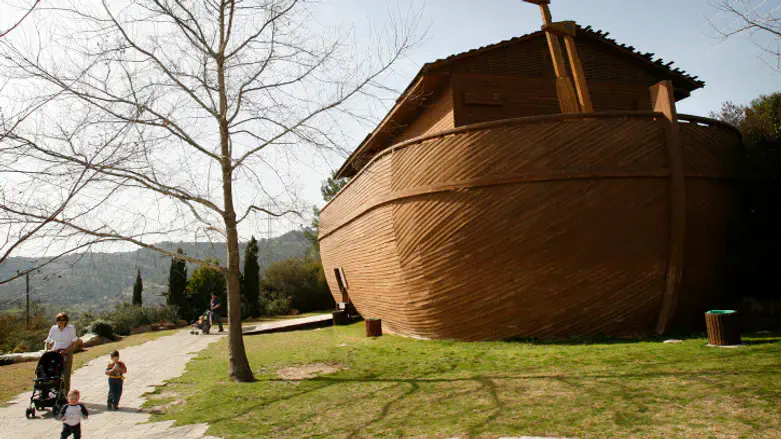
The year was 1536 from Creation (2584 B.C.E.), Noach was 480 years old, humanity was in its tenth generation, and “Hashem saw that Man’s evil on the earth was great, and all he thought about was evil all day; so Hashem regretted having made Man in the world, even though this saddened Him" (Genesis 6:5-6).
Despite His sadness, G-d decreed that the world would be destroyed by a flood. Only Noach and his immediate family would survive, to repopulate the earth. Why Noach? Because “Noach found favour in Hashem’s eyes" (v. 8).
With these words we concluded Parashat Bereishit last week.
I note, briefly and as an aside, that these final words in Parashat Bereishit already allude to how Noach would save humanity from complete annihilation 120 years hence:
וְנֹחַ מָצָא חֵן בְּעֵינֵי ה'
“Noach found favour in Hashem’s eyes".
The final four words are מָצָא חֵן בְּעֵינֵי ה', and the final letters of these four words are אֳנִיָּה, meaning “boat" - an allusion to the Ark.
What sealed humanity’s fate of destruction was that “the earth was corrupted before G-d, and the earth was filled with hamas" (v.11).
There are different opinions of what the Hebrew word חָמָס, hamas, means:
According to Rashi and Mizrachi it denotes robbery - not ordinary theft, which might be done in secret, but specifically brazen and violent robbery committed openly.
According to the Ibn Ezra it denotes a combination of violent robbery, oppression, exploitation, and violent rape of women.
According to the Ohr ha-Chayim it is an all-encompassing term for general evil, including violent robbery, sexual immorality, murder, and idolatry.
According to Rabbi Shimshon Raphael Hirsch it denotes injustices which individually are too petty and minor to be brought before human courts, and which are therefore impossible for the victims to be compensated for, but which cumulatively destroy human society.
G-d introduced His reason for the impending destruction with the words:
לֹא־יָדוֹן רוּחִי בָֽאָדָם לְעֹלָם, בְּשַׁגַּם הוּא בָשָׂר; וְהָיוּ יָמָיו מֵאָה וְעֶשְׂרִים שָׁנָֽה:
“My spirit will not abide in Man forever, since he is no more than mortal flesh; and his days will be a hundred and twenty years" (Genesis 6:3).
However this translation (which is the standard translation) is inadequate. The Hebrew word יָדוֹן, which is usually translated “abide", really connotes “judge"; hence “My spirit will not judge Man forever, since he is no more than mortal flesh" might be a better rendering.
Or more freely and idiomatically, “My spirit will not judge Man too harshly, since he is no more than mortal flesh".
The Midrash offers several insights:
Rabbi Yishmael son of Rabbi Yossi, a fifth-generation (late 2nd century) Tanna, interpreted it to mean: “I will not put My spirit into them when I will give the righteous their reward in the future time to come" (Bereishit Rabbah 26:6).
This refers to the statement in the Mishnah that “the generation of the Flood have no share in the World to Come" (Sanhedrin 10:3). According to Rabbi Yishmael, the generation of the Flood were so irretrievably evil that they were wiped out in this world, and not one of them will be resurrected in the future time to come.
A generation before Rabbi Yishmael, the Tanna Rabbi Elazar son of Shammu’a offered another, maybe starker, insight: “Wherever there is no judgment, there is judgement" (Bereishit Rabbah 26:6); the Mattanot Kehunah (commentary to the Midrash written by Rabbi Yissachar Berman ben Naftali, Poland, 16th century) explains: “Wherever there is no judgment in this lower world, there is judgement in the Upper World". If humans don’t enforce justice on human society, then G-d will enforce His justice.
And confirming this, the Midrash continues by citing the otherwise unknown Rav Bibi son of Rabbi Ami, who followed Rabbi Elazar’s interpretation: “If they do not judge, then My Spirit will judge them" (again following the Mattanot Kehunah).
And then the Midrash cites the greatest of them all, Rabbi Akiva, who applied to the generation of the Flood the verse from the Psalms, “Why does the evil man blaspheme against G-d, saying in his heart, You will not judge?" (Psalms 10:13).
The generation of the Flood, said Rabbi Akiva, proclaimed that לֵית דִּין וְלֵית דַּיָּן, “there is no justice and there is no judge". But, he continued, אִית דִּין וְאִית דַּיָּן, “there is justice and there is a Judge".
It is striking that that first person who ever claimed that לֵית דִּין וְלֵית דַּיָּן, “there is no justice and there is no judge" was Cain:
The Torah tells us very tersely that “Cain spoke to Abel his brother; and when they were in the field, Cain arose over Abel his brother and killed him" (Genesis 4:8). The Targum Yonatan reveals more of the episode:
“Cain said to his brother Abel, ‘Come, let’s both of us go out into the field’. When they had both gone out into the field, Cain spoke and said to Abel: ‘I observe that the world was created through mercy, but that it is not governed by the fruits of good deeds, and that there is favouritism in judgment. Why was your offering accepted, while mine was not accepted favourably?!"
“Abel answered Cain: ‘The world was indeed created through mercy, and it is indeed governed by the fruits of good deeds, and there is no favouritism in judgment. Because the fruits of my deeds were better than yours and preceded yours, my offering was accepted favourably’.
“Cain answered Abel: ‘לֵית דִּין וְלֵית דַּיָּן, there is no judgment and no Judge, no World to Come, no good reward for the righteous, and no punishment of the wicked’.
“Abel answered: ‘There is indeed judgment and there is indeed a Judge; there is a World to Come, there is good reward for the righteous, and there is punishment for the wicked’.
“They disputed these issues in the field, until Cain rose against his brother Abel, drove a stone into his forehead, and killed him" (Targum Yonatan, Genesis 4:8).
Cain becomes the first human being to articulate the denial of divine judgment: לֵית דִּין וְלֵית דַּיָּן, “there is no judgment and no Judge, there is no judgment and no Judge, no World to Come, no good reward for the righteous, and no punishment of the wicked" - and the consequence is the first murder in human history.
The generation of the Flood, who similarly believed that לֵית דִּין וְלֵית דַּיָּן, there is no judgment and no Judge, had no restraints on their basest animal instincts, and human society degenerated to such a low level that G-d Himself and no recourse other than global deluge to wipe humanity out and begin again with Noach and his family, the only righteous people who remained.
The beginning of the Torah, the very foundation of Judaism, is that G-d created all existence. He created life. He created Man in His own image, inherently knowing good and evil, right and wrong.
The Torah teaches us respect for life - all life, human life above all. Without G-d, there is no objective morality, no absolute truth, no justice and no Judge, no reward for the righteous and no punishment for the evil.
An almost-contemporary Gedol ha-Dor, Rabbi Meir Kahane Hy"d (USA and Israel, 1932-1991), noted the contrast between “yesterday’s idolatry, which at least accepted the authority of a higher power in spite of its false beliefs", and “today’s…human culture, which in practice denies all higher power, and who have crowned themselves and their own wisdom as sovereign".
And, he concludes, “those who deny any and all higher powers are incomparably more dangerous than the idolaters" (Ohr ha-Ra’ayon, page 43, chapter 5, “Accepting the Yoke of Heaven").
Some 800 years ago, the Rambam argued similarly:
“No one who worshipped idols ever believed that there was no other god; they never ever imagined, and never will imagine, that the statue that they fashioned from metal or stone or wood was what had created the Heavens and the earth, or that it is this statue that rules them. Rather, even though they worship it, it is merely an intermediary between them and the true G-d…
“No Torah-authority disputes this. Those idolaters believed in the reality of the Creator, however much this belief was distorted into heresy…because it is fitting to worship G-d alone…
“[And one] who doesn’t believe in His existence at all…or who ascribes some deficiency to Him, is indisputably worse than an outright idolater, for whom the idol is an intermediary or intercessor between him and G-d in his understanding" (Guide for the Perplexed 1:36).
The Torah teaches us respect for G-d and for His Creation; above all respect for the life which only G-d can create.
History has shown us - and continues to show us, with devastating clarity - that when society denies G-d, any god, even false gods, then hatred and destruction become inevitable.
The most famous - well, notorious really - proponent of atheism in modern philosophy was the German philosopher Friedrich Nietzsche (1844-1900), who famously proclaimed that “G-d is dead". And it was a natural progression from that for him to posit that “the weak and ill-constituted must perish; this is the first principle of our love for humanity. And moreover - we must help them to do so" (Der Antichrist, § 2).
Such contempt and disdain for life, self-righteously posturing as “love for humanity", is an inevitable consequence of denying G-d.
A century ago, on the seventh day of Pesach 5686 (5th April 1926), Rabbi Joseph Hertz (Chief Rabbi of Britain and the British Empire 1913-1946) delivered a sermon in the Bayswater Synagogue:
“It was the nineteenth century which discovered that we came from the beast; and ever since that discovery, many of the literary and artistic leaders of the century, and a portion of its directing classes, took it upon themselves to convince us that it was only natural for us to return to the beast. A new and powerful Paganism began its assault against the ancient organised Morality. It dethroned G-d in the sphere of human conduct; derided all moral inhibitions; and declared instinct and inclination to be the truest guides to human happiness.
“The twentieth century is continuing the instruction begun in the nineteenth.
“A new ethic has arisen, as subversive as it is godless, which bids each man, woman, or child to do that which seems right his or her eyes. It teaches that all moral laws are man-made, and that all can therefore be unmade by man.
“There is, in consequence on all sides a questioning of the sacredness of human life, a scoffing at the holiness of purity, and angry repudiation of the idea of property" (quoted in Affirmations of Judaism, London 1927, page 27).
It is chilling to see how global human history bore out the brutal truth of Rabbi Hertz’s tocsin within just a few short years. The global catastrophe of Nazism and Communism, two powerful ideologies which denied G-d entirely.
When there is no G-d, the inevitable consequence is evil. Societies which believe that there is no judgment and no Judge, no World to Come, no good reward for the righteous, and no punishment of the wicked, can be redeemed only by destruction.
Parashat Noach, and all subsequent human history, bears this out with devastating clarity.