
Yitzchak Freeman is a former school principal from Britain who made Aliya with his family in 2022. A musmach of Yeshivas Ohr Somayach, he lives in Ramat Beit Shemesh. He supports and plans to vote for Hatzibbur HaCharedi in the coming election.
There is something deeply wrong with the way Israel is now dealing with the Haredi draft crisis.
It is wrong that young men who deliberately evade a lawful military obligation should be treated as heroes, “prisoners of Torah," and welcomed home with celebrations, financial gifts, and children carrying signs celebrating their supposed “sin" of preserving Judaism by their community.
But it is also wrong to imagine that putting young haredi men in military prison is, by itself, a solution.
Indeed, I fear that the present policy is achieving precisely the opposite of what its proponents claim to want. It is hardening attitudes, deepening the divide between haredim and the rest of Israeli society, strengthening the most extreme voices within the haredi world and turning a difficult question of national responsibility into a battle over Jewish identity itself.
Israel needs a fundamental reset.
The legal position is actually rather straightforward. In 2024, the Supreme Court ruled unanimously that, in the absence of a valid statutory exemption, the government could not simply decide that the Defence Service Law would not apply to yeshiva students. In April this year, the Court went further, ordering the government to take meaningful enforcement measures against draft evasion. In September, it struck down legislation that would have prevented the arrest and investigation of qualifying haredi draft evaders.
That is the law. It cannot simply be wished away.
There is also a compelling argument behind it. Israel is fighting a prolonged existential war. Reservists have served repeated tours. The IDF has itself warned of serious manpower shortages. It is hardly surprising that a soldier who has spent hundreds of days in uniform, while his children have spent long periods without their father, finds it difficult to understand why another young Israeli man should be entitled to opt out altogether.
The frustration is not confined to the political left. Polling by the Israel Democracy Institute has repeatedly found very broad support among non-haredi Israelis for some form of haredi enlistment or meaningful sanctions against those who evade service.
So there is a real problem here. It should not be denied or minimised.
But there is another question, which is increasingly being ignored: does the way we are enforcing the law actually make Israel stronger?
I am not convinced that it does.
The arrest of a draft evader is one thing. Turning him into a folk hero is another. And this is exactly what is happening.
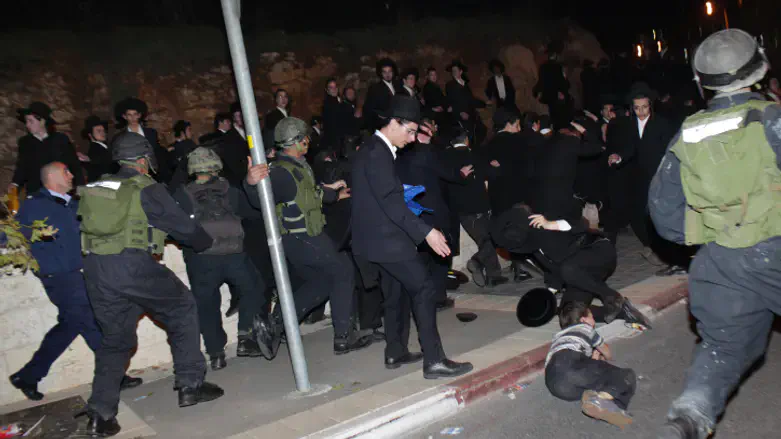
We have now seen processions welcoming hundreds of released haredi "prisoners", rallies in which they are publicly celebrated, and gifts funded by donors abroad. We have seen the language of imprisonment for law-breaking transformed into the language of martyrdom. We have seen men who knowingly defied a military order portrayed not merely as innocent victims but as heroes who have suffered for the sake of Torah.
This is not an argument for abandoning enforcement. It is an argument for recognising the consequences of the particular kind of enforcement we have chosen.
If the purpose of enforcement is to increase enlistment and strengthen Israel's capacity to defend itself, then an enforcement policy which turns a few hundred young men into celebrated martyrs may be remarkably inefficient.
Worse, it risks producing precisely the opposite political and cultural effect. A young haredi man who might otherwise have considered some form of national service can now be told that the State of Israel imprisoned him because he chose Torah over the army. His community then welcomes him home as a hero. The arrest has not brought him closer to Israeli society. It has provided him with a powerful reason to retreat further from it.
There is an uncomfortable truth here which both sides need to face.
The Haredi leadership cannot simultaneously insist that every young man who avoids military service is engaged in indispensable, full-time Torah study and then celebrate men who apparently have sufficient time and inclination to travel abroad for extended recreational and religious pilgrimages.
To be clear, travelling to Uman is not, in itself, proof that a man is not a serious Torah learner. Jewish religious life has always included holidays, travel and pilgrimage, and even the current legislative definition of a yeshiva student expressly makes provision for recognised vacation periods.
But the spectacle of draft evaders being arrested while attempting to leave the country for the annual Rosh Hashanah pilgrimage to Uman inevitably raises a reasonable question.
What exactly do we mean when we say that a particular individual cannot possibly contribute several months or years of national service because “Torah is his vocation"?
If Torah study is genuinely his vocation, then let us treat that claim seriously. Identify the genuinely exceptional or genuinely dedicated Torah students. Establish transparent criteria. Require genuine full-time study. Verify attendance. Distinguish between the outstanding minority for whom Torah study really is an all-consuming vocation and the much larger number for whom it is simply the preferred way of avoiding military service.
The haredi world should not be afraid of that distinction. On the contrary, it would restore dignity to the very concept of Torato Omanuto.
Nor should the rest of Israeli society be afraid of it.
There is a perfectly respectable position which says that the Jewish state should protect a small cadre of truly full-time Torah scholars from military service. There is an equally respectable position which says that, in the extraordinary circumstances in which Israel finds itself, even that exemption should be reconsidered.
What is much harder to defend is a system in which “Torah study" becomes a blanket category covering tens of thousands of young men, many of whom are not steadfast learners, while those who evade the law are publicly celebrated for doing so.
And that brings us to the other side of the equation.
The current campaign of arrests and imprisonment is not morally neutral simply because the underlying obligation is lawful.
A state has to think about the consequences of how it exercises coercive power. Israel is not merely administering a parking fine. It is dealing with a community whose relationship with the State and the army is extraordinarily complicated, and in which many genuinely believe that military service poses a profound spiritual threat.
That belief may be mistaken. It may also be based partly on decades of communal isolation and fear. But it is real.
The IDF has made considerable efforts in recent years to create haredi frameworks that accommodate religious requirements, including dedicated units and new service arrangements. Those efforts should be expanded, improved, and communicated far more effectively. The objective should be to make meaningful service possible without demanding that a haredi soldier cease being haredi.The IDF claims it is doing just that.
The army should also be extremely careful about humiliation, unnecessary confrontation and collective punishment.
And the government must stop playing games with the law.
The saga of legislation designed to suspend arrests, followed by judicial intervention, followed by renewed enforcement, followed by apparent reluctance to enforce, has created an almost perfect recipe for contempt on all sides. The Supreme Court has insisted that the law must be enforced. Haredi politicians have tried to prevent enforcement. The government has oscillated between the two. And the public is left watching the entire machinery of government grind itself into dysfunction.
Most recently, reports that the IDF and police have halted proactive arrests because of the scale of haredi protests illustrate the absurdity into which we have descended. If the law is to be enforced, it should be enforced consistently, proportionately and transparently. If the government believes that the law is wrong, it should change the law through the Knesset. What cannot work is a system in which everyone understands that the law exists but nobody knows whether, when or against whom it will actually be applied.
There is a way out.
It begins with both sides giving up something.
The haredi leadership should stop pretending that blanket exemption for virtually every young haredi man is a sustainable long-term position. It should explicitly acknowledge that the defence of the Jewish people is a legitimate Jewish value, that those who genuinely do not learn full-time cannot simply declare themselves Torah scholars, and that national service of some kind must become normal for the great majority of haredi young men.
The secular and religious Zionist leadership, for its part, should stop pretending that coercion is a substitute for strategy. The objective should not be to punish haredim. It should be to increase their contribution to the country while preserving what can legitimately be preserved of their religious way of life.
And perhaps most importantly, both sides should stop treating the other as an enemy.
The haredi community is not a foreign population living in Israel. It is part of the Jewish people and part of the Israeli people. The young haredi man is not the enemy of the reservist who is angry that he has served hundreds of days. Equally, the reservist is not the enemy of the yeshiva student who genuinely believes that Torah learning is his contribution to the Jewish people.
The present system encourages both to see the other as a moral outrage.
That is unsustainable.
There is an irony here that should not be lost on anyone.
The demonstrations, the arrests, the prison celebrations, the Supreme Court petitions, the political manoeuvring and the increasingly poisonous rhetoric are all taking place in the name of preserving the Jewish character and security of the State of Israel.
Yet they are steadily corroding something that is at least as important: the sense that we are one society with a shared stake in the country's future.
The haredi draft crisis will not be solved by pretending that the law does not apply.
Nor will it be solved by filling military prisons with young men and congratulating ourselves that justice has been done.
It will be solved when we distinguish between genuine Torah scholarship and mass avoidance of civic responsibility, between legitimate religious accommodation and political privilege, and between enforcing the law and deliberately humiliating those who have broken it.
Above all, it will be solved when both sides understand that the goal is not to defeat the haredim, or to defeat the secular, or to defeat the Supreme Court.
The goal is to rebuild a society in which people who disagree profoundly about Torah, army service and the nature of the Jewish state can nevertheless recognise that they belong to the same country.
That requires law.
It requires responsibility.
And, above all, it requires a reset.