
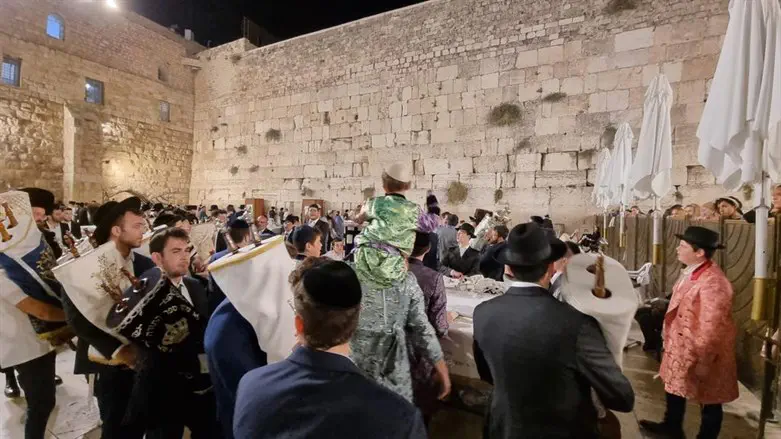
For the past three years, it has become difficult to hear the words Simchat Torah without also hearing October 7.
On the very day devoted to rejoicing with the Torah, Jews were murdered while celebrating the holiday. Synagogues that should have been preparing for hakafot were thrown into chaos. Families who had gone to sleep on a festival night awoke to a nightmare.
And yet this year, once again, we will take the Torah scrolls out of the Ark and dance.
How?
The answer may lie in the hakafot themselves of Simchat Torah.
We do not mark the day primarily by sitting and studying Torah, as we do on Shavuot night. We take the Sefer Torah in our arms and dance with it.
And the hakafot themselves are circular. We go around and around, returning each time to the point from which we began.
Rabbi Meir Shapiro of Lublin saw in that circle an image of Jewish history. For thousands of years, the Jewish people carried the Torah from country to country, through exile after exile, until returning with it to the place from which the journey began - Eretz Yisrael.
But there is another quality to a circle. It has no final point. One person may leave it, but the dance itself continues.
During the Holocaust, in the Częstochowa labor camp, a Jewish shoemaker managed to smuggle a small Sefer Torah out of a Nazi storehouse where confiscated religious objects had been gathered. He wrapped it around his body and carried it into the camp at enormous personal risk.
The prisoners hid it beneath a wooden bunk.
When Simchat Torah arrived, they desperately wanted to dance with it, but taking it from its hiding place might have led to its discovery and destruction. So they moved the wooden board just enough to expose part of the parchment.
Then the hakafot began.
One after another, the prisoners circled the bunk. When each man reached the opening, he bent down and kissed the Torah.
They could not carry the Sefer Torah around the room. Instead, they circled around it.
One survivor recalled that in their minds they could hear the familiar melody: “Sisu v’simchu b’Simchat Torah, ki hi lanu oz v’orah" - rejoice in the Torah, for it is our strength and our light.
The Sefer Torah survived the war and was eventually brought to Eretz Yisrael.
There is another extraordinary story about a dance that did not end.
Years later, an Israeli Air Force pilot named Gidi Katz visited the Stutthof concentration camp. Standing near the crematorium with a small book of Tehillim in his hand, he suddenly felt an urge to dance. He began singing Sisu v’simchu b’Simchat Torah.
He called his grandmother, a Holocaust survivor, and told her where he was.
After a long silence, she told him something she had never told him before.
She herself had been imprisoned at Stutthof. As a young girl, she had watched her father and nine other Jewish prisoners working near the crematorium. One evening, after the stars appeared, her father suddenly called out: “Jews, today is Simchat Torah. We have to dance with the holy Torah."
The exhausted prisoners formed a circle and began singing Sisu v’simchu.
The Nazis shot them.
It was the last time she saw her father.
Then she told her grandson that he bore that man's name - Gideon - and that, without knowing it, he appeared to have danced on the same ground where his great-grandfather had danced decades earlier.
“You are continuing your grandfather's dance," she told him.
There is something in that story that goes to the heart of Simchat Torah. We do not dance because suffering has disappeared. Sometimes we dance in defiance precisely because it has not.
Three years ago, on Simchat Torah, Jewish dances were violently interrupted by the savages of Hamas. Some of those who danced before October 7 will never dance with us again.
This year, when we take the Torah in our arms, we will remember them.
And then we will do something more.
We will take their place in the circle and continue the dance they were not permitted to finish.