
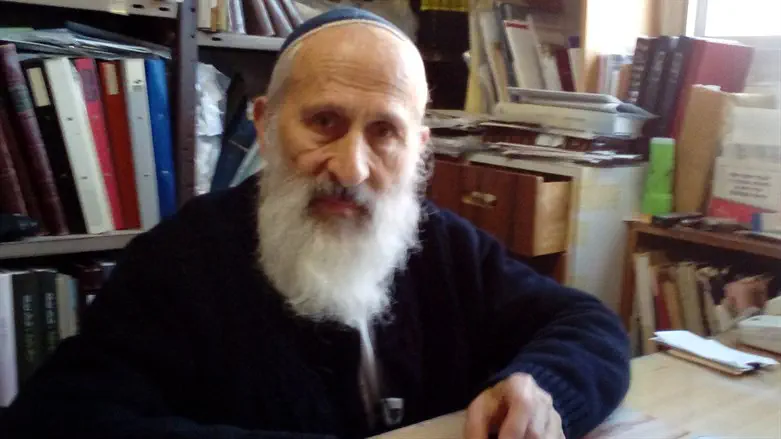
HaRav Shlomo Aviner is head of Yeshivat Ateret Yerushalayim.
The verse, “And you shall only rejoice" (Devarim 16:15) teaches us that we should include the last day of Sukkot - Shemini Atzeret - in the mitzvah of rejoicing, as on the other days of the Sukkot. This idea presents a difficulty because it is known that the word “only" always connotes exclusion, not inclusion. The Vilna Gaon resolved the matter by explaining that the word “only" refers here to the idea that on Shemini Atzeret there is no special mitzva other than to rejoice - i.e., all other mitzvot are excluded except for that of rejoicing.
Our Sages provided us with a parable to help us understand the essence of Shemini Atzeret: A king holds a big festive banquet and invites everyone. At the end of the meal, he requests his closest friends to remain another day in order to have an intimate, private banquet. To a certain extent, the festival of Sukkot belongs to all the nations, as we see in the haftarah of the first day of Sukkot where it is mentioned that God will punish those nations who don’t come to celebrate Sukkot at the End of Days. In addition, the seventy oxen offerings of the festival correspond to the seventy nations of the world.
Then, after seven days with all the nations, God requests Am Yisrael to dine alone with him. On Shemini Atzeret, Am Yisrael’s own unique character finds expression.
According to Rabbi Saadia Gaon, “Our nation is not a nation without its Torah." The Torah is the deepest possible expression of the essence of Am Yisrael ’s soul. Does Am Yisrael precede the Torah or does the Torah precede Am Yisrael? We may ask: Is the basic nature of Am Yisrael determined by the observance of Torah and mitzvot, or is the reverse true - that the very essence of Am Yisrael precedes the Torah and that it is this essence which requires that we observe Torah and mitzvot?
The answer can be found in our Sages’ formulation of the blessing over the Torah, “who has chosen us from all the nations and given us His Torah." First Am Yisrael is mentioned. The uniqueness of Am Yisrael - which is in itself the result of Divine creation and chosenness - is the reason that we were elected to receive the Torah. As our Sages recount, God offered the Torah to all the nations of the world, but Am Yisrael was the only nation who agreed to receive it. According to Maharal of Prague, this midrash expresses the idea that the Torah is incompatible with the character of all the other nations.
Eliyahu Hanavi tells us of a man who had a dilemma: He cherished two things - the Torah and Am Yisrael - and he didn’t know which one should take precedence. Eliyahu told him, “Most people say that the Torah is first, but I’ll tell you the truth. Am Yisrael is first." The Torah is the instrument through which the Divine nature of the soul of Am Yisrael can express itself. However, this nature is not always apparent to all; it may be concealed by our failure to observe Torah and mitzvot. Nevertheless, it is eternal - as everything Divine is eternal - as it says in Shmuel I, 15:29: “The Eternal God of Israel will neither lie nor change His mind." This means that all Jews are inextricably connected to their Divine Source, however unaware of it they may be.
As the prophet Yeshayahu states: “One will say, ‘I am for God,’ and another will be called by the name Yaakov; one will raise his hand to God, and [another] will be called by the name Yisrael." There are those Jews who clearly identify themselves as “for God" and who “raise their hand to God"; there are others who lack this commitment, but who can nevertheless be called “by the name Yaakov" and “by the name Yisrael," for they have a strong Jewish identity.
The unique nature of Am Yisrael finds expression in the mesirut nefesh (the devotion and self-sacrifice) with which we have built up Eretz Yisrael and continue to defend it. This mesirut nefesh is also manifested in the Aliyah to Israel. While every Jew has the potential to rise up to this supreme level of Divine attachment, we do not attempt to deny our shortcomings in Torah observance, for God will search it out, and He knows the secrets of the heart. Mankind sees the obvious shortcomings, but our Creator understands us in depth and knows that even in situations of weakness we still cling to Him, as it says in Tehillim, “For we have been killed for Your sake all the days" (Psalm 44:22). Our mesirut nefesh to sanctify His Name, His Land and His nation, even to the point of death, is the greatest testimony to our fundamental devotion to God.
This is what Shemini Atzeret signifies - a joy beyond all specific and formal definition, an unbounded delight not confined to the performance of any specific mitzva: “Only rejoice." The Arizal says that on this festival, we should dance and sing in honor of the Torah with all our might, as King David did in Jerusalem. He is even said to have ascribed his exceptional achievements in comprehending the secrets of the Torah to the great joy which he expressed on Simchat Torah.
Likewise, the Rambam extols the service of God with joy: " The happiness with which a person should rejoice in the fulfillment of the mitzvot and the love of God who commanded them is a great service" (Mishna Torah, Laws of Shofar, Sukkah, and Lulav 15).
This year and all years to come, may our joy on Simchat Torah reveal that our essence is not merely expressed by our attachment to Hashem and His laws, but by our supreme joy in serving Him and Him alone.