
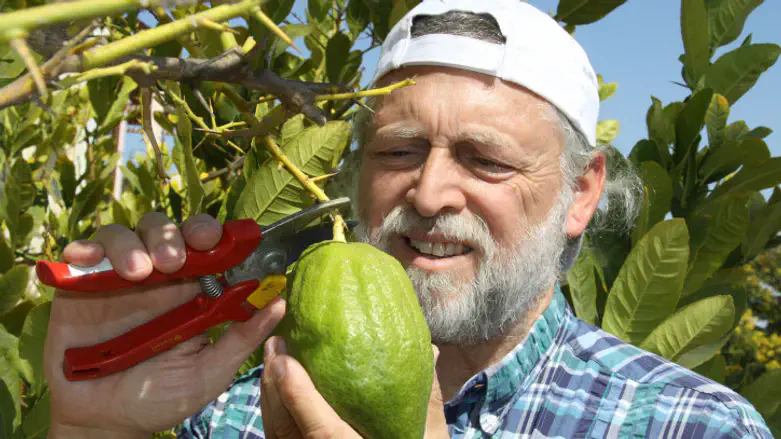
One of the central Mitzvot of Sukkot is shaking the lulav-bundle:
“You will take for yourselves on the first day [of Sukkot] the fruit of a citron tree, date-palm branches, twigs of a plaited tree, and willows of the stream; and you will rejoice before Hashem your G-d for seven days" (Leviticus 23:40).
The Midrash explains the Four Species to represent four different kinds of Jews:
“Just as the etrog has both pleasant taste and pleasant fragrance, so there are Jews who have both Torah-learning and good deeds… The date-palm has a pleasant taste but no fragrance, representing Jews who have Torah-learning but have no good deeds… The myrtle has a pleasant fragrance but no taste, representing Jews who have good deeds but no Torah-learning… And the willow which has neither fragrance nor taste represents Jews who have neither Torah-learning nor good deeds" (Vayikra Rabbah 30:12).
All four species have to be present in order to fulfil the mitzvah; if any one of them is missing, then the Jew has not carried out the mitzvah at all (Rambam, Laws of Shofar, Sukkah and Lulav 7:5 and Shulchan Aruch, Orach Chaim 651:12); if, for whatever reason, one or more of the species is unavailable, then one shakes the others without saying the Brachah, in memory of the mitzvah which should have been (Shulchan Aruch ibid.).
This recalls the aphorism of Rabbi Avraham Yitzchak Kook z"l, the doyen of religious Zionism, that the word צִבּוּר (community) is the acronym of צַדִּיק, בֵּינוֹני, וְרָשָׁע (righteous, intermediate, and wicked). For a community to be complete, it has to include every Jew - including the sinners.
This is also the lesson of the compound which formed the incense in the Holy Temple:
The Talmud (K’ritot 6a and Yerushalmi Yoma 4:5) lists all the ingredients of the incense. The dry ingredients were balm, onycha, galbanum, frankincense, myrrh, cassia, spikenard, saffron, costus, aromatic rind, and cinnamon; the liquid ingredients were lye distilled from leek and Cyprus wine.
What is unexpected here is the galbanum, which emits a foul odour when it burns. So why would it be included in the incense, whose heady fragrance is supposed to inspire reverence and awe?
The Talmud (K’ritot 6b) cites Rav Chana bar Bizna, who quoted Rabbi Shimon the Hassid: “Any fast which does not include the sinners of Israel is no fast, for after all the galbanum has a foul smell yet the Torah includes it among the ingredients of the incense".
Just as the incense had to include the foul-smelling galbanum, without which it is invalid; and just as a communal fast has to include the sinners of Israel, without whom it is no fast; and just as a community has to include the wicked, without whom the community is incomplete -- so too the bundle of the Four Species has to include representatives of every kind of Jew, including the willow-twig Jew, the Jew who has neither Torah-learning nor good deeds to his merit.
The Four Species have some deep and important lessons to teach us about the different kinds of Jew.
When you go to buy your Four Species, look at each of them. The willow-twigs - the Jew who has neither learning nor good deeds - are invariably the cheapest of the four. But though it seems to have the least value - don’t have contempt for it. For without those cheap willow-twigs, you cannot fulfil the mitzvah of the Four Species.
Notice also how one willow-twig is indistinguishable from all the others, just as one myrtle is much the same as all the others.
Lulavim come in widely differing sizes. The minimum length of the lulav is four tefachim (hand-breadths), and the minimum length of the myrtle and of the willow-twigs is three tefachim. The lulav must extend a minimum of one tefach beyond them both (Sukkah 32b; Rambam, Laws of Shofar, Sukkah and Lulav 7:8; Shulchan Aruch, Orach Chaim 650:1; Kitzur Shulchan Aruch 136:1); there is no maximum length for the lulav.
But though the lengths of lulavim vary greatly, they all look much the same as each other.
And now look at the etrogim - the species which represents the Jew who has both Torah-learning and good deeds. See what a variety they come in! Size, colour, shape - no two etrogim are identical. From the tiniest lemon-sized etrog to the biggest etrog the size of a small melon; hues of green, every shade of yellow, and combinations of green and yellow in a single etrog; from the smoothest to the roughest of skins; from almost-spherical to the rugby ball-shaped (or football-shaped, for Americans). to the wasp-waisted to the egg-shaped. All are kosher - and all are different, each has its own separate and distinct identity.
And then, during the course of the week of Sukkot and the few weeks following, observe the Four Species:
See how the willow-twigs wither and dry up within a matter of days. The Jew who has neither Torah-learning nor good deeds cannot survive very long - not even until the end of Sukkot. The willow-Jew cannot be sustained for more than a very few days.
The lulav survives a little longer, at least until the end of Sukkot. The Jew who has Torah-learning but no good deeds can be sustained by the Festival itself; but once the festivities stop, there is little to sustain the lulav-Jew.
The myrtle survives longer than the lulav. A week or so after Sukkot, when the lulav has already dried out, the myrtle is still green - although it is already beginning to wither.
This recalls Rabbi Chanina ben Dosa’s maxim: “Anyone whose [good] deeds exceed his wisdom - his wisdom will endure; but anyone whose wisdom exceeds his [good] deeds - his wisdom will not endure" (Pirkei Avot 3:12). The myrtle with its pleasant fragrance but no taste, representing the Jew who has good deeds but no Torah-learning, survives for appreciably longer than the lulav with its pleasant taste but no fragrance, representing the Jew who has Torah-learning but no good deeds.
And finally we come to the etrog, with its pleasant taste and pleasant fragrance, representing the Jew who has both Torah-learning and good deeds. The etrog remains fresh and fragrant and yellow, or green, or yellow-and-green, for weeks.
Study and internalise the lesson of the Four Species. Be an etrog-Jew!
But even while being an etrog-Jew, or at least aspiring to be an etrog-Jew, always remember that all the other Jews are indispensable.
The gematria (numerical value) of אֶתְרוֹג, etrog, is 610. Even though the etrog-Jew is the Jew who has both Torah-learning and good deeds, he nevertheless needs the other three to achieve 613, the completion of all the mitzvot.
And see how the willow-leaves, representing the Jew who has neither Torah-learning nor good deeds, is still above the etrog, representing the Jew who has both. The etrog is in the shade of the willow-leaves.
So be an etrog-Jew, contribute both pleasant taste and pleasant fragrance to the bundle of the Four Species, contribute both Torah-learning and good deeds to the community, and recognise that the willow-leaf Jew can still be above you.
The etrog-Jew is the Jew who survives, the Jew who endures.