
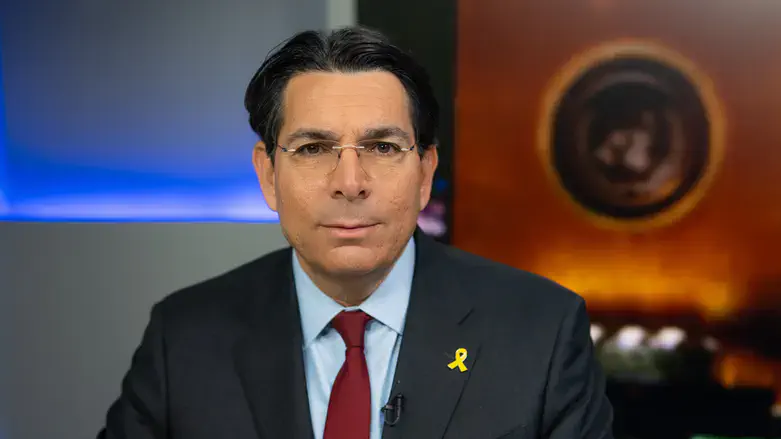
Prime Minister Benjamin Netanyahu is expected to arrive in New York for an exceptionally brief visit centered on his address to the United Nations General Assembly. Israel’s Ambassador to the UN, Danny Danon, says that despite the tight schedule, Netanyahu will hold several diplomatic meetings and use the international stage to once again place the Iranian threat at the center of the global agenda.
In an interview with Arutz Sheva-Israel National News, Danon rejected reports suggesting that security concerns were behind the decision to shorten Netanyahu’s visit. According to the ambassador, the prime minister intends to return to Israel in time for the Sukkot holiday, making the trip a whirlwind visit.
“He lands in the morning and comes here. I have arranged several important meetings for him with heads of state, both before and after his speech," Danon said. “Overall, he will be inside the UN for only a very limited number of hours, and then he will return to the airport in order to make it back in time for Sukkot."
Netanyahu’s addresses to the General Assembly have attracted considerable attention over the years, in part because of his use of visual aids to drive home his messages. Danon hinted that this year’s speech could once again include an element of surprise, but declined to reveal details.
“I’m sure you will be surprised this time as well. I can’t tell you by what," he said.
Danon did, however, make clear that Iran will be a major focus of the speech. Netanyahu, he said, is expected to present Israel’s position regarding Tehran’s nuclear ambitions and intentions to world leaders.
Danon also rejected the Iranian president’s portrayal of Iran as a victim. “They are not victims," he said. “They want to cause a great many victims around the world."
According to Danon, Israel has no intention of relying solely on the international community when it comes to confronting the Iranian threat.
“If the world doesn’t get there, we will," he said. “We will not take any risks. We have proven our capabilities, and we believe that Iran is dangerous not only to Israel."
The ambassador said he was also set to participate, alongside representatives from Bahrain, the United Arab Emirates and other countries, in an event at the UN Security Council focused on Iran. In Danon’s view, confronting Tehran is not solely an Israeli concern, but part of a broader regional struggle.
Danon also addressed the sharp criticism of Israel voiced by a number of leaders during their General Assembly speeches. While he described such rhetoric as familiar territory at the UN, he said the intensity of the criticism was particularly noticeable.
“It was a competition over who could smear more and who could lie more," Danon said, pointing to speeches by leaders from countries including Britain, France and Turkey.
The Israeli ambassador argued that some of the treatment Israel receives in international institutions goes beyond legitimate criticism of government policy and crosses into antisemitism.
“It is legitimate to criticize our policies and argue with us," Danon said. But when Israel is subjected to different standards, he argued, the criticism becomes discriminatory. He pointed to the number of resolutions and discussions targeting Israel and accused international bodies of changing standards in ways that single out the Jewish state.
Despite his criticism of the UN, Danon also pointed to the possibility of further diplomatic developments in the region. Addressing Syria and Lebanon, he said contacts have taken place and that additional countries are interested in moving closer to Israel.
Danon said the cooperation developed between Israel and the countries that joined the Abraham Accords has drawn interest elsewhere in the region. He expressed confidence that additional countries will eventually join the circle of agreements that began six years ago.
Asked why it remains important for an Israeli prime minister to appear before an institution that he himself frequently criticizes, Danon said there is no substitute for the global platform offered by the General Assembly.
“It is the most important stage in the world. Millions of people will watch him," he said, adding that Israelis can expect Netanyahu to represent the country’s position before an international audience.
Danon concluded by addressing the future leadership of the United Nations and the eventual successor to Secretary-General António Guterres. He expressed hope for a change in direction at the organization and offered a particularly sharp assessment of its current leadership.
“Whoever is elected will be better than Guterres," Danon said.
Even during a visit measured in hours rather than days, Israel’s delegation is seeking to use the UN’s most prominent stage to deliver two messages: when it comes to Iran, Israel says it will not take risks with its security; and when confronted with mounting international criticism, Jerusalem intends to make its case precisely where the opposition is most pronounced.