
לרפואת נריה דב בן חנה בתוך כל שאר חולי ישראל
In three places (Exodus 23:16, Leviticus 23:33-44, and Deuteronomy 16:13-16) the Torah commands us to celebrate the Festival of Sukkot for seven days, beginning on the fifteenth of Tishrei.
The first of these calls the Festival חַג הָאָסִף, “the Festival of the Ingathering, as the year goes out, when you ingather your work from the field". The other two call it חַג הַסֻּכֹּת (the Festival of Tabernacles).
The commandment to dwell in the Sukkah appears in Leviticus:
“On the fifteenth day of this seventh month is the seven-day Festival of Sukkot to Hashem your G-d…you shall dwell in Sukkot [tabernacles] for seven days, every native in Israel shall dwell in Sukkot, so that your generations shall know that I caused the Children of Israel to dwell in Sukkot upon My taking them out from the land of Egypt; I am Hashem your G-d" (Leviticus 23:34-43).
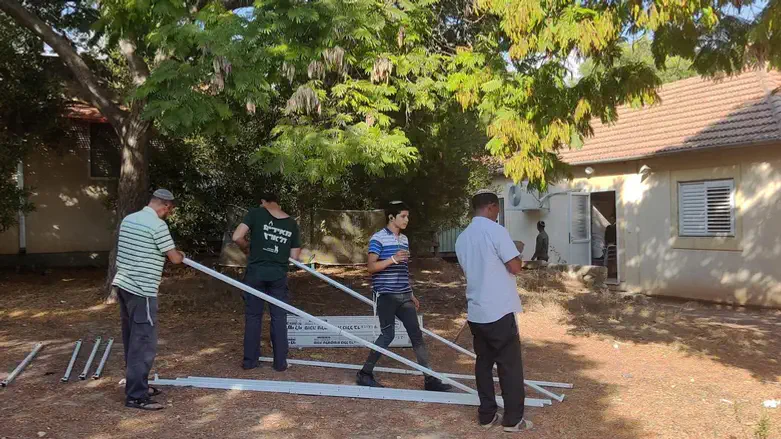
The ideal structure for the Sukkah is four walls. However, a Sukkah which is constructed with only three walls, and open on the fourth side, is still valid. The three existing walls define the limits of the Sukkah, and the fourth wall is implied. The irreducible minimum requirements for a Sukkah are two complete walls and a third wall which is one tefach (handbreadth) long (Sukkah 6b-7a, and codified as practical halachah by the Rambam, Laws of Sukkah 4:2, and the Shulchan Aruch, Orach Chaim 430:2).
The two walls and the one handbreadth of the third wall are sufficient to define the area of the Sukkah; again, the missing walls are implied.
The very Hebrew word סֻכָּה alludes to these three structures:
-The first letter, the ס, is the ideal shape for the Sukkah, four complete walls.
-The second letter, the כ, is the next acceptable shape, a three-wall structure which is open on the fourth side.
-And the final letter, the ה, is the irreducible minimum, two complete walls and one handbreadth of the third wall.
(Grammatical note: “Sukkah" is spelled סכה, not סוכה. Though in unvowelised Hebrew we often add the ו for ease of reading, this is grammatically inaccurate.)
Rabbeinu Bechayye ben Asher (Spain, 1255-1340), in his encyclopaedic work Kad ha-Kemach, offers some startling philosophical-kabbalistic insights into the significance of the Sukkah.
He analyses the Talmudic injunction to “go out from the permanent dwelling and live in a temporary dwelling" (Sukkah 2a):
The Children of Israel’s 40-year sojourn in the Sinai Desert, says Rabbeinu Bechayye, was only temporary, since they were destined for permanent residence in the Land of Israel, which contains the Holy Temple, which is called בֵּית עוֹלָמִים (Eternal House). And similarly the Torah commands us to leave our houses - our permanent dwellings - and live in the Sukkah which is only a temporary dwelling.
Hence the purpose of “going out from the permanent dwelling and living in a temporary dwelling" is to remember that in the desert we lived in a temporary dwelling (the desert), and G-d took us from there and settled in a permanent dwelling in the choicest of places, the Land of Israel.
This, says Rabbeinu Bechayye, is the overt aspect of the mitzvah of Sukkah.And then he offers several hidden, kabbalistic aspects of the mitzvah of Sukkah:
“You shall dwell in Sukkot for seven days" commands the Torah (Leviticus 23:42), and Rabbeinu Bechayye then cites Rabbi Eliezer’s opinion (Sukkah 11b) that “these were the Clouds of Glory".
He explains this by citing the Midrash (Mechilta de-Rabbi Shimon bar Yochai 13:21 and Tanchuma, Beshallach 3) that “there were seven Clouds of Glory…four in each direction [north, east, south, and west], one below them, and one above them, and one travelling ahead of them".
Rabbeinu Bechayye expounds that this showed Israel’s great distinction, because as another Midrash Pirkei de-Rabbi Eliezer 4) relates, G-d’s Throne of Glory itself is surrounded by seven clouds.
The Sukkah that we construct corresponds to those Sukkot made of the Clouds of Glory in the desert. And because there were seven Clouds of Glory, G-d commanded us to celebrate the Festival of Sukkot in the seventh month (Tishrei) and to dwell in Sukkot for seven days.
Rabbeinu Bechayye offers additional insights:
The Sukkah must have a minimum of three walls, corresponding to the three parts of Scripture - תּוֹרָה (Torah), נְבִיאִים (prophets), and כְּתוּבִים (Holy Writings).
It must be a minimum of 10 handbreadths high, alluding to the Ten Commandments.
It must be a minimum of 7 handbreadths wide, corresponding to the Seven Wisdoms. Rabbeinu Bechayye (commentary to Exodus 25:31) enumerates these as the Wisdom of the Constellations (astronomy), the Wisdom of Measurements (geometry), the Wisdom of the Soul (psychology), the Wisdom of Nature (natural science), the Wisdom of Expression (language), the Wisdom of Mathematics, and the Wisdom of Values (liberal arts).
Consequently the wall of the Sukkah must be a minimum of 70 square handbreadths, corresponding to the “seventy faces of the Torah" (Bamidbar Rabbah 13:15, and compare Shabbat 88b).
Since the Sukkah symbolises our 40-year sojourn in the desert, and by extension symbolises the redemption, I suggest an additional allusion:
When G-d forged His covenant with Abraham, He told him that “your seed will be a stranger in a land not theirs, and they will serve them and they will afflict them for 400 years" (Genesis 15:13). However, the chronology didn’t seem to tie up: from the day that Jacob went down to Egypt (Genesis 46:1-6) until the day of the Exodus, only 210 years had passed.
Therefore, as the Midrash (Shir ha-Shirim Rabbah 2:1 [8] et al.) records, there were Jews in Egypt who argued that Moshe was trying to hasten the redemption ahead of G-d’s schedule. They had to remain in Egypt for another 190 years, they argued, in order to fulfil the Divine decree.
Moshe’s response to their claim was simple: “Since He delights in your redemption, He does not take account of your calculations".
Only in retrospect would they truly understand G-d’s promise to Abram: the 400-year countdown began the day that Isaac was born. Isaac was Abraham’s first descendant; and though G-d had already promised him the Land of Israel, it was not yet his - hence Isaac was already a stranger in a land not his.
During those 190 years which had passed from the day that Isaac was born in 2048 (1712 B.C.E.) until the day that Jacob went down to Egypt in 2238 (1522 B.C.E.), the clock of redemption was already ticking.
And the Sukkah teaches this lesson of redemption from Egypt. Though the Sukkah should ideally have four walls, three walls can do duty for four. Even two complete walls and just one handbreadth of the third wall can do duty for four complete walls.
And in the same way, when G-d decided to redeem His children from slavery, even though He had decreed 400 years of exile, nevertheless two complete centuries and just one “handbreadth", just ten years, of the third century, could do duty for four complete centuries.
For seven days we will dwell in our Sukkah - the flimsy and ephemeral structure which is the physical manifestation of our faith in G-d and the Redemption which He had promised us.