
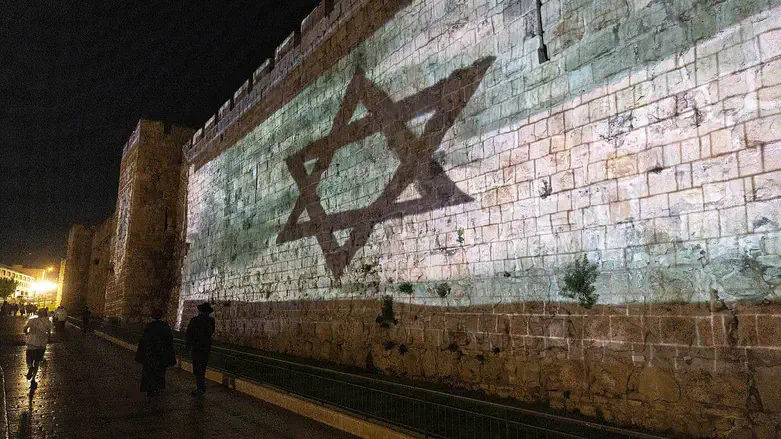
The Haftorah for the first day of Sukkot, taken from Zechariah 14:1-21, looks ahead to a dramatic future for Jerusalem.
The prophet describes the nations of the world coming against the city in war. Jerusalem suffers terribly, but G-d intervenes. Then, in a striking turn, the same nations that came to attack the city return for a completely different reason.
“And it shall come to pass that everyone who remains from all the nations that came against Jerusalem shall ascend from year to year to bow before the King, the Lord of Hosts, and to celebrate the festival of Sukkot" (Zechariah 14:16).
Those who came to fight over Jerusalem will one day come there to worship G-d.
And the holiday they will celebrate is Sukkot.
Why Sukkot?
Our Sages point to an unusual feature of the Temple service on the holiday. During the seven days of Sukkot, a total of 70 bulls were offered. The Talmud (Sukkah 55b) explains that they corresponded to the 70 nations of the world.
So even as the Jewish people celebrated a festival rooted in our own history, remembering G-d’s protection in the wilderness, the service in the Temple included offerings connected to the nations beyond Israel.
The holiday looks back to a uniquely Jewish experience, but it also looks outward. The future Zechariah describes does not erase the nations or turn Jerusalem into some neutral international city. Jerusalem remains the center of the prophecy, and the nations remain distinct. What changes is what brings them there.
Instead of trying to conquer the city, they come to recognize the G-d of Israel as the one true G-d.
It is difficult to read that passage this year without thinking about the United Nations General Assembly in New York.
Once again, leaders from around the world gathered this past week, and once again Israel was the subject of intense criticism and debate.
The contrast with Zechariah is hard to miss.
In his prophecy, the nations also gather around Jerusalem. At first, they do so in hostility. But that hostility is not permanent. The same peoples who sought to impose their will upon the city eventually come to acknowledge a sovereignty greater than their own.
The prophecy is not only about Jerusalem surviving an attack. It is about the nations coming to see Israel’s capital differently because they have come to understand G-d differently.
The 70 bulls offered in the Temple were tied to the 70 nations. Zechariah describes the day when those nations will no longer be represented only by sacrifices offered on their behalf. They themselves will come to Jerusalem to celebrate the festival.
When hostility lasts for years, it can begin to feel permanent. We grow accustomed to certain countries opposing Israel, certain institutions condemning it and certain arguments being repeated over and over again.
Zechariah tells us not to assume that the present arrangement of the world is fixed forever.
History can change, and so can nations and the way they relate to the Jewish people and to Jerusalem.
That does not make the hostility of the present unimportant. Speeches, resolutions and policies can have real consequences. But Zechariah reminds us that they are part of a much longer story.
The chapter begins with nations coming against Jerusalem. It ends with a world in which they recognize the G-d of Israel and ascend to His city.
Zechariah sums up that future in words we know well:
“And the Lord shall be King over all the earth; on that day the Lord shall be One and His name One" (Zechariah 14:9).
That is the future Zechariah asks us to keep in view on Sukkot.
May we merit to see it soon.