
Less than two weeks ago we read the תּוֹכָחָה, tochachah (reprimand) - the frightening and sobering reprimand and warning of the curses that Hashem would inflict upon us as a punishment for transgressing His mitzvot (Deuteronomy 28:15-68). Parashat Ki Tavo, which contains the תּוֹכָחָה, is invariably read on the penultimate Shabbat of the year.
This is a deliberate decision, and the Talmud records both its origin and its reason:
“Rabbi Shimon ben Elazar says: Ezra decreed that Israel would read the curses in the Book of Leviticus before Shavuot, and those in the Book of Deuteronomy before Rosh Hashanah. What is the reason? - Said Abayyé, and some say it was Reish Lakish: So that the year should finish together with its curses" (Megillah 31b).
The Tosafot (ad loc., s.v. קללות שבתורת כהנים קודם עצרת ושבמשנה תורה קודם ראש השנה) notes:
“The question was asked in Rabbeinu Nissim’s academy: why are Parashot Nitzavim and Vayeilech read separately when there are two Shabbatot between Rosh Hashanah and Sukkot (excluding Yom Kippur), rather than separating Parashot Mattot and Massei which are longer? And they answered: It is because in Parashat Nitzavim there are curses with which Israel was afflicted, and we want to finish these before Rosh Hashanah"
It is strange that it is not clear whether the principle that “the year should finish together with its curses" should be attributed to Abayyé or Reish Lakish. These two Torah-giants lived 1,100 km (600 miles) and a century apart from each other: Reish Lakish (Rabbi Shimon ben Lakish) was a first-generation (3rd century) Amora in Israel, and Abayyé was a fourth-generation (4th century) Amora in Babylon.
We can understand how a teaching might be attributed to either of two contemporaneous rabbis, living in close proximity. Such indeed happens with Rabbi Ami and Rabbi Asi - both third-generation Amoraim in Israel, both colleagues, both in Tiberias, both students of Rabbi Yohanan bar Nafcha; for instance, the Torah tells us that the Children of Israel “despoiled Egypt" (Exodus 12:36), “which teaches that they left Egypt like a bird-trap without grain", which imagery is ascribed both to Rabbi Ami (Berachot 9b) and to Rabbi Asi (Pesachim 119a).
Such happens with Rabbi Hanina bar Papa and Rabbi Zeira - both third-generation Amoraim in Israel, both students of Rabbi Yohanan (see for instance Berachot 5a, Shabbat 85a, and Sukkah 46a).
Such happens with Rava and Rav Hisda - both second-generation Amoraim in Babylon, Rava was Rav Hisda son-in-law and student (see for example for instance Berachot 5a and Arakhin 15b).
Such happens with Mar Zutra and Rav Ashi - both sixth-generation Amoraim in Babylon, both students of Ameimar and Rav Papa (see for example Berachot 5a, 23a, Shabbat 50b, Pesachim 17a, and Yoma 27b).
That such rabbis could be confused with each other is understandable.
But how could Abayyé and Reish Lakish, so widely separated both geographically and chronologically, be confused with one another?
I suggest: -
Both Abayyé and Reish Lakish presented this reason - that we read the תּוֹכָחָה in Parashat Ki Tavo immediately before Rosh Hashanah “so that the year should finish together with its curses" - each for his own reasons.
We have much to learn from both Abayyé and Reish Lakish about Rosh Hashanah and its meaning.
We begin with Abayyé:
It was Abayyé who instituted the custom which we all know and love of eating specific foods on Rosh Hashanah to symbolise the blessings for the coming year. In response to Rabbi Ami who suggested certain omens which foretell success or failure in various undertakings, “Abayyé said: Since you claim that omens are significant, let every person customarily eat on Rosh Hashanah pumpkin, fenugreek, leek, beet, and dates" (Horayot 12a and Keritot 6a).
Rashi (Commentary to Keritot 6a) says simply, “because they grow quickly and are sweet".
Later commentators offered additional symbolisms inherent in these foods, and later generations added more foods with their respective symbolisms. The Shulchan Aruch cites this as practical halakhah:
“A person should be accustomed to eat on Rosh Hashanah fenugreek, leek, beet, dates, and pumpkin. And when he eats the fenugreek (rubiya), he says ‘May it be His will that our merits increase (yirbu)’. On the leek (karti) - ‘…may our enemies be cut off (yekartu). On the beet (silka) - ‘…that our enemies be banished (yistalku)’. On the dates (tamar) - ‘…that our enemies come to an end (yitamu)’. On the pumpkin (kara) - ‘…that harsh decrees against us be torn (yekara) and our merits be read (yikaru) before You’" (Orach Chayim, Laws of Rosh Hashanah 683:1).
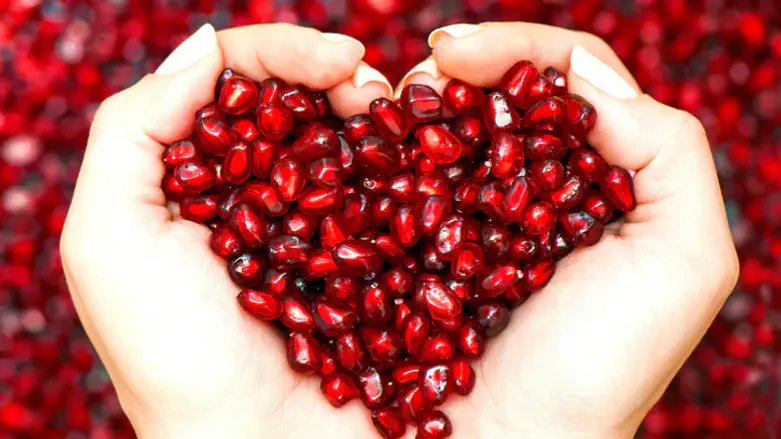
The Ram"a, the Ashkenazi possek, adds in a gloss here: “And there are those whose custom is to eat sweet apple with honey, and to say: ‘…that a sweet year be renewed for us, and this is our custom. And there are those who eat pomegranate and say: ‘May our merits be as numerous as [the seeds in] the pomegranate’".
Since it was Abayyé who instituted this sensual custom - to eat fast-growing and sweet foods as omens, literally to taste the sweetness that we hope the incoming year to bring - it is eminently appropriate that Abayyé also saw the reading of the תּוֹכָחָה immediately before Rosh Hashanah as a significant omen - “that the year should finish together with its curses".
As for Reish Lakish - he epitomises the capacity that we all have for teshuvah (repentance). Though he was born to a family of Torah-sages (Shabbat 119b), Reish Lakish became a bandit, a robber, a violent highwayman - and then utterly reformed and became one of the great Torah-masters of his generation.
It was Reish Lakish who taught the value of repentance: “Great is repentance", he said, “because it transforms deliberate sins into accidental errors.... Great is repentance, because it transforms deliberate sins into merits.... These two statements do not contradict each other - one speaks of repentance due to love, the other of repentance due to fear" (Yoma 86b).
Since it was Reish Lakish who understood - maybe better than anyone else - how sins could be transformed into mitzvot, how Hashem’s castigation, His warnings of punishment and the punishment itself, is actually a sign of His love for us, it is equally appropriate that Reish Lakish would have seen and expounded upon the significance of reading the תּוֹכָחָה immediately before Rosh Hashanah.
We stand this Rosh Hashanah in the midst of historical events. The last three years have been a maelstrom of violent events, a whirlpool of despair, grief, hope, euphoria, shock, courage, determination, and a host of other emotions.
As I write these words on the final night of 5786, Israel is simultaneously preparing for the beginning of the Festival season, and bracing itself for whatever the insane tyrants in Iran might (or might not) be plotting for us.
As the final hours of 5786 tick away and the New Year 5787 approaches, this is the time for every Jew to beseech G-d for a happy, healthy, sweet, and good year 5787.
This prompts one final thought: It is customary to wish each otherשָׁנָה טוֹבָה וּמְתוּקָה - a good and sweet year (vide Shulchan Aruch ha-Rav, Siddur, Kiddush for Rosh Hashanah, and the Kitzur Shulchan Aruch 129:9).
Why both “good" and “sweet"?
- As we all know, that which is good for you is rarely sweet, and that which is sweet is rarely good for you. War can bring long-term benefits by defeating evil - but it is a horribly bitter medicine. Peace is sweet - but if it is false, it causes bitterness more horrible than can be described.
May this year bring a sweetness that is truly good for us, and a goodness that will be truly sweet.
So indeed, שָׁנָה טוֹבָה וּמְתוּקָה, have a good and sweet year. For the year תשפ"ז (5787) I suggest the acronym תְּהִי שְׁנַת פָּז, may it be a year of fine gold.
And if I have offended any readers with anything I have written over the last year, I take this opportunity to ask you to forgive me.