


The modern world does not suffer from a shortage of information. Every day, people encounter breaking news, historical analysis, financial reports, scientific discoveries, social-media commentary and countless opinions competing for attention. The difficult part is no longer simply finding information. It is deciding what deserves attention, what deserves skepticism and what deserves further investigation.
This makes cognitive fitness an increasingly interesting subject.
The ability to recognize patterns, evaluate alternatives and reconsider an assumption is useful far beyond academic examinations. It influences how people learn, work, communicate and navigate an environment where information can change within minutes.
Intelligence Is More Than a Number
IQ has traditionally been associated with logical reasoning, pattern recognition and problem-solving. These abilities are important, but they represent only one part of human intelligence.
A person's knowledge, creativity, emotional awareness, practical judgment and ability to learn from experience cannot be reduced to a single score.
This distinction matters when considering online IQ testing.
A Test as a Snapshot
An online IQ test should be viewed as a snapshot rather than a permanent identity.
Performance can be influenced by concentration, familiarity with particular question types, environment and other circumstances. A result may provide an interesting reference point, but it does not explain everything about the person taking the test.
The more productive question is often not "How intelligent am I?" but "How do I approach unfamiliar problems?"
That shift turns testing into an opportunity for reflection.
Why Cognitive Flexibility Matters
One of the most valuable mental abilities in an unpredictable environment is cognitive flexibility - the capacity to adjust one's thinking when circumstances or evidence change.
Imagine receiving information that contradicts something you strongly believed yesterday.
There are two possible reactions.
One is to immediately reject the new information.
The other is to examine it, compare the evidence and determine whether the original belief needs to be updated.
The second response requires intellectual humility as much as intelligence.
From Information Consumer to Information Analyst
This distinction is becoming increasingly important.
A passive information consumer asks, "What does this source say?"
An active information analyst asks:
- What evidence supports the claim?
- What assumptions are being made?
- Is there another explanation?
- What information is missing?
- Has the conclusion been presented with more certainty than the evidence allows?
These habits are useful in education, professional life and everyday decision-making.
Where MyIQ Enters the Conversation
MyIQ offers online IQ testing together with exercises designed to engage reasoning and mental skills.
Its most interesting role is not as a definitive authority on intelligence, but as a way for users to interact with cognitive challenges directly.
A person might discover that visual patterns are intuitive while numerical sequences require more concentration. Someone else may find that they tend to answer quickly and occasionally overlook details.
Such observations can be more valuable than simply celebrating a high score.
The Value of Mental Practice
Just as physical skills can be practiced, certain forms of mental performance can be exercised through challenging tasks.
This does not mean that repeatedly taking an IQ test will transform every aspect of intelligence. Nor does it mean that a particular score predicts future achievement.
Instead, cognitive exercises can provide structured opportunities to practice attention, reasoning and problem-solving.
The benefit lies partly in the process.
What a Reddit Discussion Can Teach Us About Test Results
Independent discussion is particularly useful when evaluating online services because it introduces perspectives that may differ from the platform's own presentation.
A Reddit discussion about MyIQ raises a notable question about receiving two different scores. Rather than treating this simply as a positive or negative verdict, the discussion provides an opportunity to consider a broader issue: How much confidence should people place in individual online test results?
Readers can examine the MyIQ discussion for themselves.
The lesson is useful beyond IQ testing.
A single data point rarely tells an entire story.
That principle applies equally to news reports, economic indicators, scientific claims and personal experiences.
Three Habits for a Stronger Mind
1. Question Your First Interpretation
The first explanation that comes to mind is not necessarily the best one.
Before reaching a conclusion, consider whether another interpretation could explain the same evidence.
2. Look for the Missing Context
Information becomes more meaningful when its surrounding circumstances are understood.
A statistic without context can be misleading. A quotation without context can change meaning. A test score without context can be overinterpreted.
3. Practice Changing Your Mind
Changing an opinion after encountering convincing evidence is not intellectual weakness.
It is evidence that the thinking process is functioning.
People who treat their conclusions as permanently fixed can become less responsive to reality. Intellectual flexibility allows knowledge to evolve.
Cognitive Fitness and Lifelong Learning
Education does not end when formal schooling does.
Adults constantly encounter unfamiliar technologies, changing professional requirements, new scientific information and cultural developments.
The ability to learn continuously therefore becomes a practical advantage.
Cognitive exercises are only one small component of this process. Reading, learning languages, solving problems, discussing ideas and acquiring unfamiliar skills can all challenge established mental habits.
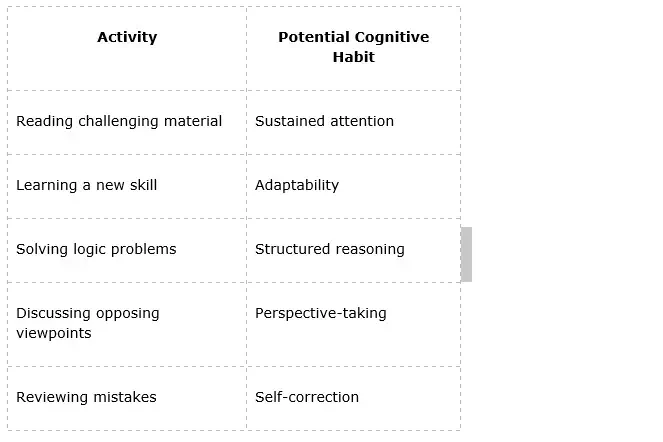
The objective is not to turn life into a permanent examination.
It is to maintain curiosity.
The Real Meaning of Cognitive Strength
There is something misleading about imagining intelligence as a fixed possession.
A more useful perspective is to see cognitive ability as a collection of habits: paying attention, asking questions, recognizing patterns, evaluating evidence and remaining willing to learn.
An IQ test can illuminate a narrow part of that landscape. A platform such as MyIQ can make cognitive exercises accessible to people who are curious about their reasoning abilities.
But the number itself should never become the destination.
The deeper value lies in what happens afterward.
Do we become more curious about how we think? Do we notice our assumptions more quickly? Are we willing to investigate information before accepting it?
In an age when information is abundant but certainty is often scarce, those qualities may matter more than any single score.
Curiosity as a Form of Mental Resilience
A curious mind does not necessarily know more than everyone else.
It simply remains willing to ask one more question.
That may be the most valuable form of cognitive fitness: not memorizing every answer, but developing the discipline to examine patterns, challenge assumptions and adapt when reality provides new evidence.
The strongest mind is not necessarily the one that never changes its conclusion.
It may be the one capable of changing it for the right reasons.