
The Peres Peace Center has released excerpts from minutes of a secret meeting held in Amman in November 1993 between then-Foreign Minister Shimon Peres and Jordan’s King Hussein, revealing details of the covert talks that helped pave the way for the peace treaty between Israel and Jordan.
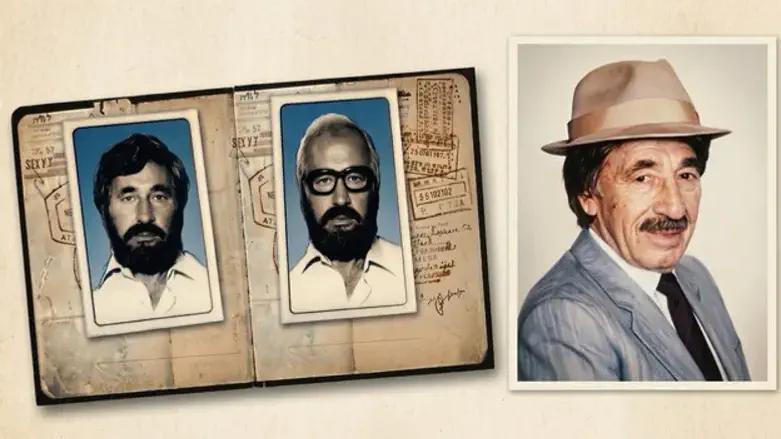
The meeting, held at the King’s Palace, required Peres to alter his appearance and travel under tight secrecy. According to the newly released documents, the Jordanian royal household sent a dramatic message on October 26, 1993, conveying Hussein’s desire to meet Peres. A week later, the two met secretly in Amman.
The documents state that Hussein agreed to hold the meeting on November 2, with Jordan promising that “the necessary measures will be taken to prevent the identification of the foreign minister." That morning, Peres, his chief of staff and the deputy head of the Mossad crossed the Allenby Bridge on foot. “On the Jordanian side, they were quickly gathered into two cars that were waiting just adjacent to the bridge," the minutes recount. The driver of Peres’s vehicle was identified as “the personal office manager of King Hussein."
Despite the secrecy, Hussein wanted a memento of the encounter. He presented Peres with a large photograph of himself bearing an inscription "Taken during friendy convesation" and agreed to be photographed with the Israeli minister. The joint picture was taken with a Polaroid camera by the manager of the king’s private office.
During the meeting, the two discussed the future of Israeli-Jordanian relations and possible areas of cooperation. Peres proposed developing a unified regional infrastructure network encompassing ports, aviation, maritime links and roads. He also suggested preparing an unofficial document summarizing the talks and their conclusions so he could present them to Prime Minister Yitzhak Rabin. According to the minutes, Peres said he and Rabin “work hand in hand" and “see eye to eye," adding that both believed their time was limited as they sought to “pull the peace cart together."
A key moment came when “the king straightened up, for the first time since the start of the meeting," and declared: “We are the masters of our fate and we are not connected to any outside approval. We can act."
Peres also stressed that a rare opportunity for peace had emerged. “Your Majesty - there is currently tremendous public support for the peace agreement. Young people have had enough of wars, of deprivation and of the lack of freedom," he told Hussein.
Near the end of the meeting, Peres added: “Our generation must make difficult decisions - all for our children. We must make the difficult decisions before we disappear - and we must ensure the children’s future. Therefore, we must not lose momentum - there is a contradiction between the limited time available to us and the size of the opportunities facing us."
Hussein then spoke personally about his family and the limited time he believed remained for him. “I want to clarify my position. In 1951 there was a tragic event - the murder of my grandfather. I want to pass on to the future - the best possible for my brother Hasan and for the entire administration. Perhaps I have only a year or two left. I will put everything on the balance," he said in what the minutes described as a weak voice.
The Jordanian king also expressed hope that reducing the differences between the sides would ease mutual fears. “When the gaps are narrowed - the fears will fade - hopes will grow for all the children of Abraham - and it is time that this happens," he said. At the conclusion of the meeting, Peres and Hussein signed the heads of understandings using their initials.
Less than a year later, in October 1994, Israel and Jordan formally signed their peace treaty in the Arava, cementing the diplomatic breakthrough that had begun with the secret contacts revealed in the newly released documents.