

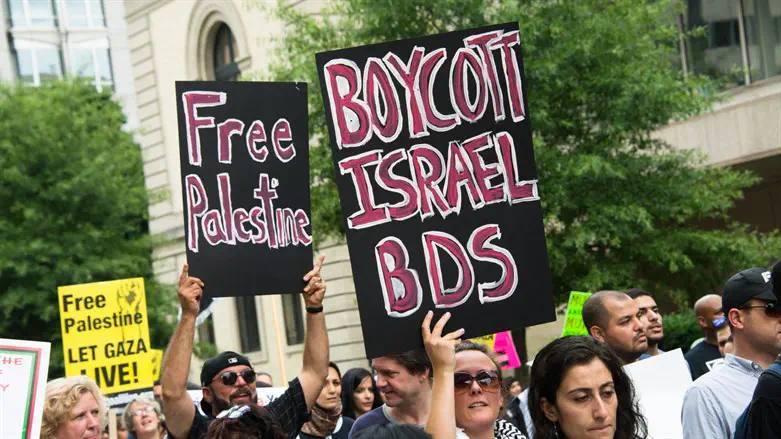
The US House of Representatives on Thursday approved bipartisan legislation that would make colleges and universities ineligible for federal student aid if they participate in certain commercial or academic boycotts of Israel associated with the Boycott, Divestment and Sanctions (BDS) movement.
The Protect Economic and Academic Freedom Act, introduced by Representatives Josh Gottheimer (NJ-5) and Virginia Foxx (NC-5), passed by a 237-169 vote. The legislation now moves to the US Senate.
Gottheimer said the measure is intended to prevent students and academics from facing discrimination while maintaining protections for speech and academic debate.
“No student, no professor should be shut out of research, study abroad opportunities, or academic partnerships, or feel unwelcome in the classroom because of where they’re from or what religion they practice. Yet that’s exactly what the boycott-divest-sanction movement seeks to do - targeting one country and one religion: Israel and Judaism," he stated. “My bipartisan bill with Congresswoman Foxx is narrow and targeted - it doesn’t touch anyone’s speech, protest, or academic debate. It simply says that if your university takes federal taxpayer dollars, it can’t discriminate against academic partnerships or investments with one country. That’s it. I urge my colleagues on both sides of the aisle to support this bipartisan bill."
Foxx said the legislation responds to what she described as antisemitism on American college campuses and would impose consequences on institutions that adopt BDS policies.
“The antisemitic rot that has corroded college campuses must be eradicated - enough is enough. The safety and security of Jewish students, faculty, and staff should never be threatened under any circumstances. Today, the House sent a clear message: if an institution of higher education chooses to capitulate to the caustic BDS movement, there will be consequences - starting with this bipartisan legislation," she stated.
Under the legislation, colleges and universities would have to certify that they are not engaging in a non-expressive commercial boycott of Israel in order to remain eligible for federal student aid. Institutions that decline to make the certification would forgo that funding, and the Department of Education would be required to publish a list of institutions that do not certify.
The bill defines a “non-expressive commercial boycott of Israel" as a commercial action, including refusing to conduct business with Israel or ending business activities, that is intended to restrict commercial relations with Israel or with people or entities doing business in Israel or Israeli-controlled institutions and is not based on a valid business reason.
The legislation would also impose requirements on institutions receiving funding through the International Education Programs under Title VI. Those colleges and universities would be prohibited from allowing academic boycotts and instead would be required to engage in academic exchange reciprocity.
House Democratic leadership opposed the legislation, citing concerns over free speech. House Minority Leader Rep. Hakeem Jeffries said Democrats continue to oppose the BDS movement but argued that the bill would not adequately address antisemitism.
“Our Jewish brothers and sisters deserve safety and security on campuses across the nation, and I continue to oppose the Boycott, Divestment and Sanctions movement. Unfortunately, H.R. 4795 is a poorly written Republican bill that does not achieve that goal."
“Instead, it would provide Donald Trump with the power to punitively launch political attacks on our colleges and universities, which are already under tremendous stress due to the toxic actions of this extreme Republican administration. When we are in the majority, House Democrats will advance unifying legislation to aggressively combat the rise of antisemitism and protect the Jewish community in America," he added.