
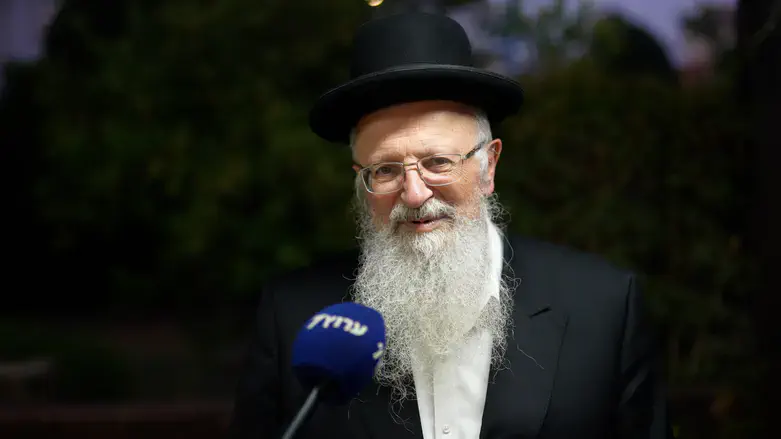
HaRav Shmuel Eliahu is the Chief Rabbi of Tzfat
It is written in the Shulchan Aruch that Parashat Nitzavim is always read before Rosh Hashanah (Shulchan Aruch 428). Whoever reads Parashat Nitzavim sees that the entire portion deals with the central theme of Rosh Hashanah: the peaks of judgment or mercy, depending on our heeding the sounding of the shofar.
The Torah briefly describes the peak of exile in the dispersion of the Nation of Israel throughout the world:
“And the Lord uprooted them from their Land in anger, in wrath, and in great fury, and cast them into another land, as it is this day."
This is not merely leaving the Land of Israel - it is an expression of tremendous Divine anger when a Jew is exiled to New York, Paris, London, or any other country.
The Torah says that during the exile, the Land is punished like Sodom and Gomorrah:
“Sulfur and salt, a burning throughout its Land; it shall not be sown, nor shall it sprout, nor shall any grass grow upon it, like the destruction of Sodom and Gomorrah, Admah and Zeboiim, which the Lord overturned in His anger and His wrath" (Deuteronomy 29:22-27).
It is a destruction that comes from “the heat of this great anger," a destruction resulting from Israel’s violation of its covenant with God:
“And they will say: Because they forsook the Covenant of the Lord, the God of their fathers, which He made with them when He brought them out of the land of Egypt."
Therefore, on the Day of Remembrance, there is a mitzvah to remember the Covenant.
Seeing the Peak of Redemption
In this Torah portion we also find the peak of Redemption. The portion describes that when Israel returns to its Land and fulfills its role, it merits the height of Redemption.
There is the Ingathering of the Exiles:
“And He will return and gather you from all the peoples among whom the Lord your God has scattered you" (Deuteronomy 30).
There is also the conquest of the Land, leading to an abundance of goodness:
“And you shall possess it, and He will do good to you and multiply you more than your fathers."
There are also severe blows against our enemies:
“And the Lord your God will place all these curses upon your enemies and upon those who hate you, who persecuted you."
There is also repentance:
“And you shall return and listen to the voice of the Lord, and you shall perform all His commandments which I command you this day."
Coupled with this are all the other blessings that appear throughout the entire Torah.
There Is No Middle Ground - Either the Head or the Tail
At the conclusion of the Torah, Moses tells us: There is no middle ground. You can receive either all the good or all the evil.
You can be the most hated and suffering nation on earth:
“The stranger who is among you will rise higher and higher above you, while you will descend lower and lower. He will lend to you, but you will not lend to him; he will be the head and you will be the tail. And all these curses will come upon you and pursue you and overtake you until you are destroyed."
This is what will happen if you ignore the Covenant concerning your role to bring blessing to all the families of the earth.
If you remember your role, you will receive an abundance of goodness:
“And the Lord your God will set you high above all the nations of the earth" (Deuteronomy 28:1).
“And the Lord will make you the head and not the tail, and you shall be only above and you shall not be below" (ibid. 13).
“And all these blessings will come upon you and overtake you, if you listen to the voice of the Lord your God."
This is what we pray for on Rosh Hashanah night: “May we be the head and not the tail."
This Is What the Mashiach Looks Like
The Rambam writes that all the good described in Parashat Nitzavim is the Redemption:
“And these matters explicitly stated in the Torah include all the things that were spoken by all the prophets" (Hilchot Melachim, Chapter 11).
All the prophecies of the prophets are written in condensed form in this Torah portion. All the descriptions in the portion are, in fact, descriptions of the Mashiach.
“And whoever does not believe in him, or does not await his coming, denies not only the other prophets, but also the Torah and Moses our teacher, for the Torah testified about him, as it says: ‘And the Lord your God will return your captivity and have compassion upon you, and He will return and gather you from all the peoples among whom the Lord your God has scattered you.’"
Where did the Torah testify about him? After all, the word “Mashiach" is not mentioned in these verses.
The Rambam is saying that the entire Ingathering of the Exiles and everything described in this Torah portion are the actions of the Mashiach, who is working energetically behind the scenes, even when he cannot be seen with our eyes. And this constantly developing process of Redemption is happening now!
How fortunate is our lot. May we merit to see its completion soon with the ingathering of all our people still scattered in increasingly darkening exiles around the globe, and may our complete and reunited Nation heed the call of the shofar and return to our Land, to the Torah, and to our Father in Heaven who watches over the Holy Land from the beginning of the year to its end.