
Adina Ellis is a graduate of the Matan Bellows Eshkolot Educators Institute. She has been teaching Tanakh and machshava over the last two decades, initially on college campuses and in Hebrew Schools in the New Jersey area. Since making aliyah in 2005, she has given weekly shiurim in Hebrew and English to women in her community. Adina has taught in the ALIT program and Rosh Chodesh seminars run by the OU Women's Initiative as well as in the mother-daughter "learn and art" program of OU Israel. She is known for her unique ability to facilitate in-depth textual learning along with engaging and relevant discussions. Adina lives with her husband and children in Yad Binyamin.
The Sara Litton Z"L Monthly Emunah Essay for Elul
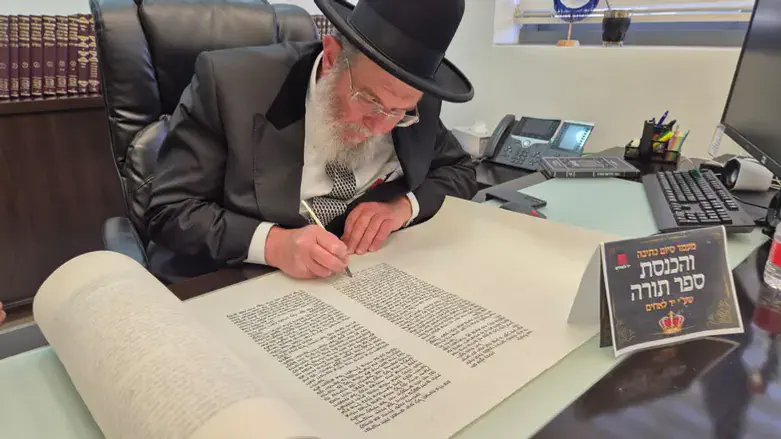
If you glance inside a sefer Torah-or any Hebrew book- you’ll notice that the smallest letter in the alef-bet, the yud, resembles a tiny swirl suspended on the parchment. This micro- letter, according to Sefer Yetzirah, represents the month of Elul.
When a scribe forms any one of the 22 letters of the Hebrew alphabet, the first stroke is a yud. In a sense, every letter begins with this tiny initial shape and extends from it.
This is one of the messages of Elul: It is an opportunity to return to our core, to our beginning, to the letter yud. For much of the year, we accumulate layers. We wear cloaks of degrees and titles, the armor of roles and responsibilities, and we wear many hats: parent, grandparent, sibling or child, professional, friend, or neighbor. We often forget the “clothes" that we are wearing, seamlessly morphing into the identity others expect of us. Elul invites us to temporarily strip away all the extensions we’ve added to ourselves, and tap into our deeper essence and ask: Who am I underneath it all?
We say Ani l’dodi v’dodi li- “I am my beloved’s and my beloved is mine"-from Shir HaShirim, an acronym for the month of Elul. But sometimes the ani, the “I," gets lost.
Who Am I?
My deeper spiritual self, the core of my being-the tiny yud that exists beneath the roles and expectations-can feel very far away.
Rav Avraham Yitzchak HaKohen Kook z"l writes about the possibility of a person losing touch with his or her authentic self, experiencing that inner self as though it were in exile. Perhaps one dimension of teshuvah in Elul is the journey of returning to ourselves- to the ani- that has become obscured.
The search for self is inherent in Elul.
In describing the spies’ journey through the Land of Israel, Onkelos (Bamidbar 13:21) translates vayaturu-“they scouted the land"-using language of searching and exploring, v’alilu, from the same root associated with Elul. Elul, then, can be understood as a month of searching: looking carefully, honestly and courageously within ourselves.
Psychotherapist Carl Rogers recognized this search as deeply human. Reflecting on what he heard from his clients, he described a question that lay beneath many of their struggles: “Who am I really? How can I get in touch with this real self, underlying all my surface behavior? How can I become myself?" The search for self is a universal part of the human experience.
What Am I Searching For?
The forty days from Rosh Chodesh Elul through Yom Kippur is a time to return to our deeper sense of self-to rediscover the simple beauty and purity of the eternal soul, reflected in the simplest and holiest of letters. The phrase ani l’dodi v’dodi li ends each of its four words with the letter yud. Since yud has the numerical value of ten, these four yuds together allude to the forty days from Elul to Yom Kippur-a sacred period in which we are called to rediscover the true ani, the true self.
Forty is also significant in another context. The Talmud describes the first forty days of the formation of an embryo as a unique period of development and for the duration of the forty weeks of pregnancy a proverbial flame burns above its head in the womb. During this time, the fetus is taught the entire Torah. When the child enters the world, an angel causes him or her to forget it all (Niddah 30b).
We begin life knowing, and then we forget.
We enter the world carrying something deep within us, and then life happens. We learn to please. To achieve. To belong. We learn what earns approval and what invites rejection. We develop identities. We become increasingly skilled at being the person the world needs us to be.
And somewhere along the way, we may forget something about who we were before all those layers were added. Elul and the teshuva process is less about changing and more about remembering; Seeking what has been buried and become hidden and forgotten.
Something forgotten has an element of loss to it. Throughout our lives we may feel pangs of loss, mourning something we cannot always name. It is a forgotten connection to our soul. Therefore, it is incumbent on each of us to seek what has been lost (see Likutei Moharan Part I, Torah 188:1).
This Elul, we’re searching within ourselves to find that yud-the tiny, ever-present yet almost imperceptible point at the core of our being, and the starting point of every word, and therefore of everything, in creation. In doing so, we seek the unique Torah song that lies within each of us.
The shape of the scribal yud resembles a flame, reminding us of the divine we experienced even before we came into this world. Perhaps, then, the deepest meaning of teshuvah is precisely this: a return to the part of ourselves that has always been there, but that somewhere along the way we may have forgotten.
The yud represents the divine spark of a yid, of every Jew - It represents our holy soul, eternally, silently, and valiantly reaching upwards.