

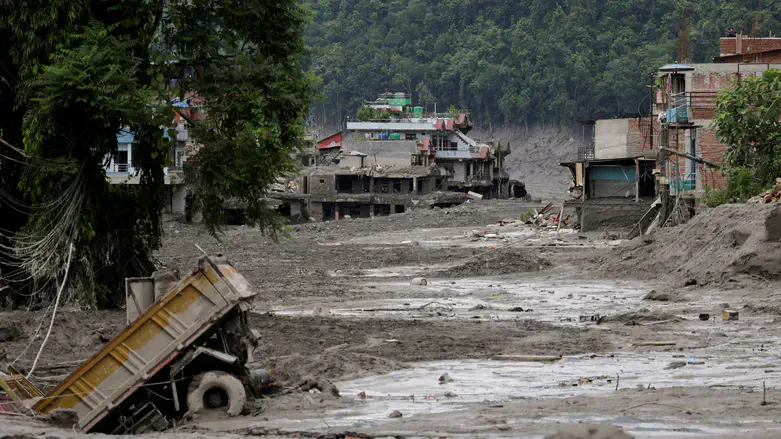
At least 353 people have been killed in the severe flooding that struck the border region between Nepal and Tibet, and more than 1,300 people are still listed as missing. Among the missing are hundreds of tourists and foreign nationals from dozens of countries.
The floods began on Wednesday following a massive collapse of ice and rock in the Himalayan Mountains. According to preliminary findings and satellite images, part of a glacier collapsed from a great height into the valley, creating a massive torrent of water, mud, and rocks that rapidly swept through populated areas. Initial reports raised the possibility that an earthquake had caused the disaster, but the US Geological Survey determined that the seismic activity detected was most likely caused by the collapse itself.
The enormous torrent advanced along the Bhote Koshi and Trishuli rivers, sweeping away homes, vehicles, and infrastructure in its path. Roads and bridges were destroyed, hydroelectric projects were damaged, and entire areas were cut off from electricity and communications. According to reports, water levels rose by several meters within a short period of time.
One of the main concerns is the fate of hundreds of tourists and hikers who were in the area at the time of the disaster. According to an Associated Press report, 826 people are listed as missing in Nepal and another 558 in Tibet. Hundreds of those missing are foreign nationals, including citizens of India, the United States, Ukraine, Malaysia, Australia, and Britain.
Rescue forces continue to operate in the area using helicopters and ground forces, but the extensive damage to roads and bridges is making it difficult to reach some locations. More than 100 people have already been rescued by Nepalese military helicopters, while teams in Nepal and China continue searching for survivors and missing persons.
The disaster also affected tourism and pilgrimage routes in the Himalayan region. Some of those missing had been traveling to the area of Mount Kailash and Lake Manasarovar, which are considered sacred sites by Hindu and Buddhist believers.
Alongside the rescue operations, authorities are monitoring the danger of additional flooding. In Tibet, there are concerns that a lake formed or blocked as a result of the landslide could burst, potentially sending another wave of water downstream.
Experts warn that the disaster illustrates the growing danger posed by unstable glaciers in the Himalayan region. Studies indicate that glaciers in the region are melting at an accelerating rate, while warming temperatures, thawing permafrost, and unstable slopes could increase the risk of landslides and sudden floods. However, an investigation into the precise causes of the incident is still underway.