
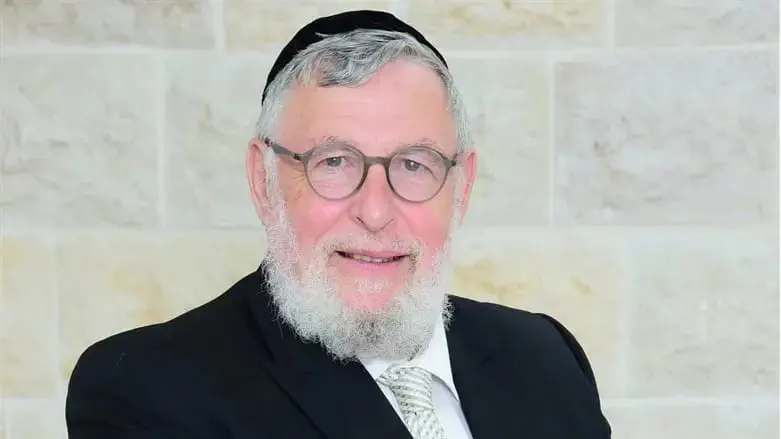
Rabbi Eliezer Simcha Weisz is a member of the Chief Rabbinic Council of Israel
"וְהָסֵר שָׂטָן מִלְּפָנֵינוּ וּמֵאַחֲרֵינוּ"
We are now in the month of Elul, and our preparations for Rosh Hashanah have begun. Chazal tell us:
"למה תוקעין? רחמנא אמר תקעו. אלא למה מריעין? כדי לערבב השטן"
(Rosh Hashanah 16a)
Chazal connect the blowing of the shofar on Rosh Hashanah with "לערבב השטן", confusing the Satan. We find this idea reflected in several practices of these days. We do not blow the shofar on Erev Rosh Hashanah, and on the Shabbos before Rosh Chodesh Tishrei, we do not announce Rosh Chodesh as we do before the other months. The blowing of the shofar throughout Elul, besides being a preparation for the Yom HaDin, , the Day of Judgement, and a call to teshuvah, repentance, is also part of this preparation.
But there is a question. How can we confuse the Satan year after year with the same practices? He has heard the shofar blasts of Elul many times before. He knows the minhagim of Rosh Hashanah and knows very well that when Elul arrives, we begin preparing for the Yom HaDin.
Perhaps the answer is that the nisayon (challenge) of one year is not necessarily the nisayon of the next.
Our obligations do not change. We must serve Hashem, maintain the kedushah of our homes, raise our children in the ways of Torah, and remain loyal to Torah. But the nisyonot we face do change.
The nisayon we faced in 5786 is not necessarily the nisayon we will face in 5787. The world changes, and the ways in which the yetzer hara, the evil inclination, seeks to weaken a person in his emunah and his commitment to Torah change as well.
We therefore have to recognize the nisyonot of each generation and know how to deal with them.
This is especially clear in the reality in which we find ourselves today. We are witnessing open expressions of antisemitism once again, and at times even acts of frightening violence. A Jew is living in a world in which simply being Jewish can make him a target.
This itself is a nisayon. We must stand firm in our Yiddishkeit, strengthen our children in their Jewish identity, and not allow fear or the atmosphere around us to weaken our commitment to Torah and mitzvot.
At the same time, here in Eretz Yisrael, we face deep differences between different parts of Jewish society. These differences are felt in public life, in society, and sometimes even within families. We have to know how to live with this reality without compromising our loyalty to Torah, and without allowing these differences to lead to unnecessary division and sinat chinam among Jews.
These are some of the nisyonot of our generation. We have to recognize the reality in which we live and think about how a ben Torah should deal with it.
This is especially important in chinuch. Our obligation to transmit the Torah from one generation to the next does not change. The Torah is the same Torah, and its principles do not change. But the nisyonot of each generation are different, and parents and mechanchim must know how to strengthen children and prepare them for the nisyonot they will face.
"חֲנֹךְ לַנַּעַר עַל פִּי דַרְכּוֹ"
(Mishlei 22:6)
The Torah does not change. But we have to know how to teach our children Torah and yiras Shamayim in the world in which they are growing up, and how to prepare them for the nisyonos they will face.
What was taken for granted by one generation is not always taken for granted by the next. The influences that affected one generation are not necessarily the same influences affecting the next. The ways that helped us deal with the nisyonot of the past may not be enough for the nisyonos we face today.
The same is true of our own avodat Hashem.
Elul is not only a time to look back at the past year. We have to ask ourselves: What is the nisayon I am facing now?
What has changed in me? What has changed in my home? What has changed in my children's lives? What do I need to respond to differently?
There is a danger in relying too much on past experience. A person may think that because he has already dealt with a particular nisayon, he knows how to deal with it now. But circumstances change, and sometimes the same nisayon comes in a different form.
The Satan does not have to come to us in the same way every year. It is enough for him to find another opening, at another time and in another way.
Perhaps this is part of what we ask in our tefillah:
"וְהָסֵר שָׂטָן מִלְּפָנֵינוּ וּמֵאַחֲרֵינוּ"
We ask Hashem to remove the Satan from before us and from behind us.
But we also have to recognize the particular nisyonot that stand before us in our generation. We have to know what we need to be careful about, where we need to strengthen ourselves, and what demands greater effort from us.
This is one of the cheshbonot of Elul: not only to ask where we need to strengthen ourselves, but also whether we are dealing properly with the nisyonott that stand before us.
The nisayon changes. The Torah does not.
Our task is to recognize the nisyonot of our generation and deal with them through the koach of Torah, which has guided Klal Yisrael throughout the generations.
Therefore, the question is not only where we need to strengthen ourselves beyond what we did in 5786. We must also ask:
What do we need to do differently in 5787?
What should we do to confuse the Satan in 5787?
This is the question we should ask ourselves as we prepare for Rosh Hashanah. If we take this question seriously, we can enter Rosh Hashanah with a true cheshbon hanefesh and with the proper preparation for the Yom HaDin.