

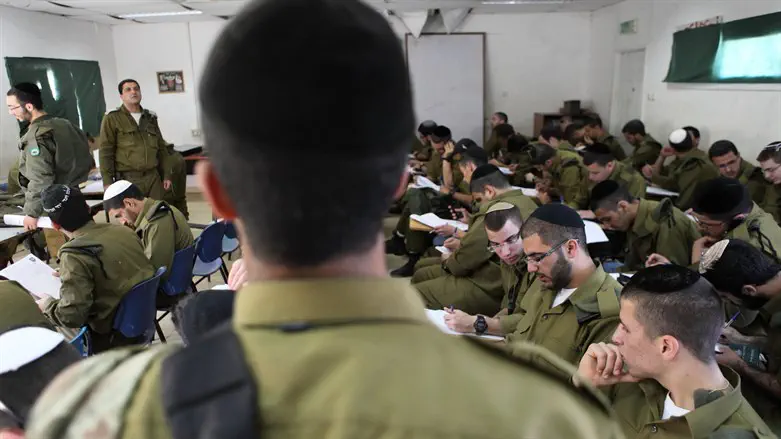
A series of new measures being led by the IDF Chief of Staff’s adviser on Haredi affairs is intended to improve service conditions and adapt the military support framework for soldiers from the Haredi community.
As part of the program, the Logistics Corps and the General Staff Supply Center in the Technology and Logistics Directorate have formulated an updated approach to providing meals for Haredi soldiers in the military.
The first stage will include the gradual discontinuation of meals distributed in sealed, prepackaged trays - the method used until now for soldiers who require Mehadrin kosher food. Instead of the trays, daily food services at bases will be expanded to allow fresh and varied Mehadrin kosher food to be served as part of the regular supply system, while ensuring respect for the soldiers’ way of life.
The program is being implemented in cooperation with the “Mehadrin and Special Populations Section," a new body established within the Military Rabbinate’s Kashrut Branch as part of a broader initiative to improve services for soldiers who require Mehadrin kosher food, those with medical dietary sensitivities, and all service members.
The section is responsible for establishing policy and halachic supervision in the areas of procurement, infrastructure, and field operations, as well as formulating dedicated procedures for kitchens on military bases designed to ensure that food meets halachic standards without compromise.
The initiative is the product of joint staff work by the Chief of Staff’s adviser on Haredi affairs, the Military Rabbinate, and the Technology and Logistics Directorate. The process included an examination of the current situation, identifying gaps based on reports from soldiers and commanders in the field, and developing a logistical solution that enables Mehadrin kosher food to be incorporated into the general food-service system.
The Chief of Staff’s adviser on Haredi affairs, Brig. Gen. Avinoam Emunah, said: “We are not satisfied merely with ensuring that a Haredi soldier can serve in the IDF while maintaining his way of life. Our responsibility is to make sure that he receives the conditions that will enable him to serve well, with dignity, and over the long term."