
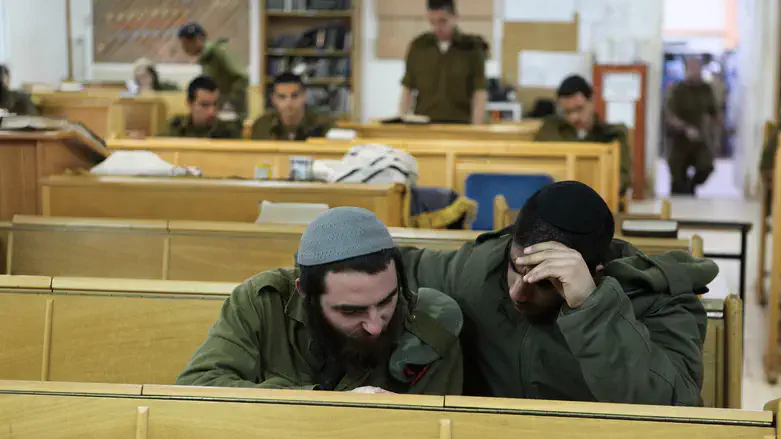
Eliahu Michaeli lives in Jerusalem with his family and recently retired from a long career in high-tech.
Let us begin by clarifying some terms:
Haredi - literally means one who trembles at the word of God. It is an expression of reverence and a desire to fulfill the will of one’s Creator.
Of course, this trait, like all traits, is relative. My Religiious Zionist family also aspires and strives to be haredim - those who tremble at the word of God. But for the purpose of this discussion, so that we do not become confused, let us assume that the word “haredi" refers to someone who makes a great effort to observe the commandments of the Torah but does not regard service in the IDF as the fulfillment of any particular mitzvah.
What and who are we angry about?
There is no doubt that public discourse makes extensive use of stereotypes. This does indeed sharpen the debate and succeeds in arousing a great deal of anger. It sharpens and oversimplifies - exactly the kind of content that the media favors and feeds to the public.
Allow me to bring a short and fragmented quotation from Rabbi Kook, of blessed memory, from his essay “The Generation" (HaDor), in which he strives so hard to elevate all of us:
“The great pain... found in our generation in the heart of anyone who thinks even a little... cannot be described or told.
“At the sight of an entire generation, fathers and sons together, of an entire nation undergoing its birth pangs... the pain is so great that it even deprives us of the ability to speak. One cannot even tell of one’s troubles... which would certainly bring considerable relief...."
He has the power of speech, but not to tell of the afflictions of his heart so that he might find relief. Instead, he uses that power to insult and revile, or to become enraged and curse.
What part does “our community" play in the present situation, in the lack of dialogue between the generation of the fathers and the generation of the sons? Here, another clarification of terms: let us assume that “our community" includes anyone who makes a great effort to observe the commandments of the Torah and most certainly regards service in the IDF as the fulfillment of a Torah commandment.
At first glance, our community stands in a key position in the public debate that is gaining momentum as the Knesset elections approach. After all, we study Torah and also serve in the IDF. So we are conclusive proof against the claim of the haredi public that they are obligated to study Torah and therefore cannot enlist.
Conclusive proof, apparently. But perhaps this proof serves more as “oil on the fire" than as a source of inspiration? Perhaps we should take a moment to examine the substance of the dispute, and perhaps then we will know how, at the very least, not to serve as oil on the fire? And perhaps, if we can free ourselves from the role of being that oil, we might even succeed in becoming a calming and bridging influence.
First of all, let us look inward. Is everything perfect in our ranks? Let us speak for a moment about an important and decidedly unpleasant subject: the dropout rate. In a quick consultation with Mr. AI, I received a figure worse than I had thought: 40%. (I don’t believe it. I had innocently thought that we were already dropping below 25%.) And among the haredi public? 12%. What I did not want to ask Mr. AI was the reason for the difference in the dropout rate. I prefer to think a little for myself.
The familiar explanation, when comparing dropout rates between the sectors, is that whoever encloses his children within a hermetically sealed environment will naturally have a lower dropout rate. I do not like this explanation because it, too, is superficial. Presumably, there are additional layers behind the educational system of the haredi public. There is something deeper there that fosters genuine adherence to the path of the fathers.
My own focus is on learning, on the beit midrash. To what extent do we succeed in transmitting to the next generation a love of Torah - a love like fire, which even many waters cannot extinguish? To the extent that we succeed in this, we will increase the percentage of those who remain devoted to the path of Torah and decrease the percentage of those who leave it.
Since there is no intention here to broaden the discussion into the subject of education in general, I will suffice by saying that it seems to me that precisely on this issue - the love of and devotion to Torah study - we have something to learn from the haredi public. A great deal to learn.
And this cannot be summed up in useful “tips" that our teachers receive in a Ministry of Education professional-development course. Presumably, the strength of the haredi public in Torah study grows out of an entire framework of life and society. It would not be right to try to copy and paste from their society into ours. It is not relevant.
What is relevant is this: if we recognize that there is a connection not only between Torah study and adherence to the path of Torah, but also between a lack of success in Torah study and enlistment in the IDF at a young age, and subsequently between these and leaving the path of Torah (although not the only factor) - then we will conduct ourselves with the humility that is called for.
We will examine what can be changed within our own community, and from there, what we can change so that the IDF will be the army of the Jewish people in the fullest sense of the term. We have a long road ahead of us before reaching that goal.
In the meantime, let us relinquish our status as the “model example," and consequently also our function as oil on the fire. The very fact that we refuse to serve as a divisive force will already move all of us one step forward in the right direction.