
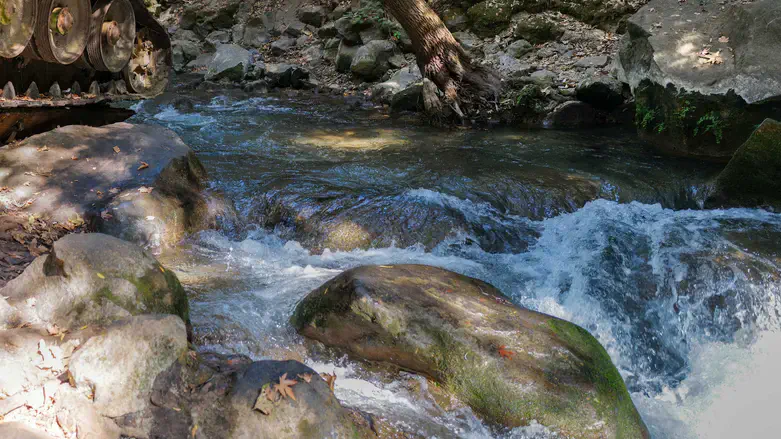
The Ministry of Health and the Ministry of Environmental Protection have issued a warning to hikers and local authorities following unusual results in water samples collected from streams in northern Israel.
The ministries said that entering streams where irregularities were detected may be dangerous until further sampling produces stable and reliable results.
Bacterial tests conducted on samples collected Sunday and Monday found that several streams had fecal coliform levels exceeding the Ministry of Health’s recommended limit of 400 colonies per 100 ml, indicating possible contamination of the water.
In the Banias, a level of 670 was measured at the bridge near Kfar Salda. In the Hatzbani, levels of 420 were recorded at the Roman Bridge, 2,300 at North Park near the hydroelectric station, and 1,800 at the Meeting of the Streams promenade at the entrance to the Jordan River.
In the Jordan River, elevated levels were recorded at several locations: 1,400 at the Yosef Bridge, 1,250 at the Lehavot HaBashan Bridge, 1,400 at the Chameshet Bridge, 1,700 at the Pekkek Bridge, 1,900 at the Ataret Estuary, 830 at the Dodot Bridge, and 1,300 at the Erik Bridge. At the Meshushim Pool, a level of 3,400 was measured.
At the Gilabon, a level of 1,500 was measured; in Zaki, 940; and at the Yehudia Falls, 3,000. At the Carob Pool in Nahal Tzalmon, a level of 2,900 was measured. In Nahal Kziv, levels of 1,300 were recorded at Ein Ziv and 900 at Ein Hardalith.
Following the results, the ministries warned against entering the Banias area at the Kfar Salda Bridge; the Hasbani from the Roman Bridge to the Meeting of the Streams promenade; and the Jordan River from the Yosef Bridge to the Erik Bridge.
The warning also applies to the Meshushim Pool, Gilabon, Zaki, Yehudia, the Carob Pool in Nahal Tzalmon, and Ein Ziv and Ein Hardalith in Nahal Kziv.
The Ministry of Environmental Protection said that no known source of contamination has been identified in the streams.
As part of routine monitoring, Israel Nature and Parks Authority inspectors collect samples every two weeks at fixed points along streams in the Upper Galilee, the Golan Heights, and the Western Galilee. The sampling points represent waterfalls, pools, or sections of streams.
The Ministry of Health and the Ministry of Environmental Protection said they will continue to conduct sampling and monitor the water quality, and will issue further updates as necessary.