
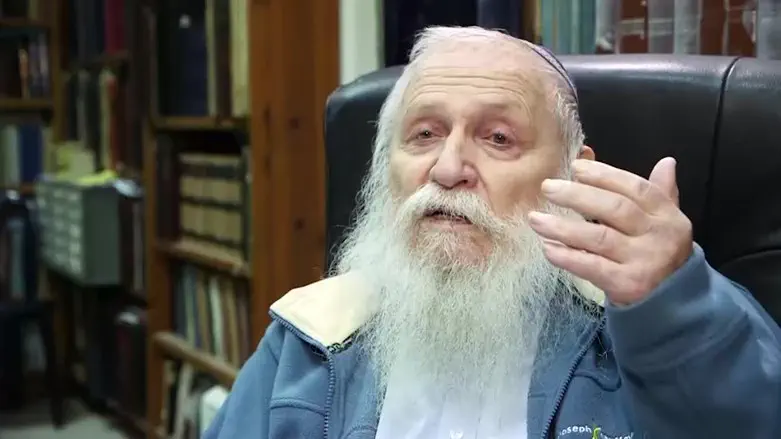
Rabbi Chaim Drukman was a venerable spiritual leader of political religious Zionism and a founder of the settler movement who coined the term Gush Emunim, influenced country’s top leaders as a rabbi, educator and political power in Israeli society.
This article is an extract from his book, “La-Zeman Hazeh," a series of essays about Jewish holidays, including both traditional holidays and “new" ones that were established in the last hundred years to celebrate the Jewish people’s return to the Land of Yisrael.
(Adapted and translated by Moshe Goldberg)
“They All Rise to the Same Place"
In his book Orot HaTeshuvah (4:3) Rav Kook, zt"l, notes that there are two kinds of teshuvah (repentance) - that of an individual person and that of the whole world. They are not separate from each other but share common ground, and through both of them the world rises to greater heights:
“General teshuvah is the elevation and mending of the world, and individual teshuva is related to the character of each and every individual... taken together they are one and the same. This includes cultural improvements through which the world emerges from its ruin and social and economic elements, which continue to develop and improve, together with the mending of every sin and iniquity - all of these are a single unit, and they are not disconnected from one another. They all rise to the same place."
The power of teshuvah is not limited, it encompasses every domain of life, that of the individual and that of civilization as a whole.
There is no need to explain how the mending of sins is connected with the individual’s power of teshuvah. The “mending of culture" of which the Rav speaks is connected with improving the moral perfection of the world, a matter that is likewise connected with teshuvah. But what do “economic elements" have to do with teshuvah? Seemingly, this concerns mundane affairs of this world - how is it connected to the “power of teshuvah"?
The Role of Material Rewards
In the portion of Bechukotai, the Torah promises a reward to those who fulfill its commandments (Vayikra 26:3-5): “If you follow My statutes and keep My commandments and do them, I will give your rains in their season, and the land will yield its produce, and the trees of the field will yield their fruit. Threshing shall last until the vintage, and the vintage will last until the sowing time. You will eat your bread to the full and dwell safely in your land."
The Holy One, blessed be He, promises material rewards in this world for the fulfillment of the Torah and its commandments. Following these and similar verses, the Rambam raises a difficult question (Hilchot Teshuvah 9:1):“Since it is known that the reward of the commandments and the good that we merit if we keep the way of God written in the Torah is life in the world to come... what then is meant by what is written throughout the entire Torah: if you hearken, such-and-such will befall you, and if you do not hearken, such-and-such will befall you - all of these things in this world! Such as: satiety and famine, war and peace, sovereignty and lowliness, dwelling in the land and exile, success of one’s endeavors and failure, and all the other matters of the covenant?!"
We understand that true life is not in this world, but in the world to come. The world where we now live is only a kind of “corridor," a path on the way to the world to come. Accordingly, the reward for our labor in fulfilling the Torah and its commandments is reserved for the world to come, where it holds great value, and this refers to a spiritual reward.
On the other hand, we find passages in the Torah that promise material reward in this world! How do we reconcile the two approaches? The Rambam explains: “Here is the way to understand this matter: the Holy One, blessed be He, gave us the Torah. It is a tree of life - and whoever fulfills all that is written in it, and knows it with complete and correct knowledge, is rewarded with life in the world to come. One merits it in proportion to the greatness of one’s deeds and the abundance of one’s wisdom, And He promised us in the Torah that if we perform the mitzvot with joy and a good spirit, and contemplate its wisdom, He will remove from us all the things that prevent us from performing the mitzvot - such as illness, war, famine, and the like. He will grant us all the good things that help us perform the Torah, such as satisfaction, peace, and abundance of silver and gold. And we will not spend all our days occupied with the things the body needs, but rather sit free to study wisdom and perform the commandments, so that we may merit life in the World to Come."
In another place, the Rambam writes a similar idea (Introduction to Perek Chelek, 4):“But the promises and their opposites stated in the Torah mean... that He (God) says to you: if you fulfill these commandments, I will help you fulfill them and attain perfection in them, and I will remove from you all obstacles, since it is impossible for a person to serve God while sick or hungry, or thirsty, or in a state of war; therefore He promised to remove all these, and that they be healthy and tranquil - so that through them they attain knowledge and merit life in the World to Come. It thus emerges that the purpose of the Torah is not that the earth be fattened, that days be lengthened, and that bodies be healthy - but rather that these things assist in its fulfillment."
The value of reward in this world is only as a means for acquiring a reward in the World to Come. Through prosperity in this world, a person becomes free to serve God and is thus able to attain the reward of the World to Come. The rewards of this world are a means, not an end.
This is how Rabbi Ovadiah Sforno explains the “Priestly Blessing" (Bamidbar 6:24-25):“May He bless you" - with wealth and possessions, for “if there is no flour, there is no Torah" (Avot 3:17)... “May He shine" - may He reveal the light of His countenance to your eyes, to behold the wonders of His Torah and His works, after you have attained your needs through His blessing.
The fulfillment of physical needs helps us attain true values. Illness and poverty prevent a person from increasing in good, whereas health and wealth create a comfortable foundation for a person to rise and become sanctified.
With this approach the words of the Rav, zt"l, are clear: any development whatsoever, in any domain, ultimately supports spiritual advance. For example, human life can be prolonged through the proper use of scientific discoveries, thereby enabling humanity to spend more time on good and morality in the world. The result is spiritual development of the entire world.
This is the power of teshuvah, which pushes the world toward the completion of its destiny. The fact that people do not yet make use of material and scientific progress for the sake of spiritual advancement does not change the truth that this is what they were meant to do.
Examples of Advancing the World
The situation of the world has not yet been completely mended, but at the same time one should not ignore many improvements that have already taken place.
We will discuss several prominent examples of the advance of humanity and the world. Every advance stems from the power of teshuvah that the Holy One, blessed be He, embedded within creation. The process of teshuvah has been improving the world for thousands of years, and it can be expected eventually to lead to a much better future.
When one looks at the state of the world, the negative that exists strikes us - how much wickedness and injustice exists! It is important to remember that achieving perfection is a gradual process. The development of the world is a long journey, and as in every journey there are great dangers along the way. Indeed, it is a slow and dangerous process, but at its end it holds within it the promise of perfection of the entire world.
Barbarism and Education: In the past, humankind was much coarser, cruder, and more barbaric than it is today. This is true both in terms of the number of nations that were in a debased state, and in terms of the severity of the moral degradation of each individual nation.
In the past there were cannibals. This reality gradually diminished over the years, until in our time it has disappeared entirely. Perhaps there still exists some savage tribe here or there, but humanity as a whole recoil from eating human flesh and strongly condemns such acts.
True, we are still far from eliminating every trace of barbarism and savagery, Even though today people are not literally eaten, other ways are found to “devour" human beings. But at the same time one must not ignore the tremendous advance of humanity, and this is part of the teshuvah of the entire world.
The Social Domain: There is great progress in the social domain as well. We live in a reality in which things are taken for granted, but it is important to know that this was not always so! There are various benefits given in many countries of the world to every citizen, however poor:
Working conditions - a defined fixed number of work hours during the day, a basic wage, fair relations between employer and employee, and so on.
Health insurance - a person receives medical treatment through health funds; in most cases a sick person is never thrown into the street to fend for himself.
National insurance - a person who is injured and unable to support himself is helped by the state. In the past, such a person would have wasted away from hunger in the street. Indeed, there were always charitable institutions among the people of Israel, but not a complete national and orderly system that cares for the weak as a matter of law, rather than as charity.
Education - in the past, most people did not know how to read and write. Today, in developed countries there are public schools; at least up to a certain age, children receive a basic education, and sometimes even more than that, whereas in the past they would work in the field with their father and remain uneducated for their entire lives.
Improved Communication: Another result of scientific development is the expansion of human perception. A person who spends his entire life within his own surroundings sees only himself. The development of science and the means of communication have given people a broader and more general outlook. A person begins to take interest in everything that happens in the world, from one end to the other. The individual emerges from his privacy and from the narrow circle in which he lives, and becomes more general. And the more general a person becomes the greater he is.
Here too, these tools can be used for bad or for good, and as the world continues to develop they will be used only for the good.
Idolatry: In the past, the entire world, from one end to the other, was deeply steeped in idolatry.
Ever since the light of our father Abraham appeared, idols have gradually been shattered. This is a long process, and at times one form of idolatry is lost only to be replaced by a new form. But it is clear that the severity of idolatry is diminishing. In the past there were coarse and crude cults, which included severe acts such as human sacrifices, but today, apart from the fact that many no longer practice idolatry at all, even those who do practice it do so with more refined rites.
This advance is leading the world towards true faith. It is true that Christianity, which is one of the two great international religions, is still defined by us as idolatry. However, one can point to a considerable difference between this religion and ancient idolatry, which was extremely coarse and crude, and this too is an example of worldly progress toward complete faith.
Teshuvah as a Neverending Power
These are but a few of many examples that show the power of teshuvah which was created before the world and was embedded within reality. It is the driving force for the advancement of humanity, for its improvement and perfection. It is destined to lead to an ultimate end, when all the peoples of the world will recognize God and act accordingly.
This wondrous future will definitely come, as Rav Kook, zt"l, writes (Orot HaTeshuvah 5:3): “The world is bound to arrive at complete teshuvah. It is not static, always remaining at one level; rather, it continues to develop. And true and complete development will make it healthy, both materially and spiritually - and it will bring with it the light of a life of teshuvah."
Our world has a purpose; it was not created for naught. But in order for it to achieve its goal, there is a need for the “power of teshuvah," which pulses like a living soul throughout the whole of reality, awakening it and advancing it toward its purpose.
Teshuvah constitutes a kind of “remedy" that precedes the “wound." It was embedded in the world before the creation in order to help achieve perfection. Teshuvah acts continuously within creation, and therefore - “the world is bound to arrive at complete teshuvah."
The world is not static but dynamic, developing all the time. This does not come about on its own, but is the result of the “power of teshuvah" that pushes creation forward. It is destined to heal the world, through the perfection of both spirit and matter. This is what is called “a healthy soul in a healthy body."
We will conclude with two more passages from Rav Kook, zt"l, which are related to the meaning of the “spirit of teshuvah" in the world: “The spirit of teshuvah hovers over the world and gives it its essential character. It drives its development, and like perfume in its spices it refines it and gives it all the talent of its beauty and glory (ibid. 5:4). Teshuvah comes from the desire of all of reality to improve and to become more purified, more resilient and better than it is now. This desire hides a living force for overcoming the limited measure of existence and its weaknesses. And the individual teshuvah of a single person, and how much more so that of the people as a whole, draws its strength from this source, which always acts with its might in unceasing action (ibid, 6:1)."
The basis for teshuvah today is a general attempt of the entire reality to achieve perfection. The “spirit of teshuvah" gives the world the drive to rise, to advance, to reach a more complete status. This spirit nourishes both the development of humanity as a whole and the advancement of the individual.
Teshuvah gives us the power to overcome the limitations of life and to rise above the weaknesses of our current existence.