
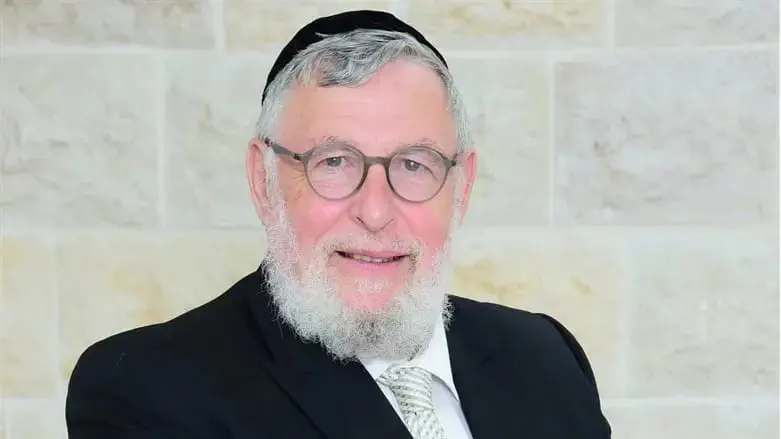
Rabbi Elieizer Simcha Weisz is a member of Israel's Chief Rabbinate Council.
In Parashat Ki Teitzei, the Torah tells us:
“When you build a new house, you shall make a guardrail for your roof, so that you will not place blood in your house, should someone fall from it."
(Devarim 22:8)
When a person builds a home, it is not enough for the house to be beautiful, strong and well planned. He must also think about what could go wrong. If there is a place from which someone could fall, he has to put up a ma’akeh. The Torah does not tell us to wait until something happens and then react. We are expected to recognize the danger and prevent it.
There is an important lesson here. A home has to be protected not only from dangers that come from outside. We also have to be aware of things within the home that can weaken it.
Immediately after the mitzvah of ma’akeh, the Torah brings the laws of kilayim:
“You shall not sow your vineyard with a mixture," and “You shall not plow with an ox and a donkey together."
The two mitzvos are, of course, separate, and we should not turn them into one halachic subject. But their proximity gives us a thought that is especially relevant to our generation.
Kilayim reminds us that differences are real. The Torah does not ask us to erase every distinction. There are different species, different qualities and different purposes, and the Torah teaches us that sometimes they must remain distinct.
But being different does not mean that we cannot live together.
A house can contain people who are different from one another, each with his own character and his own way, and yet they are all living under the same roof.
That is the picture we should have of Am Yisrael.
We do not have to become the same. We do not have to give up our different traditions, our different rabbanim or our different approaches. We can recognize the differences between us and still understand that we are travelling within the same larger framework.
The ma’akeh surrounds the whole house.
It does not belong to one room and not to another. It protects everyone who lives there.
So too, there can be different paths within the religious community, but we are still under the same ma’akeh: the same Torah, the same emunah, the same history, the same people and the same responsibility for Am Yisrael.
We can walk on different paths without becoming strangers to one another. We can preserve our differences and still live within the same house.
That, perhaps, is the message we can take from the juxtaposition of kilayim and ma’akeh: know what makes us different, but also remember what surrounds us all.
The purpose of a boundary is not necessarily to separate people from one another. Sometimes it allows different people to remain who they are while still belonging to the same larger home.
And that is precisely what we need today.
We are living through a very difficult period for Am Yisrael. Our enemies are still threatening us, soldiers are carrying a heavy burden, many families have gone through experiences that no family should have to endure, and there is still much uncertainty about what lies ahead. We all know how much we need the rachamim of the Ribbono Shel Olam.
At such a time, it is especially painful when the divisions within our own ציבור become so pronounced.
Within the religious community there are different communities, different batei midrash, different rabbanim and different approaches. There are genuine differences in outlook and in the way we understand questions concerning the State, society, leadership and many other matters.
We should not pretend that these differences do not exist. There are matters on which each person must follow the guidance of his Rabbonim. There are principles that we believe must be preserved, and there are differences that are important.
But when we step back for a moment, we also have to recognize how much we have in common.
We learn the same Torah. We daven to the same Ribbono Shel Olam. We are part of the same people and live in the same Land. We want our children to grow up with Torah, mitzvos, emunah and good middos. We care about the future of Am Yisrael and Eretz Yisrael. We daven for the safety of our soldiers and for the families who are carrying so much. We want to see Am Yisrael strengthened and the Torah world continue to flourish.
These are not small things. They are the foundations of who we are.
And yet it is easy for a person to become so identified with his own group that he begins to see another Jew primarily as someone who belongs to a different camp. Instead of first seeing the person, the Jew, the ben Torah and the fellow member of Klal Yisrael, we see his political position or his community and judge him accordingly.
That is something we need to think about.
Chazal give us a remarkable example in the relationship between Beis Shammai and Beis Hillel. Their disagreements in halachah were genuine. They were not minor differences of opinion. Nevertheless, Chazal tell us:
“Beis Shammai did not refrain from marrying into the families of Beis Hillel, nor did Beis Hillel refrain from marrying into the families of Beis Shammai."
(Yevamos 13b)
They disagreed in Torah, but they did not allow those disagreements to destroy the relationship between them. They continued to live as part of one people.
This does not mean that every opinion is equally valid, or that differences in Torah outlook should be ignored. It means that a disagreement does not have to become a reason to stop respecting the person with whom we disagree.
We can hold firmly to our own position and still recognize that the other person is a Jew who is trying to serve Hashem. We can believe that his approach to a particular issue is mistaken and still understand that he is part of our ציבור and that we have a responsibility towards him.
This becomes even more important during elections.
We are now in a period of bechirot, and this is a time when differences naturally become sharper. Political arguments become more emotional. People begin to speak about one another in terms of camps and labels, and sometimes a disagreement over a political question becomes a personal judgment about the person himself.
There is nothing wrong with having strong political convictions. There is nothing wrong with voting according to one's understanding of what is best for the country and for Am Yisrael. There is nothing wrong with listening to the guidance of one's Rabbonim and following it.
But an election lasts for a day. The Jewish people remain one people afterwards.
We have to be careful that a political disagreement does not create a lasting hatred between people who otherwise have so much in common. We may vote differently and still daven together. We may have different ideas about leadership and still recognize one another as brothers. We may disagree about the direction in which the State should go and still understand that we are responsible for one another.
We may walk on different paths, but we are still living under the same ma’akeh.
The same Torah surrounds us. The same history surrounds us. The same people surround us. The same responsibility for Am Yisrael surrounds us.
That is where the idea of ma’akeh becomes so relevant. The purpose of a guardrail is to prevent the fall before it happens. There are things we say during periods of tension which perhaps seem harmless at the time, but which leave a lasting impression. There are children who hear the way adults speak about another group and learn from it. There are friendships damaged because of political arguments. There are people who begin to think that someone from another camp is somehow less religious, less committed or less worthy.
These are dangers that we should recognize before they become permanent.
The enemy outside does not always distinguish between the different groups within our community. When Am Yisrael is in danger, the danger does not stop at the boundary of one community or one political camp. The pain of a family does not belong to one group. The safety of a soldier does not belong to one group. The future of the Jewish people does not belong to one group.
Our responsibility therefore has to be bigger than our differences.
There is an important distinction between saying, “We are not the same," and saying, “We do not belong to one another."
We may not be the same. We may have different traditions, different rabbanim and different ways of looking at important questions. But we still belong to one another.
And perhaps this is something that each of us should consider personally.
We are accustomed to asking ourselves where we stand on an issue. But we should also ask whether we have begun to look at another Jew only through the prism of his political or communal affiliation. Do we recognize the Torah and the good that exist in a person even when we disagree with him? Do we know what we share with the other community, or have we become accustomed to seeing only what separates us?
There is no need to surrender principles in order to answer these questions honestly.
The Torah itself demands from us sensitivity towards another person. Chazal teach:
“Just as He is compassionate, so should you be compassionate; just as He is gracious, so should you be gracious."
(Sotah 14a)
Our relationship with Hashem cannot be separated from the way we treat other people. Avodas Hashem is not confined to the Beis Midrash. It is also expressed in the way we speak about another Jew and in the way we regard him.
We also have to be careful not to make cheshbonos about why particular tragedies happen. We do not know the calculations of Heaven, and it is not our place to explain why one event occurred or another. But we certainly have to make a cheshbon about ourselves.
The Ribbono Shel Olam gave us one Torah and one people. Within that people there are many communities and many approaches. That is part of the richness of Klal Yisrael. But all of them are within one larger home.
And when the home is under pressure, we all have a responsibility to strengthen it.
That is the lesson of the ma’akeh. We should not wait until the fall to realize that there was a danger. We have to recognize the danger while there is still time to do something about it.
We are at a point where we have to be careful: before political disagreements become personal hatred; before children learn to look down on another Jew because of the community to which he belongs; before differences in outlook become a permanent distance between people who should be able to speak to one another.
We can disagree. We can have different rabbanim and different approaches. We can vote differently and hold different opinions about the future of the State.
But we must not lose sight of the fact that we are one people.
And now, as we approach the month of Elul, this takes on another dimension.
Elul is the time when a person makes a cheshbon hanefesh, looks honestly at his actions and asks the Ribbono Shel Olam for selichah and mechilah. Much of our attention naturally goes to bein adam laMakom - our relationship with Hashem, our mitzvos, our tefillos and the areas in which we need to do better.
But Elul also requires us to look carefully at bein adam lachaveiro.
It is not enough to ask Hashem for forgiveness while ignoring the way we have treated another Jew. We have to think about the words we have used, the way we have spoken about other communities, the judgments we have made, and the distance we may have allowed to develop between people who are really brothers.
This is a good time to put aside some of the anger and suspicion that have accumulated between us. Not to give up our principles, and not to pretend that legitimate differences do not exist, but to put those differences in their proper place.
For the sake of Am Yisrael, we have to find our way back to one another.
This is not simply a matter of being nicer to one another. It is part of our responsibility as Jews and as people of Torah.
We have to make the effort. We have to speak with greater respect. We have to listen to one another. We have to make room for the fact that another Jew may see an issue differently without becoming our enemy.
And we have to daven.
We should ask the Ribbono Shel Olam to give us the wisdom to know which boundaries are necessary and which have become walls; to give us the strength to overcome anger and resentment; and to give us the humility to recognize the Torah, sincerity and goodness that exist in another Jew even when we disagree with him.
זה הבית שלנו, והאחריות עליו מוטלת על כולנו.
This is the time to put aside what can be put aside, to strengthen what we share, and to make a real effort to bring Jews closer to one another for the sake of Am Yisrael.
And this is precisely what we should be asking for in our tefillos during Elul: that the Ribbono Shel Olam give us the wisdom and the strength to do what is right, to repair what needs repairing, and to overcome the divisions that have grown between us.
We also turn to Him to protect all of Am Yisrael, the residents of Eretz Yisrael, our soldiers and their families, and all our brothers and sisters who are suffering and in captivity.
“Hashem will give strength to His people; Hashem will bless His people with peace."
The responsibility is ours. The effort is ours. The teshuvah is ours. And we ask the Ribbono Shel Olam to help us fulfill that responsibility faithfully.
In this month of Elul, when we ask for selichah and mechilah, let us remember that our teshuvah must include both bein adam laMakom and bein adam lachaveiro. Let us put aside what does not need to divide us, strengthen the bonds between us, and do our part for the sake of Am Yisrael.
We are different, but we are not separate. We may follow different paths, but we live within the same house, under the same ma’akeh. And we have a shared responsibility to work together to strengthen the home that belongs to all of us.
And we should ask the Ribbono Shel Olam to give us the wisdom, the courage and the siyata diShmaya to do our part faithfully, to strengthen Am Yisrael from within, and to bring yeshuah, peace and blessing to all of Klal Yisrael.