
Ta-ta-ta-Taaa.
Beethoven's Fifth Symphony begins with four of the simplest notes ever written. Four notes. Barely two seconds. No elaborate melody, no developed harmony - almost nothing, by the ordinary rules of composition. And yet from that handful of notes Beethoven built one of the most ferocious musical journeys ever composed and turned four notes into one of the most recognizable phrases in the history of music.
Whether Beethoven himself ever called it "fate knocking at the door" as his assistant claimed has long been debated. But the phrase has endured because it names something every listener feels and no listener can explain. Before the symphony has revealed a single theme, before it has hinted at where it is going, those four notes already own the concert hall. They interrupt. They awaken an expectation the mind has not yet caught up to - because music can seize the human heart before the intellect has found a single word to describe why.
Words must be understood. Sound can strike before understanding begins. Speech is decoded largely by temporal and frontal language networks; music spreads more widely, engaging the auditory cortex and reaching into the amygdala, hippocampus, and insula. A few notes can awaken fright and longing before the prefrontal cortex has found words for what is happening. Language tells the brain what something means. Music can make the brain feel that meaning first.
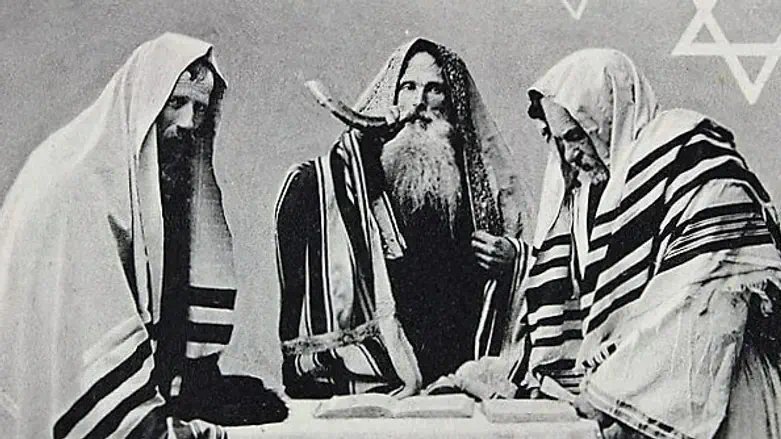
Perhaps that explains one of Judaism's oldest mysteries. The shofar has no symphony's complexity. No harmony at all, in fact - scarcely what a musician would even call a melody. It is little more than breath forced through the twisted horn of a ram, a single raw cry with nowhere to hide. And yet for more than three thousand years, that cry has torn through Jewish hearts with a force that sermons and syllogisms have rarely matched.
Maimonides understood why. He called the shofar a gezeirat hakatuv, a divine decree, yet immediately added, ramez yesh bo - "there is an allusion within it."
The allusion was not an explanation of the symbolism of the ram’s horn but an echo of its voice:
"Awake, sleepers, from your sleep; arise from your slumber; examine your deeds, remember your Creator, and return in repentance."
The shofar does not teach what we never knew. It awakens what we have allowed ourselves to forget.
Voice and melody precede the word, and awakening precedes understanding.
Maimonides leaves us at the threshold of language, where the shofar speaks without words.
The Zohar offers a striking interpretation of Moses' initial reluctance to lead the people. When Moses protests, "I am heavy of mouth and heavy of tongue" (Exodus 4:10), the Zohar explains: "משה הוה קול ודיבור הוה בגלות"-"Moses was the voice, while speech was in exile" (Zohar II:25b). Rabbi Joseph Soloveitchik, the Rav, in his essay Redemption, Prayer and Talmud Torah, expounds that Moses first emerges not as a master of eloquence but as the bearer of the kol, the living voice through which redemption begins.
Speech, with its precision and articulated meaning, still awaits its redemption. Only gradually does the voice become fully united with speech, reaching its fulfillment at Sinai, where Moses becomes the living instrument through which the Torah is communicated to Israel. Before Israel receives commandments, it encounters voice-"וכל העם רואים את הקולות" ("All the people saw the voices"). The Torah itself enters history through a revelation in which voice precedes articulated teaching.
The shofar follows this same pattern. It does not begin with teaching or explaining. Like the voice of Moses, it first awakens the soul, preparing it to receive the divine word. In both the Zohar and the experience of the shofar, the voice and melody precede the word, and awakening precedes understanding.
Jewish tradition has long expressed those same ideas about voices and melodies. Rabbi Nachman of Breslov taught that every blade of grass possesses its own song and that all creation continually sings before its Creator. His disciple, Rabbi Nathan, gave poetic expression to that vision in the beloved Shirat Ha'asavim:
דע לך שכל רועה ורועה
יש לו ניגון מיוחד משלו,
ומשירת העשבים
נעשה ניגון של רועה.
"Know that every shepherd has his own unique melody, and from the song of the grasses the shepherd's melody is made."
The shepherd does not impose music upon the world. He first learns to listen. His melody is born from hearing the hidden music already woven into creation.
No modern Jewish writer developed that idea more beautifully than Y. L. Peretz. Asking the deceptively simple question, "What is a melody?" he answers that music is not created from nothing because the world is already filled with sound. Birds possess their songs. Forests whisper when the wind moves through their branches. Stones answer one another when they collide. Even the rumble of a train rushing across iron rails contributes its own rough music to creation. The artist creates nothing from nothing. He gathers the scattered sounds of the world into a meaningful whole.
Yet sounds alone remain lifeless. What gives them life is the human heart. Love and grief, hope and disappointment, fear and consolation, repentance and joy breathe themselves into those sounds until they become more than melody. They become memory. Every generation leaves something of itself within a song until it carries not only notes but the accumulated emotional life of all who have sung it before. Peretz therefore reaches a most beautiful conclusion:
"I believe with perfect faith that whatever gives me life must itself be alive. And when I see that a beautiful melody breathes into me the breath of life itself, I know that the melody, too, is alive."
Perhaps that is why the shofar, possessing neither the complexity of a symphony nor what musicians would ordinarily call a melody, has nevertheless stirred Jewish hearts for more than three thousand years. Like Beethoven's four unforgettable notes, its ancient cry does not first explain. It first awakens. shevarim-tekiah- combination of short and long sounds. Ta- ta- ta- taaa
_________________________________________
One summer afternoon in the late 1970s, during Rabbi Joseph B. Soloveitchik's annual Yarchei Kallah in Brookline, Massachusetts, dozens of rabbis sat absorbed in another of the Rav's mesmerizing lectures about the Days of Awe. For several days he had guided them through the intricate arguments of the Talmud and Maimonides with the brilliance and precision for which he was renowned. Familiar texts had opened into entirely new landscapes of meaning, and as the lecture drew toward its conclusion, everyone leaned forward, certain that one final insight was coming.
Rather than continuing his analysis, he slowly surveyed the audience, until his eyes came to rest on an elderly Jew seated near the back of the hall. He was a member of the Brookline community, neither a distinguished scholar nor a celebrated ba'al tefillah. Most of those present certainly did not know his name. Yet there was something unmistakably authentic about him, as though he carried within himself the echoes of another generation.
Then, without a word of explanation, the Rav asked him to chant the ancient piyyut recited in the morning service of Rosh Hashanah. A murmur passed through the hall.
The elderly gentleman seemed embarrassed.
His voice was quiet, unpolished, frail, but every phrase seemed carved by decades of prayer rather than performance. The melody carried the unmistakable cadence of Eastern European nusach, shaped by generations of Jews who had poured into it their deepest fears, hopes, and longings - and something in the room went very still.
“Through the shofar's call I seek His favor; and with bended knee;
In the company of friends in His garden, I will enjoy His friendship."
“בשופר אפתנו, בברך כריעה, במנגינת רעים אתרועעה"
When the final note faded, the Rav let the silence stretch. Then he looked around the room and asked, quietly:
"What did you hear?"
No one answered. The silence deepened. After a long moment, the Rav himself broke it, with a single sentence:
"The melody interpreted the prayer."
The Rav had not pulled an old gentleman to his feet to admire a fine nusach. He was listening for a single hinge in the music, so small that a room full of scholars could sit through it a hundred times and never once notice it turning.
As the melody enveloped the words,
בשופר אפתנו, בברך כריעה, במנגינת רעים אתרועעה
it happened.
Until that instant, the first four words the melody had carried the full weight of the Days of Judgment - awe, dread, the naked knowledge that every soul stands utterly alone before God. Then, the music lifted. It simply opened - brighter, warmer, more rhythmic, no longer solitary.
The Rav later explained that this transformation occurred because the melody revealed what the words alone could not fully express. At the beginning of the sentence, the worshipper confronts God as an individual, conscious of personal responsibility and personal judgment. By the time the melody reaches " In the company of friends in His garden, I will enjoy His friendship."
"במנגינת רעים אתרועעה," that same individual has been gathered into Knesset Yisrael. The prayer has become communal. Through sounding the shofar, the burden of judgment is now carried within the covenantal life of a people that has stood before God for generations.
That movement is one of Judaism's deepest religious insights. Repentance is never merely a private act. The individual returns to God as part of a covenantal community stretching across time. One enters the synagogue carrying personal anxieties, failures, and hopes, but one discovers that these have always been shared by generations who prayed the very same words. The melody makes that discovery audible; before the mind has analyzed the transition, the heart has already experienced it.
The Rav's five words - "The melody interpreted the prayer" - also cast Beethoven's Fifth in a different light. The symphony's greatness lies not only in that thunderclap opening but in what it costs to earn the ending. Those same four notes return again and again, hunted through key after key, each return colored by everything that came before - defiant, then anxious, then almost broken - until, after a struggle that spans four movements, the darkness of C minor finally gives way to the blazing confidence of C major. The triumph convinces precisely because the music never lets you forget how dark it was. Nothing is erased. It is redeemed.
TA-TA-TA-TAA!
And perhaps the custom to sound an exceptionally long tekiah at the end of the Rosh Hashanah’s day service is to point to the ultimate redemption: “On that day a great shofar shall be sounded…"
Rabbi Soloveitchik heard that same arc buried inside the few seconds of nusach. What opened as one voice, trembling alone before divine judgment, had through the sound of the shofar become the voice of Knesset Yisrael itself: a people who had carried those same syllables through exile and return, through ash and rebuilding, through despair answered by hope, generation after generation after generation. The turn from din to rachamim, from judgment to mercy, needed no novel words. The melody had already done the work.
Every generation sings the same nusach, yet no generation sings it in exactly the same way. It becomes, in Peretz's unforgettable image, a living thing.
Rabbi Soloveitchik's lectures fill notebooks and published volumes today, and their brilliance still shapes how Torah is studied around the world. But ask anyone who was in that hall in Brookline what they remember, and it is an old man standing near the back. A melody that had crossed oceans and generations to reach that room on that particular afternoon - and a teacher who, for once, stopped teaching and simply listened.
Before words teach, sounds awaken.
Itzhak David Goldberg is a Professor Emeritus at Albert Einstein College of Medicine