

A court in Damascus just sentenced Bashar al-Assad to death for war crimes. But the man presiding over Syria’s "transitional justice" is a veteran al-Qaeda commander who belongs in the very same dock.
The recent death sentence handed down against ousted dictator Bashar al-Assad by the Fourth Criminal Court in Damascus was celebrated across Western capitals as a historic victory for accountability. Assad, a bloodthirsty tyrant whose regime murdered hundreds of thousands of civilians and systematically deployed torture, undeniably deserves the maximum punishment under law. The conviction of his brother Maher and former security chief Atef Najib marks an indisputable accounting for decades of state-sponsored terror.
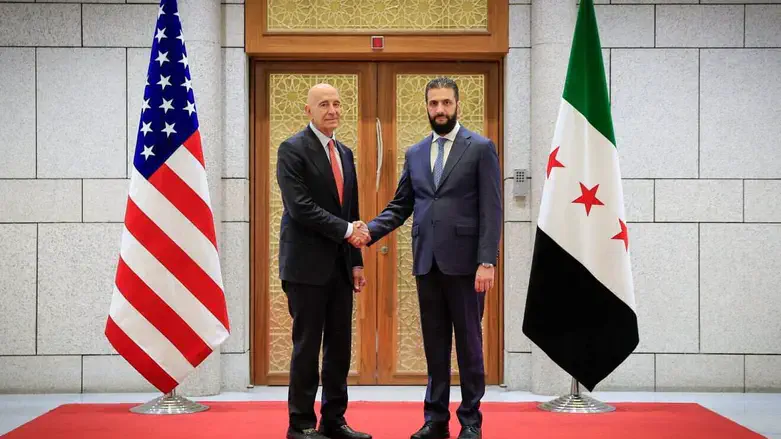
Yet behind the cheering crowds outside the courthouse lies a grotesque political theater. The tribunal delivering this moral judgment operates under the direct authority of Syria’s self-appointed president, Ahmed al-Sharaa. A veteran jihadist commander is now executing state justice, posing as a reformed statesman while escaping accountability for his own long list of atrocious crimes.
The international community’s willingness to applaud Sharaa’s prosecution of the former regime while ignoring his own record is a catastrophic failure of moral clarity and strategic judgment. Before he exchanged his military camouflage for tailored suits and began receiving foreign diplomats in Damascus, Sharaa was known to the world as Abu Mohammad al-Julani. He was not a pro-democracy freedom fighter. He was a committed lieutenant in al-Qaeda in Iraq, the founder of Jabhat al-Nusra, and the undisputed leader of Hay’at Tahrir al-Sham.
Under his command, jihadist brigades carried out suicide bombings against civilian centers, persecuted religious minorities, executed political rivals, and ran secret detention facilities in Idlib. Rebranding his terror network was never a moral awakening. It was a calculated operational maneuver designed to evade American airstrikes, shed global sanctions, and deceive credulous foreign observers.
Applying one standard of law to Assad while granting practical immunity to Sharaa destroys the very concept of international justice. True accountability cannot be selective or dictated solely by whichever warlord captures the capital. If slaughtering civilians, running torture chambers, and enforcing totalitarian rule constitute war crimes for a Ba’athist dictator, they constitute war crimes for an Islamist insurgent as well.
Sentencing Assad in absentia while elevating Sharaa to the presidential suite sends a lethal message to extremist movements worldwide. It tells every jihadist leader that committing horrific acts of terrorism carries no permanent consequence, provided one eventually hires a public relations firm, puts on a necktie, and adopts the language of Western diplomacy.
The normalization of Ahmed al-Sharaa under the guise of post-Assad stabilization represents an acute and immediate danger. Western policy circles routinely indulge in the short-sighted assumption that Sharaa can serve as a convenient counterweight to Iranian regional hegemony and Hezbollah influence in the Levant. This geopolitical calculation is fatally flawed. Replacing Shia radicalism with Sunni jihadism does not deliver stability to the Middle East; it merely exchanges one existential threat for another. A sovereign Syrian state governed by a seasoned jihadist, now armed with heavy military hardware, state treasuries, and state intelligence networks, is far more dangerous than an isolated terror cell operating from the mountains.
Israel cannot afford the deadly indulgence of Western wishful thinking along its northern border. While Sharaa currently issues reassuring statements to Western journalists regarding regional non-aggression and security coordination, his foundational worldview remains rooted in militant Islamism and hostility toward the Jewish state.
Israel must remember that tactical moderation is a standard operating doctrine within jihadi movements, utilized to consolidate state power before pursuing ultimate ideological objectives. The Golan Heights cannot be safeguarded by placing trust in a ruler whose entire career was forged in the fire of transnational jihad. Sharaa has not abandoned his radical vision. He has simply institutionalized it within the machinery of the Syrian state.
The legal proceedings in Damascus prove that justice in Syria remains deeply corrupt and incomplete. If a post-Assad Syria is ever to achieve legitimate rule of law, the judicial system cannot serve merely as a tool for victor’s justice. The victims of al-Nusra atrocities, suicide bombings, and religious persecution deserve the same legal recognition as the victims of Assad’s barrel bombs. Ahmed al-Sharaa must be held to account for every drop of innocent blood on his hands. Granting him a diplomatic pass because he defeated a rival tyrant undermines regional security and mocks international law.
Israel and its allies in the West must replace appeasement with uncompromising realism. Security in the Middle East is maintained through deterrence, moral clarity, and the strict enforcement of accountability, not through the coddling of dangerous opportunists. The international community must reinstate strict counter-terrorism measures, maintain existing sanctions, and demand that Sharaa face trial before an independent international tribunal.
Allowing a former al-Qaeda operative to rule Syria under the cover of pragmatic statecraft is a ticking time bomb for Israeli security. Ahmed al-Sharaa does not belong in international diplomacy suites issuing verdicts. He belongs in a courtroom dock, facing sentencing for his decades of terror.
Amine Ayoub, a fellow at the Middle East Forum, is a policy analyst and writer based in Morocco. Follow him on X: @amineayoubx